2026 IEEE World Congress on Computational IntelligenceSpecial Session on AI in Space and Aerospace

21-26 June 2026 | Maastricht, the Netherlands

WCCI 2026 will take place in the beautiful and historic city of Maastricht, a vibrant hub of culture, innovation, and international collaboration. This congress brings together the three flagship conferences of the IEEE Computational Intelligence Society:

  • The International Joint Conference on Neural Networks (IJCNN)
  • The IEEE International Conference on Fuzzy Systems (FUZZ-IEEE)
  • The IEEE Congress on Evolutionary Computation (IEEE CEC)

We are committed to delivering a comprehensive and engaging program that includes:

  • Cutting-edge technical sessions
  • Inspiring keynote talks
  • Hands-on tutorials and workshops
  • A dynamic student and early-career program
  • Ample networking opportunities
  • And, new for 2026, a dedicated Industry Day – designed to foster meaningful collaboration between academia and industry, and to showcase real-world applications of computational intelligence.

Whether you are a researcher, practitioner, educator, or industry professional, WCCI 2026 will offer a unique opportunity to connect, learn, and shape the future of our field.

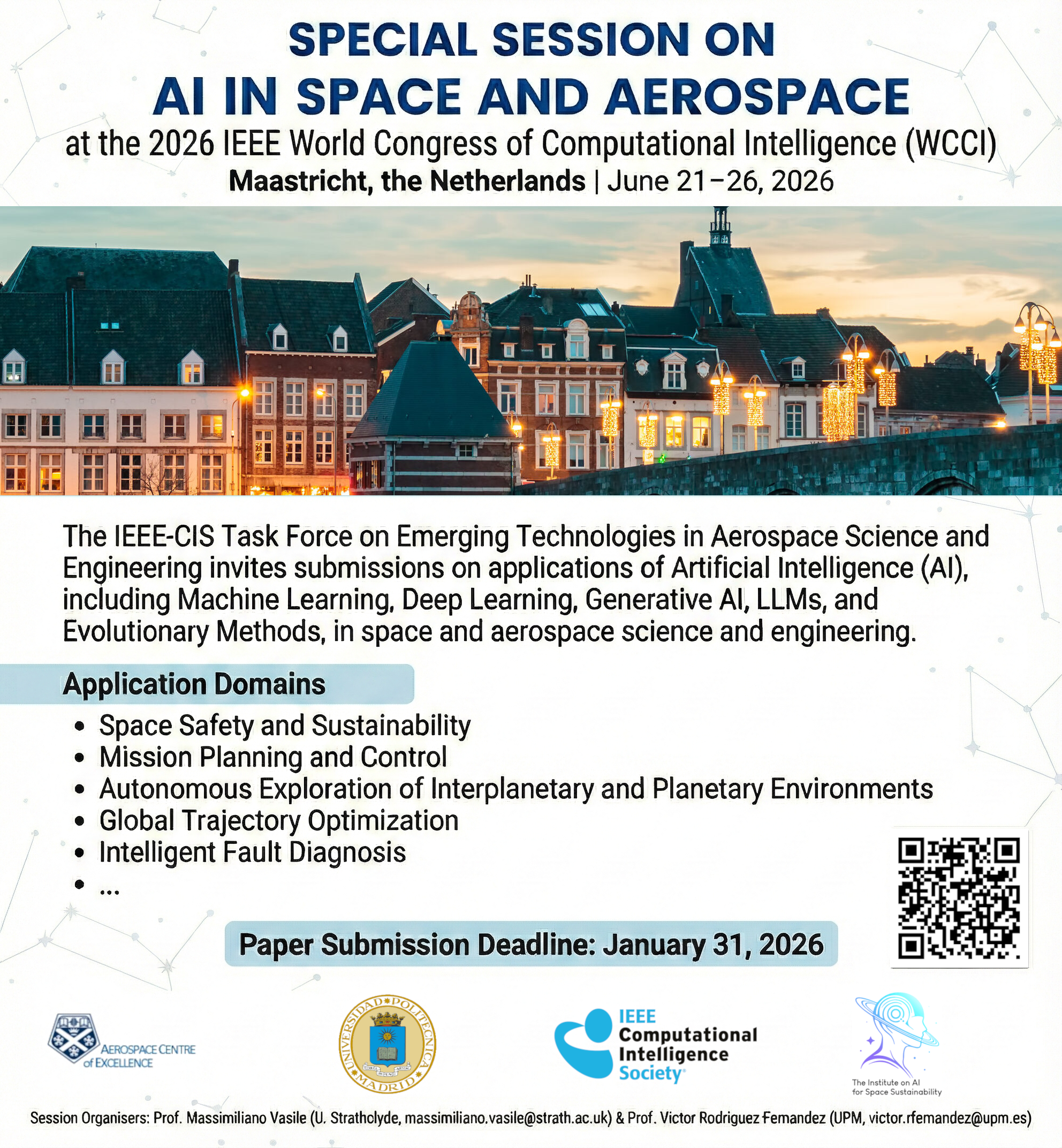
The Special Session on AI in Space & Aerospace is organised by the IEEE CIS Task Force in Emerging Technologies in Space and Aerospace, and has been running since 2007. 

This session collects the many diverse efforts made in the application of artificial intelligence techniques, or related methods, to space and aerospace science and engineering. The session seeks to bring together researchers from around the globe for a stimulating discussion on recent advances in machine learning, deep learning, generative AI, large language models and evolutionary methods for the solution of space and aerospace problems.

Authors are invited to submit papers on one or more of the following topics:

  • Global trajectory optimization
  • Multidisciplinary design for space missions
  • Formation and constellation design and control
  • Optimal control of spacecraft and rovers
  • Planning and scheduling for autonomous systems in space
  • Multi-objective optimization for space applications
  • Resource allocation and programmatics
  • Evolutionary computation for Concurrent Engineering
  • Distributed global optimization
  • Mission planning and control
  • Robust Mission Design under uncertainties
  • Intelligent search and optimization methods in aerospace applications
  • Image analysis for Guidance Navigation and Control
  • Autonomous exploration of interplanetary and planetary environments
  • Implications of emerging AI fields such as Artificial Life or Swarm Intelligence on future space research
  • Intelligent algorithms for fault identification, diagnosis and repair
  • Intelligent control for aerospace systems
  • Multi-agent systems approach and bio-inspired solutions for system design and control
  • Autonomous vehicles and autonomous air traffic management
  • Space Safety and Sustainability
  • Intelligent interfaces for human-machine interaction
  • Knowledge discovery, data mining and presentation of large data sets

Scope and Motivation

In an expanding world with limited resources and increasing complexity, optimisation and computational intelligence become a necessity. Optimisation can turn a problem into a solution and computational intelligence can offer new solutions to effectively make complexity manageable.

This special session collects the many diverse research of AI to space and aerospace problems.

All this is particularly true in space and aerospace where complex systems need to operate optimally often in harsh and inhospitable environment with high level of reliability.  In Space and Aerospace Sciences, many applications require the solution of global single and/or multi-objective optimization problems, including mixed variables, multi-modal and non-differentiable quantities. From global trajectory optimization to multidisciplinary aircraft and spacecraft design, from planning and scheduling for autonomous vehicles to the synthesis of robust controllers for airplanes or satellites, computational intelligence (CI) techniques have become an important – and in many cases inevitable – tool for tackling these kinds of problems, providing useful and non-intuitive solutions. Not only have Aerospace Sciences paved the way for the ubiquitous application of computational intelligence, but moreover, they have also led to the development of new approaches and methods.

In the last two decades, evolutionary computing, fuzzy logic, bio-inspired computing, artificial neural networks, swarm intelligence and other computational intelligence techniques have been used to find optimal trajectories, design optimal constellations or formations, evolve hardware, design robust and optimal aerospace systems (e.g. reusable launch vehicles, re-entry vehicles, etc.), evolve scheduled plans for unmanned aerial vehicles, improve aerodynamic design (e.g. airfoil and vehicle shape), optimize structures, improve the control of aerospace vehicles, regulate air traffic, etc. 

In particular evolutionary methods specifically devised, adapted or tailored to address problems in space and aerospace applications or evolutionary methods that were demonstrated to be particularly effective at solving aerospace related problems are welcome. 

IEEE Computational Intelligence Society