Quantum gates with fermions open new route to quantum computing
Researchers at the University of Strathclyde have contributed to a breakthrough in quantum technology, demonstrating high-fidelity quantum logic operations using fermionic atoms - an approach that could enable a new class of quantum computers.
The results, published this week in Nature, show how individual atoms trapped in an optical lattice can be made to interact through controlled collisions, implementing quantum gates with a fidelity exceeding 99.7%.
Unlike most current platforms, which encode fermionic behaviour indirectly in qubits, this experiment uses fermions themselves - the class of particles that includes electrons. This allows the quantum hardware to naturally follow the same rules as the systems it aims to simulate, potentially reducing overhead and improving efficiency for problems in chemistry and materials science.
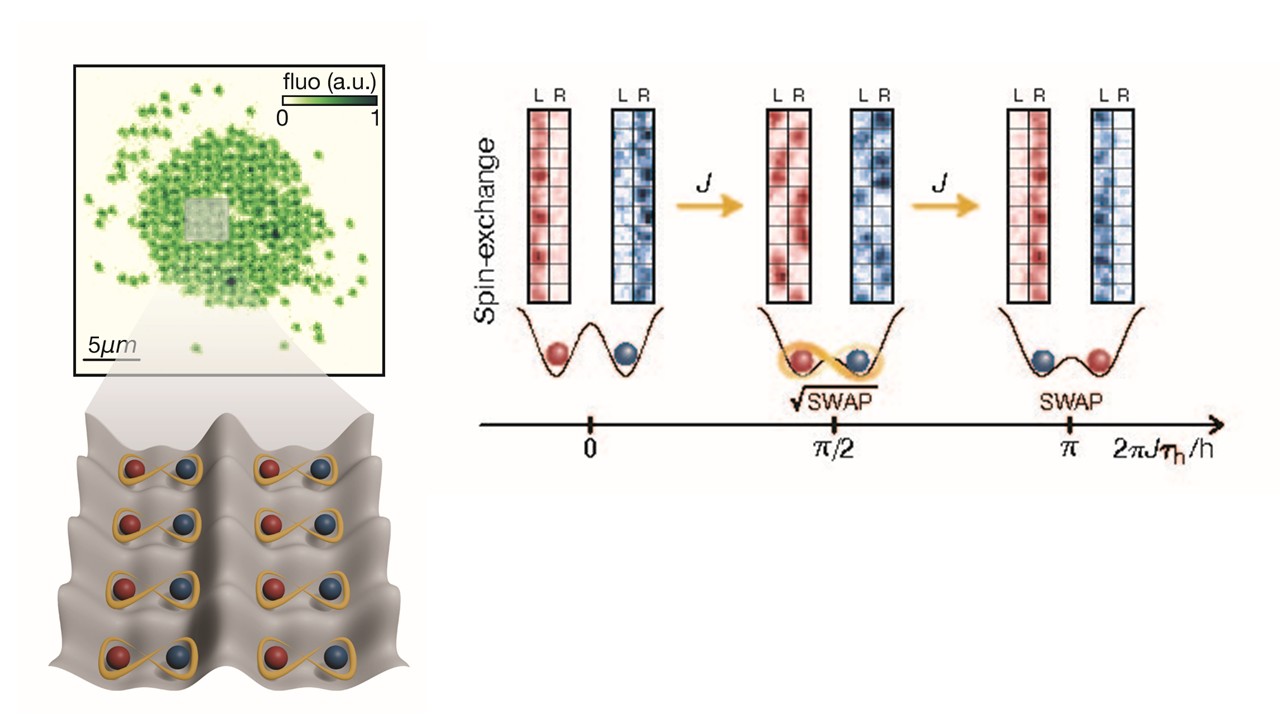
Left: With a double-well lattice structure made of light, pairs of ultracold lithium atoms get entangled with high fidelity - an important building block for a quantum computer.
Right: During the quantum gate, independent pairs of atoms with spin up (red) and spin down (blue) tunnel between two lattice sites (L, R). After a certain time (middle), both particles are delocalized between both sites, such that each appears randomly on the left or on the right. But they are perfectly anticorrelated; thus, measuring one determines the position of the other. After twice the time, a full SWAP is completed, demonstrating that the atoms were fully entangled after one time step.
The work was led at the Max Planck Institute of Quantum Optics (MPQ) in collaboration with international partners, including Strathclyde.
Dr Timon Hilker, Reader in Strathclyde’s Department of Physics, said:
“By realising high-fidelity quantum gates directly with fermions, we combine two previously separate directions - quantum simulation and quantum computation - on the same platform. This opens a realistic path towards a fermionic quantum processor.”
The experiment uses atoms cooled to billionths of a degree above absolute zero and arranged in a precisely controlled lattice of light. When neighbouring atoms are brought together, they undergo controlled collisions that generate entanglement - the key resource for quantum computation - while remaining observable at the level of single particles using a quantum gas microscope.
Dr Hilker has planned and supervised these experiments at MPQ before joining Strathclyde, where he established a research group focused on quantum simulation and quantum computing with fermionic atoms. Building on these results, the group aims to develop a new generation of quantum devices that integrate analogue simulation with programmable quantum gates, targeting problems involving electronic structures that are difficult or impossible for classical computers to simulate. The research is funded by the European Union with nearly £2M through an ERC Starting Grant.
The full paper is openly available here: Nature 652, 602-608 (2026)
April 2026