Quantum Simulations with a Nonlinear Optics Device
Physicists have demonstrated theoretically and experimentally a new coherent Ising machine in a simple nonlinear optics device made of a fiber ring driven by a laser.
The realization of the Ising Hamiltonian describing the energy and interactions of spins on a chain has been considered as a test bench of quantum analog simulations in superconducting rings, Bose-Einstein condensates, trapped ions and Rydberg atoms. In an international collaboration between research groups in Auckland (New Zealand), Dijon (France), and Gian-Luca Oppo at Strathclyde, a coherent Ising machine based on spontaneous polarization symmetry breaking has been realized and successfully tested in a coherently driven fiber Kerr nonlinear resonator. In this architecture, the spins are encoded in the polarization state of laser light, allowing robust, all-intensity readout with off-the-shelf telecom components at room temperature. This all-fiber platform not only simplifies the hardware but also opens a path to more stable, high-throughput, fully integrated and transportable coherent optical optimization devices for applications from finance to drug design and beyond.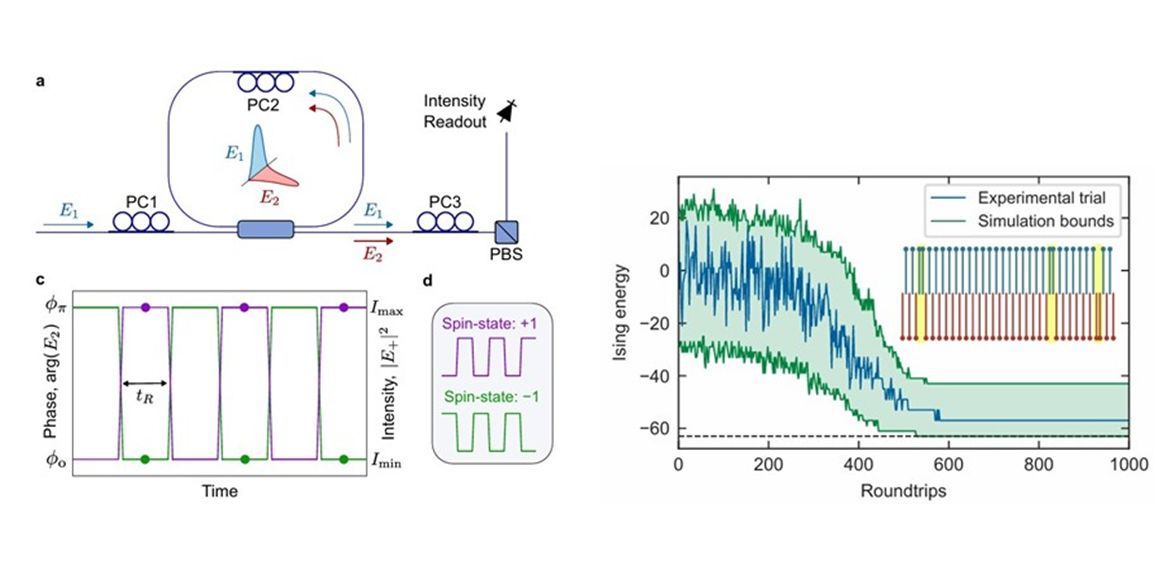
The schematic of the fibre-loop experiment is shown on the left of the figure with an explanation of the way in which spin up (+1) and spin down (-1) states are encoded in the output intensity of the laser light. A typical run of the coherent Ising machine is shown in the blue line on the right displaying a relaxation to the minimum of the Ising energy. The inset shows a typical state of Ising spins where yellow highlights mark ‘defects’. In previous realizations of Ising machines, post-selection of measurements deemed to be unsuitable has been hugely employed leading to an unbearable slow-down of operations.
‘I am happy to confirm that the number of post-selected data in our coherent Ising machine based on a nonlinear optics device is a big fat zero just proving major improvements with respect to existing architectures by realizing robust Ising operation at room temperature without the need of post-selection’ says Gian-Luca Oppo. The results were presented in a paper titled ‘Coherent Ising machine based on polarization symmetry breaking in a driven Kerr resonator’ in Nature Communications (2026), https://doi.org/10.1038/s41467-026-68794-6 at the end of January 2026.
February 2026