Sustainability Report 2023/24: our progressOperational Sustainability
Our 2025 Strategic Vision sets out the importance of delivering Net Zero and embedding sustainability across the whole organisation. This means moving beyond carbon, and considering a whole system, climate neutral approach to reducing emissions, adapting to climate change, and contributing to the sustainability of our local environment.
The University has committed to achieving Net Zero emissions for scope 1 and 2, and limited scope 3 emissions by 2040 at the latest – KPI 16 of our strategic plan. To help drive near-term reductions and limit our total emissions over this period, we have set interim milestones for each five-year strategic cycle:
- 30% reduction against the 2018-19 baseline by the end of 2024-25
- 80% reduction against the 2018-19 baseline by the end of 2029-30
Our Carbon Footprint 2023-24
In 2023-24, University greenhouse gas emissions within our KPI 16 boundary* were 31,571 tonnes carbon dioxide equivalent (tCO2e). Emissions went up by 3714 tCO2e compared to 2022-23, an increase of 13.3%.
- 31,571 tCO2e for 2023-24
- 12% reduction from 2018-19 (base year)
- up 13% from 2022 to 23
This increase in emissions for the third year in a row makes it likely that we will miss our 2025 milestone to achieve a 30% reduction in carbon emissions and highlights the challenges of tackling our scope 1 emissions.
*This includes all scope 1 and 2 emissions, scope 3 business travel, waste disposal, water use, grid electricity losses, and staff commuting.
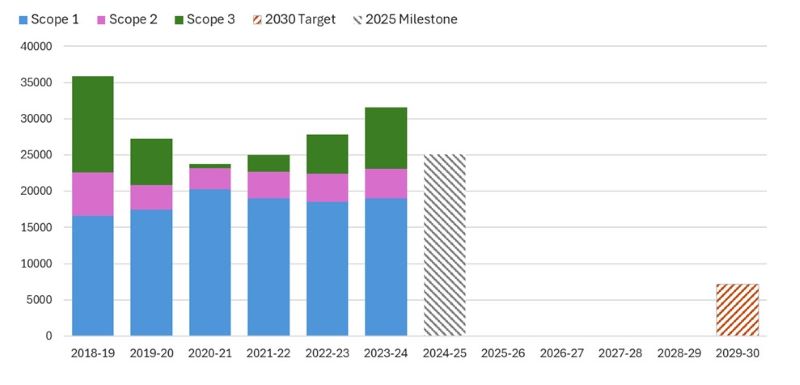
University GHG emissions rose across all three scopes compared to the previous year. The increase in scopes 1 and 2 were relatively low at 2.3% and 6.3% respectively, while scope 3 emissions increased substantially, by 55%.
Most of this increase was from staff commuting emissions, which this year used data from our 2024 travel survey – providing us with a more accurate and up to date picture of the impact of staff commuting and post-covid flexible working patterns.
Read our full 2023/24 annual report for a detailed breakdown carbon emissions across different categories.
Improving our estate
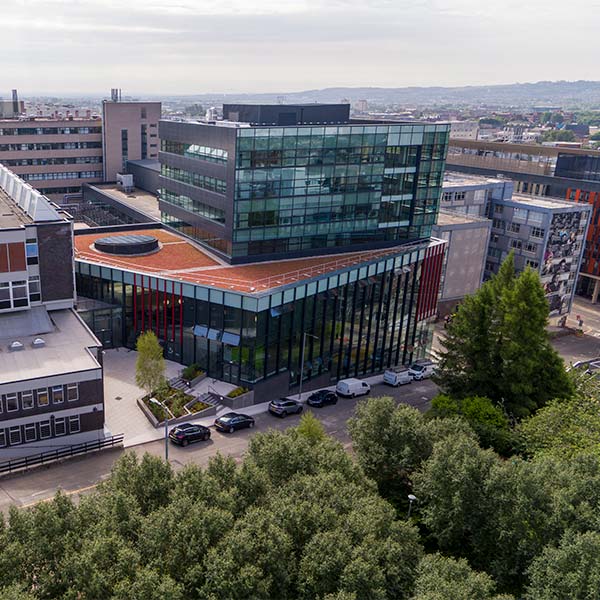
Our programme of works to enhance the Curran building's Andersonian Library was completed in early 2023/24 with further improvements to internal spaces, and external building fabric. Internal refurbishment provided a new study space, family zone, and meeting spaces, while high performance insulation and roofing systems improved thermal efficiency.
These improvements, including external wall cladding, triple glazed windows, and replacement of lighting to LEDs have reduced the energy demand of the curran building, saving an estimated 280 tonnes CO2e per year.
Sustainability in our supply chain
Sustainable Strathclyde continue to work closely with the University’s Procurement Team to embed sustainability into purchasing decisions. We expanded sustainability questions for potential suppliers to ensure that the University can make more informed decisions about where we source our goods and services from and helped evaluate sustainability information from prospective suppliers on strategic contracts.
Tackling Furniture Consumption
In collaboration with our portering and procurement teams, this year we trialed re-use and refurbishment of existing furniture stock over buying new. Through engaging with local suppliers and diverting internal requests for new furniture we re-furbished 143 items – mostly chairs and tables – that would have otherwise been disposed of and replaced with new items.
We estimate that this investment in local remanufacturing saved around three tonnes of waste, and 14 tonnes of carbon compared to buying new items. The trial projects also reduced costs – helping to challenge the assumption that sustainable choices often cost more.
Sustainable Labs
We continued to run our successful Sustainable Labs programme, running engagement programmes and helping researchers upgrade old equipment with more energy and water efficient ones. Throughout 2023/24 we provided £29k of match funding to help seven research and teaching labs upgrade ovens, freezers, and equipment that reduced single-use plastic.
- we provided three labs across the University with the opportunity to take part in the My Green Lab behavioural change programme, who are working towards Bronze level
- by the end of 2023/24, we had a total of 52 labs enrolled in the Laboratory Efficiency Assessment Framework (LEAF)
- we used £245K from our Salix Recycling Fund to upgrade 26 ultra-low temperature freezers in the Strathclyde Institute of Pharmacy & Biomedical Sciences to units with significantly lower Global Warming Potential refrigerants and reducing electricity consumption by almost 79MWh