12 May 2026
The following is a SISC blog guest post from Dr Deirdre Harrington, Senior Lecturer in Physical Activity and Health at Strathclyde, and Lead of the Active Mobility Hub.
With the 2026 Scottish Parliament election come and gone, a new government will be sworn in next week. The Joint Active Travel Manifesto for 2026 signed by 50 organisations ahead of the election, makes a strong, evidence-based case for sustained investment in walking, wheeling and cycling. As an academic researcher in health and someone who cycles, I strongly support the five key asks which I have summarised here:
- Long-term investment of at least 10% of the transport budget to active travel funding.
- Long-term commitment through multi-year budgets.
- Infrastructure for travel more safely on foot, by wheeling or by bike.
- Linking active and public transport.
- Reduce road danger and increase road safety.
I want to add something else important onto the Joint Manifesto that is often left implicit:
Active travel behaviour change is ignited, built, and sustained by people
Their work (“toil”) is creating change in communities, changes to people and to place. This work must be properly supported and funded. Currently it is not. This is taking a toll.
Consistent themes have emerged through my experience of researching cycling programmes in the last two years and engaging with local authorities, charities, campaigners and practitioners in action. These themes boil down to one common challenge: resource.
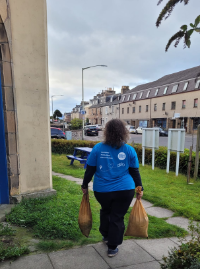
The physicality of carrying sandbags to weigh down temporary road signs (Credit: Dr Deirdre Harrington)
Multi-Year Budgets means People Stability
The active travel sector operates on year-to-year budgets and funding cycles that reward numbers but not longevity of projects or organisations. This creates conditions where unpaid labour, short-term contracts, lack of career progression, high staff turnover and burnout is the norm. Staff, trainers, ride leaders, coaches, coordinators are often undervalued, unseen and overstretched.
Multi-year budgets would let delivery organisations and contractual staff plan, develop skills, grow careers and retain sector knowledge and networks.
Multi-Year Budgets means Organisational Stability
The Joint Manifesto’s call for multi-year funding matters as it can create organisational stability to make active travel behaviour change happen. Creating healthy and thriving communities isn’t just about infrastructure and programme delivery, it’s about enabling organisations and their staff to plan, build expertise, enjoy their work and stay in the sector. It requires time to think, reflect, learn, collaborate and recover. Without that, expertise, skill and networks are lost and the time and resource put into staff training (first aid, ride leader) is repeated, like a cycle!
Smaller organisations are fragile under constant precarity. The turnover and loss of organisations in the active travel sector is rarely mentioned. Success of active travel initiatives does not consider the health of the sector. Instead, success is focussed on cycling levels, perceptions and attitudes of individual programme participants.
Having continuity is amazing for actual change rather than stopping and starting and changing times, days, projects...Sometimes it can take many months to get something up and running.
Time is needed for that informal, often unrecognised, relational work that happens beyond the structured sessions.
Little attention is being paid to the active travel sector and work conditions and mechanisms to support growth. This is despite well documented benefits across society of active travel behaviour change. There is not a skill or experience shortage, but a shortage of properly paid roles with some longevity, substance and progression to them. Regardless, work is being done because people care.
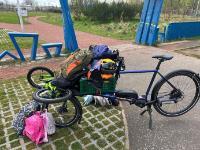
A cargo bike laden with balance bikes (Credit: Katherine Cory)
What is “The Toil” behind the scenes of behaviour change?
Speaking with individuals in the sector and seeing them in action you get a good sense of the work that is being done.
It’s often physical
It’s lifting adapted bikes in and out of vans. It’s strapping eight balance bikes to a cargo bike. It’s dragging sandbags and traffic signs out of storage units. It’s getting scrapes, bumps and bruises while manoeuvring adults on bikes as they try to pedal for the first time. It’s cycling.
It’s unseen work
It’s unpaid hours on communications platforms reassuring new cyclists about a route. It’s opening a bike lock-up to find that the bikes need maintenance before the group arrives. It’s when a participant encounters a volunteer in everyday settings and seeks time, conversation and connection, even when the volunteer is already under pressure.
People will open up to me and tell me things. I know it's kind of just part of the job now, but I know that it's definitely extra...I don’t get paid for those hours.
It’s unexpected emotions
It’s calling off a ride because of the weather, while knowing this ride is a lifeline for some participants. It’s a regular rider disappearing suddenly as their family have been relocated. It’s telling a teenager or a young adult who you finally have built rapport with that you don’t know will you be back for next week’s session because of funding uncertainty.
It’s care
It is physical, unseen, emotionally laden work. And behind it all, there is the care.
We understand as an organisation working with vulnerable groups that the effort going in compared to getting a couple of people turning up is huge...But also maybe funders don't always understand that...there is a bit of disconnect there.
Funding active travel means funding the people who make it happen. Funding them properly, predictably and with care. If Scotland is serious about scaling up active travel, we must remember this: behaviour change is people-intensive work. It is relational, emotional, physical – it is care. And it deserves recognition. A government that cares about active travel must show care for the people making change happen.
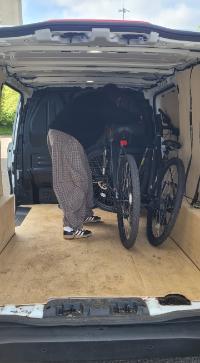
Loading and unloading bikes in a hire van (credit: Deirdre Harrington)
So, what is my ask?
My ask feels deeper than a single sentence stating what needs to change in the active travel sector. But it can be summed up as:
Take care of the people making change happen
