26 November 2026
This blog is both a celebration of international collaboration and a reflection on the importance of being exposed to new ideas and ways of being. It is also an opportunity to celebrate the Empowered Futures research school, which I have had the pleasure of being part of since its inception in 2022.
At a time when the world appears to be increasingly turning inwards, working in collaboration offers one of the most powerful ways of expanding the limits of our understanding. By bringing people together across disciplines, cultures, and experiences, it exposes us to ideas, forms of knowledge, and ways of being that might otherwise remain beyond our reach.
The philosopher Immanuel Kant argued that our understanding of reality is always shaped by the conditions through which we experience it. In simpler terms, none of us possesses a complete picture of the world. Every perspective is partial. Every understanding is situated. A similar sensitivity to conditionality can be found within Buddhist philosophy to describe the contingent and causal nature of reality. It says that everything arises in dependence on an array of conditions interacting with each other. This is defined as ‘conditioned co-production’.
These analogous insights, emerging from very different intellectual traditions across human history, are profound in the questions they provoke. If none of us possesses a complete picture of the world, then understanding perspectives beyond our own becomes a central task for those of us engaged in research.
Drawing on my experience within the Empowered Futures research school, I argue that fostering an ethos of meaningful, expansive collaboration should be a central priority within research environments. In a world facing increasingly complex social, environmental, and technological challenges, our ability to learn with and from others may be among the most important resources we possess.
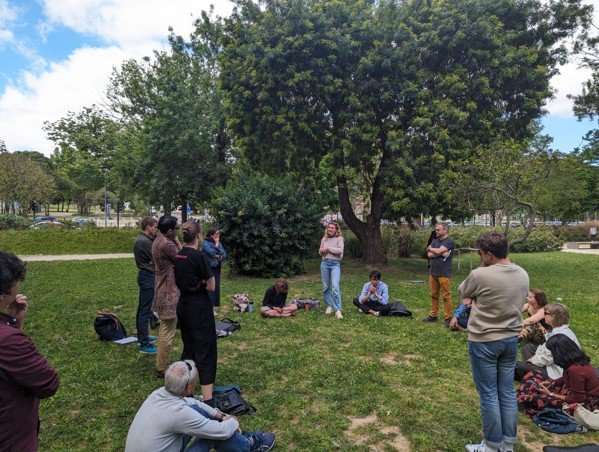
Empowered Future Members engaged in discussion during the Lisbon Excursion (photo credit: Finlay Bain Kerr)
A celebration of the Empowered Futures Research School
Empowered Futures is a global research school exploring the tensions, controversies and societal dimensions of energy transitions, funded by the Research Council of Norway. What attracted me to the research school was the prospect of being challenged. I wanted to encounter unfamiliar ideas, engage in debate, and test my own assumptions about energy, society and sustainability.
Over the following years, the research school became one of the defining experiences of my PhD.
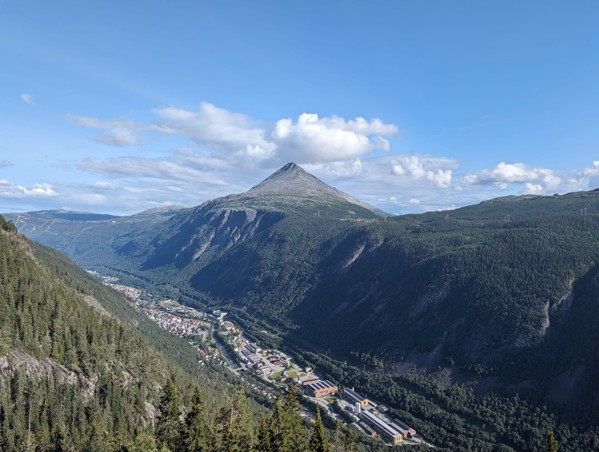
The Rjukan Excursion, where we explored energy histories, futures and utopias (photo credit: Finlay Bain Kerr)
Through field trips, workshops and collaborative activities in Norway, Portugal and the Orkney Islands, I had the opportunity to work alongside researchers from different disciplines, institutions and cultural contexts. Each excursion offered something different, whether through conversations during workshops, engagement with local communities, or simply the chance to discuss our research informally over a meal after a long day.
What mattered most was not any single event. It was the cumulative effect of repeatedly encountering different ways of thinking. Looking back, it is difficult to overstate the impact this had.
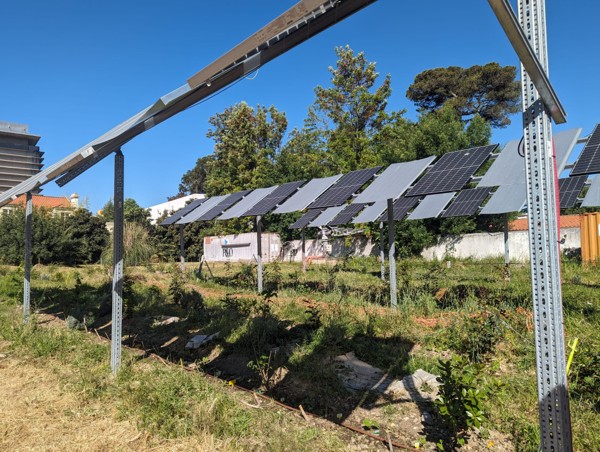
Hearing about solar energy transitions with partners in Lisbon (photo credit: Finlay Bain Kerr)
The research that emerged from my PhD is stronger because of those interactions. Concepts, theories and questions that I encountered through the research school found their way into my thinking and, ultimately, into my work. Ideas around the pluriverse, energy sovereignty, green extractivism and critical perspectives on energy justice, were all introduced to me through Empowered Futures colleagues. Further, the opportunity to engage in dialogue with community activists in Lisbon, municipality workers in Orkney, and industrial actors in Norway brought into sharp focus tensions and commonalities within the energy transition. But the influence went beyond the content of my research. It changed how I approach knowledge itself.
As researchers, it is easy to become embedded within particular disciplinary communities and intellectual traditions. Those communities are valuable, but they also shape the questions we ask and the answers we consider possible. Genuine collaboration creates opportunities to step outside those boundaries. It exposes us to perspectives that can challenge our assumptions and reveal dimensions of a problem that may otherwise remain invisible.
The culmination of these experiences came a couple of weeks ago in Oslo, at the first Empowered Futures Conference, marking the halfway point of the school.
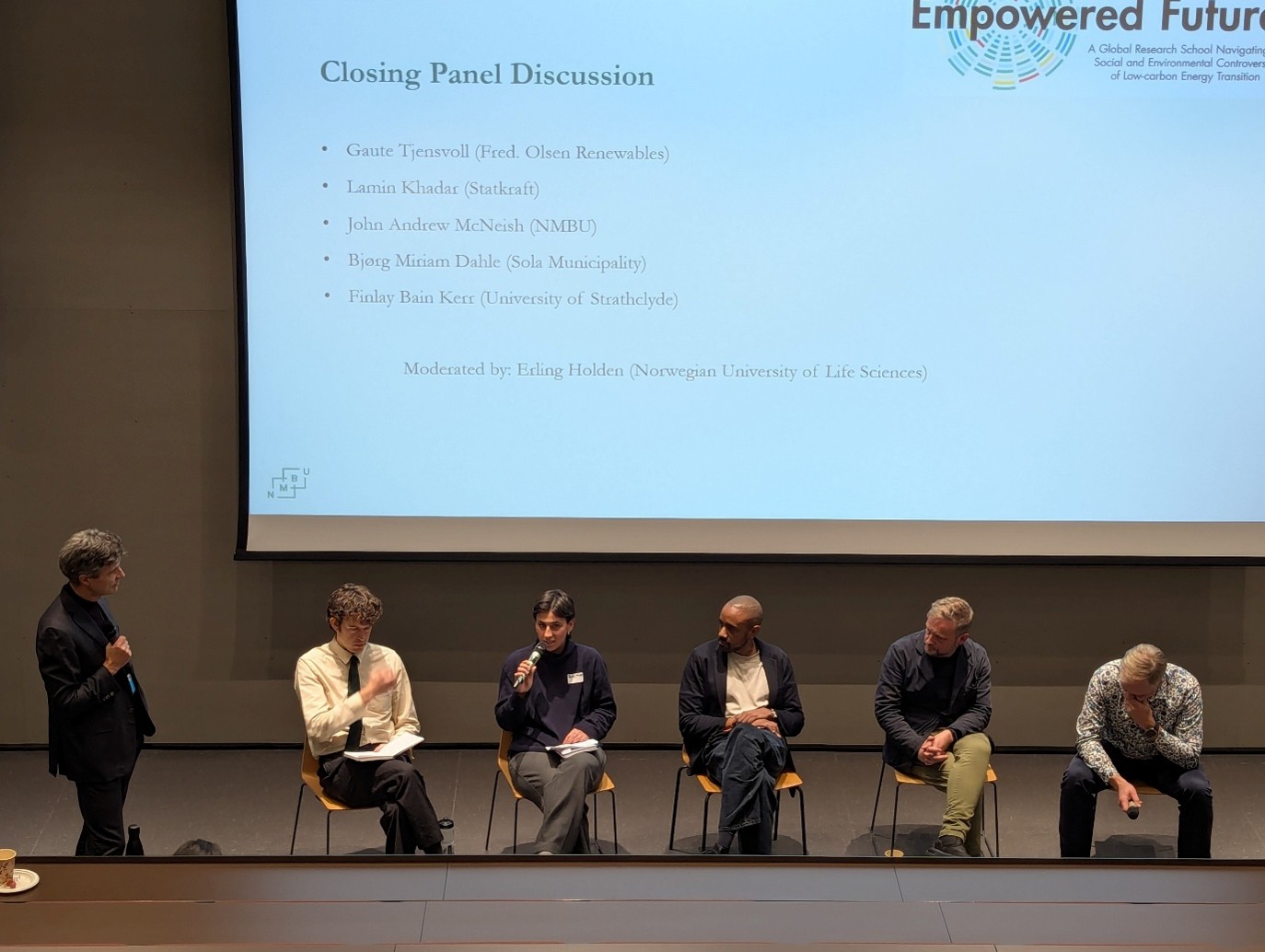
Taking part in the conference closing panel as an alumnus of Empowered Futures (photo credit: Neil Gordon Davey)
The conference brought together many of the school's members new and old, alongside societal partners to give space to many perspectives on energy transition. I was delighted to take part in the closing panel and made it my goal to represent the diverse and deep range of critical thought that my fellow researchers had explored throughout the day.
After witnessing intense and critical discussions not only amongst academics, but with and between private and state actors, I left Oslo feeling energised. Not only about my own research, but about the role that collaboration plays in creating better research.
Deepening our understanding through collaboration
By engaging with people from different disciplines, countries and backgrounds, we gain access to ways of seeing that would otherwise remain beyond our reach. We begin to recognise both the strengths and limits of our own perspectives. In doing so, we become not only better researchers but, better citizens. It was Empowered Futures that demonstrated the value of this ethos and perspective to me, and that I now aim to continue through the JUST-Systems project. As Churchman (1968, pg. 231) famously said: ‘The systems approach begins when first you see the world through the eyes of another’.
Of course, international collaboration requires resources, time and funding. In times of financial pressure, programmes that enable travel, exchange and collaboration can sometimes appear expendable. Yet my experience has convinced me that their value extends far beyond any simple accounting exercise. The relationships, ideas and intellectual growth that emerge from these experiences are difficult to measure, but they are profoundly important.
As I reflect on my time with the Empowered Futures Research School, I am left with an overwhelming sense of gratitude. Gratitude to the organisers who created the opportunity, to the fellow researchers who generously shared their ideas and experiences, and to the wider community that made the programme possible.
Most importantly, I am reminded that some of the most transformative moments in research happen when we step outside familiar settings and engage with people we might never otherwise have met. Those encounters do more than improve our work. They change how we see the world, understand the patchwork of conditioned realities, and how we see ourselves within it
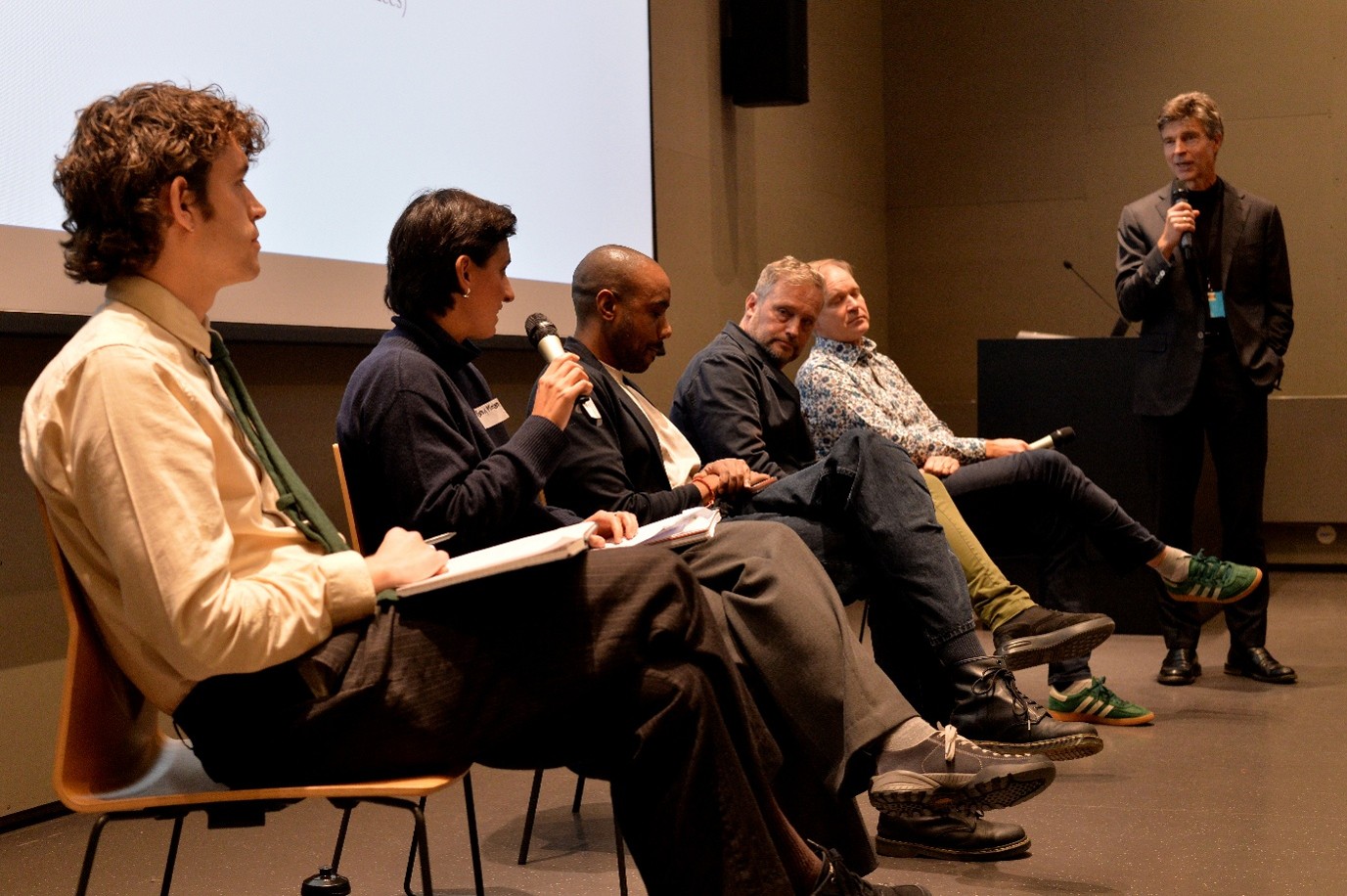
Taking part in the conference closing panel as an alumnus of Empowered Futures (photo credit: Neil Gordon Davey)
Thanks for reading this blog, we hope you found it thought-provoking. Any comments or feedback? Please feel free to email us at sbs-sisc@strath.ac.uk and continue the conversation!