

MFA Creative Writing
ApplyKey facts
- Start date: September
- Study mode and duration: Full-time: 24 months, part-time: 48 months
Second year entry: available for suitably qualified students
Work placement: optional placement opportunity
Study with us
The MFA is an internationally recognised terminal degree (the highest level of education you can achieve within the field of creative writing), qualifying graduates to teach creative writing in Higher Education.
- unique blend of intensive skills-based training (year 1) and advanced project-based work (year 2)
- flexible approach: explore multiple genres before specialising in your Creative Thesis
- inspiring guest lectures from published, award-winning writers
- expert supervision in fiction, poetry, creative nonfiction, screenwriting, and hybrid writing
- modules in creative pedagogy and communicating research for real-world impact
- no prior postgraduate qualification in creative writing required for entry
View our MLitt/MFA Creative Writing information session recording.
Please note that while the MFA qualifies graduates to teach creative writing in Higher Education, it does not qualify you to teach in Primary or High Schools; a PGDE qualification is required for this.
The Place of Useful Learning
UK University of the Year
Daily Mail University of the Year Awards 2026
Scottish University of the Year
The Sunday Times' Good University Guide 2026
Why this course?
The MFA in Creative Writing at Strathclyde is an internationally recognised, practice-based terminal degree designed for writers seeking to develop their craft at the highest level. This programme offers a rigorous and supportive environment where students refine their creative approaches across genres while engaging with literary theory, craft, and cultural discourse. Unlike shorter postgraduate options, the MFA provides the time and structure to produce a substantial work—such as a novel, poetry collection, or screenplay—while gaining transferable skills for careers as professional writers and educators.
As one of the most prestigious qualifications in the field, the MFA (when combined with a good publication record) equips graduates to teach creative writing in higher education, and to navigate the creative industries with confidence. During the course you will benefit from advanced training in project management, research application, and workshop facilitation, alongside insights into publishing and entrepreneurship.
Strathclyde’s MFA stands out for its industry-led faculty, interdisciplinary expertise, and international outlook, ensuring an authentic and forward-thinking learning experience. This degree is ideal for writers seeking a recognised qualification that opens doors to teaching, publishing, and creative practice worldwide.


Why choose to study an MFA instead of a PhD?
The PhD is a three-year degree and an opportunity to work on an extended project (up to 80,000 words) under the supervision of a successful, published author. Your project is subject to the viva scrutiny process. There are no taught elements in a PhD.
An MFA is a two-year degree. The first year comprises of taught modules and follows the structure of the MLitt Creative Writing Masters degree. The second year is a Creative Thesis, plus one taught module. While a PhD is suitable for someone who wants to work in academia, the MFA prepares you for a wide variety of writing roles and careers.
Both an MFA and a PhD qualify you to teach in a higher education institution after successful completion of your degree.
What you'll study?
MFA Creative Writing is made up of 300 credits at SCQF level 11, comprising 140 credits of taught modules in year 1 and 160 credits in year 2.
Year 1
In year 1 you will take 3 Semester 1 and 3 Semester 2 taught classes, as well as Advanced Topics in Creative Writing and Research in Semester 3.
Year 2
In Year 2, you complete one core taught module, either Communicating Research (20 credits) or Creative Pedagogy (20 credits) - alongside the major assessed component of the programme, the Creative Thesis.
Each 20-credit module (all classes but the 140-credit Creative Thesis in year 2) is 200 hours of study, 20 of which are class time. The rest of the time is reading, research, and writing assignments. All classes are currently scheduled for weekdays, between 9am and 5pm.
Work placement
The MFA offers one formal placement opportunity, delivered through the optional English & Creative Writing Research Placement module.
Major projects
The Creative Thesis (140 credits) is a 35,000-word (or equivalent) extended creative work, supported by seven supervision meetings across the year. Preparation for this major project is provided through the Advanced Topics in Creative Writing and Research module in the summer semester of year 1.
Learning & teaching
The MFA combines structured teaching with independent creative practice through the following methods:
- lectures and seminars: core and elective modules introduce advanced creative writing techniques, literary theory, and cultural discourse
- interactive workshops: you share works-in-progress, receive peer and tutor feedback, and develop critical evaluation skills
- one-to-one supervision: regular supervision meetings support the development of the Creative Thesis and other major projects.
- co-taught modules: innovative modules such as Communicating Research and Creative Pedagogy involve collaborative teaching across faculty
- student-led learning: in year two, you design your own creative writing workshops, gaining practical teaching experience
- industry engagement: opportunities for guest speaker events, research placements, and connections with arts organisations, literary agencies, and media outlets
- networking and research culture: participation in interdisciplinary research clusters, reading groups, and student-led initiatives such as The Strathclyde Review and Strathlit writing retreats
- practical skills development: emphasis on project management, workshop facilitation, and applying research to real-world contexts
Assessment
Assessment on the MFA in Creative Writing combines creative, critical, and practical components to reflect the professional demands of the discipline. In year one, you complete creative writing portfolios and critical essays, including work that integrates research and creative practice. Year two focuses on the Creative Thesis - a substantial piece of original writing supported by regular supervision - and modules that assess professional skills, such as designing and delivering workshops and communicating research to diverse audiences. Feedback is provided through written reports, tutorials, and workshops, ensuring continuous support and development throughout the programmes.
Guest lectures
MFA students benefit from access to the MLitt Creative Writing guest speaker series, gaining valuable perspectives from visiting authors, industry experts and creative practitioners.
Past visiting speakers have included:
- Chris Kelso (fiction/nonfiction writer & Strathclyde alumni)
- Jackie Kay (poet & playwright, former Makar of Scotland)
- Andrea Gibb (BAFTA-nominated screenwriter & actress)
- Nat Raha (poet & activist-scholar)
- Denise Mina (crime fiction writer)
- Camilla Grudova (fiction writer)
- Adura Onashile (actor, playwright, director)
- Sara Sheridan (historical fiction writer)
- Michael Pedersen (poet, current Edinburgh Makar)
- Kirsten Innes (fiction writer)
- Heather Parry (fiction and nonfiction writer)
- Chitra Ramaswamy (nonfiction writer)
- Colin McLaren (screenwriter)
- Alycia Pirmohamed (poet and scholar)
- Tawnya Selene Renelle (writer and educator)
- Katalina Watt (fiction writer and Literature Officer at Creative Scotland)
Meet the programme leaders
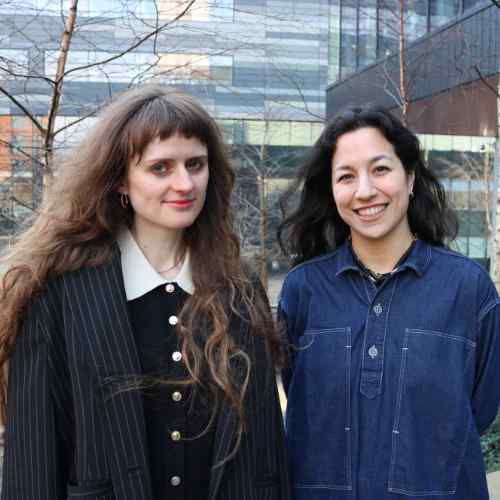
The MFA is an internationally recognised degree which prepares students for a modern literary landscape. You will focus on creative practice with industry-led teaching from our expert team of published authors, while building a research pathway towards specialisms that suit your own writing interests. We look forward to meeting you!
Dr Maria Sledmere (left)
Programme leader, Creative Writing (MFA)
We’re excited to be able to work with students over two years. Classes in the first year will allow them to explore and develop their craft, with plenty of opportunities to play and experiment. In the second year, they’ll be able to dive into a big project, with one-on-one supervisions.
Dr Jessica Widner (right)
Programme leader, Creative Writing (MFA)
You will take 140 credits in year 1
Core modules
The Shape of Stories 1 (20 credits)
The Shape of Stories 1 works with the bones of good stories across genre and form, resembling a seminar in format. This class introduces you to classic and contemporary writers and writing approaches that will be useful in future work. It also includes workshop time to share work with your peers and benefit from editorial feedback from tutors who are also published writers. We're mindful from day one that you're working towards the Major Project of your final Semester. The first semester is the time for planning and experimentation that will later be useful when tackling that Major Project.
The Shape of Stories 2 (20 credits)
The Shape of Stories 2 is a partner to The Shape of Stories 1, the Semester 1 workshop focused on the bones of good stories across genre and form. This module takes that a step further, exploring hybrid writing across fiction, script, screenwriting, poetry and creative non-fiction, closely studying innovative contemporary works that blur the boundaries between different kinds of writing. You'll broaden your reading and experience, and will be encouraged to experiment with hybrid forms in your own creative work. From short stories containing to poetry, from ekphrastic responses to art and photographs to autobiographical, illustrated vignettes, The Shape of Stories 2 is an opportunity to explore new possibilities, in exciting ways.
The Writer's Studio
The Writer's Studio is a student-led class. By this we mean that students who take this option are free to choose the focus, research area, genre and form of their work.
The ‘advanced topic’ you select will be the beginning of a conversation with your tutor about the kind of work you wish to produce for the module. Independent research is key, as is robust debate with your tutor and classmates about the direction, nature and rigour of the project. You'll work in editorial groups and pairs, as well as with the tutor to develop your work over the course of the semester.
Being placed in Semester 2 alongside The Shape of Stories 2 and The Made Project for all Creative Writing students who select it, The Writers' Studio is designed to complement the experimentation encouraged in the other two Creative Writing modules at this point in the MLitt in Creative Writing. It may also provide good preparation for The Major Project in Semester 3, acting as a research basis for future creative work.
The Writing Life
The Writing Life is all about the contemporary literary landscape. It introduces you to the practicalities of a life in the creative industries – how writers make a living, and how that living is changing in the 21st Century. Through a series of talks and seminars from visiting speakers from across the writing worlds, you'll have direct access to those who have been there and done it. In assignments, you'll choose a target, for example, a publisher, a journal, an online magazine – then write a new piece of creative work to submit to that target, as well as an essay profiling the target they have chosen. This ensures you increase knowledge of the publishing industry you wish to enter while also having a practical challenge, writing to a brief you've chosen.
The Made Project (20 credits)
The Made Project encourages experimentation across literary forms, genres and media, with opportunities to work collaboratively or individually on a substantial project. This course adds diversity to your writing portfolio, while also developing core researcher skills in organisation, engagement and project management. From editing to publication, archival visits to web design, adaptation to broadcasting and performance, this is an eclectic module which offers the chance to work creatively with new approaches, methods and materials.
Building on The Writing Life module in semester one, you'll apply critical and practical skills to a ‘made project’ which shows awareness of its readership/audience, literary contexts, process and potential circulation. Classes will involve student-led planning sessions and peer feedback, a field trip, visiting speaker, small group work, podcast training and supervisions.
The Made Project consists of two assignments: a short oral presentation in response to a creative brief, and a final ‘made project’ developed in discussion with your course tutor over a number of weeks, with an accompanying craft essay which reflects on the process and outcomes of the assignment. Previous made projects have included works such as short films, handmade books, graphic novels, a recipe book, a deck of tarot cards, ekphrastic works and visual poems. You'll also be involved in editing and publishing our in-house literary magazine, The Strathclyde Review.
Advanced Topics in Creative Writing & Research (20 Credits)
Advanced Topics in Creative Writing and Research is an independent research project over the summer semester of the MFA, bridging the first and second years and preparing you to work on their Creative Thesis in year two. You will create the critical context for your creative work, producing a portfolio that consists of an annotated bibliography, critical proposal, and project synopsis. You will develop essential skills in research and creative practice, crafting a clearly defined project rationale, reading list, and proposal, with the guidance of your supervisor.
Optional modules
Storytelling, Memory & Heritage
20 credits
This interdisciplinary module focuses on narrative, memory and public history. You will receive a mixture of theory and practical skills and engage with questions like: what is public history? How do we tell stories about the past?
The module casts a critical eye on what voices are privileged at the expense of others, thinking about sexualities, race and ethnicity, disability and gender. This public history class will equip you with transferable skills for careers in heritage, public engagement, creative practice and journalism.
English & Creative Writing Research Placement
The English & Creative Writing Research Placement class provides an opportunity to gain practical, research-based experience in an area where you can apply literary critical and/or creative writing experience and knowledge in a setting that is professionally relevant to you. The class is a one semester 20 credit class, undertaken in second semester, which equates to around 100 learning hours overall (this includes travel time to and from placement, assessment preparation, and attendance at campus supervisions). By the end of the class, you should be able to:
- Demonstrate an understanding of the relationship between Interdisciplinary English Studies or Creative Writing and the operations of a specific organisation working in a relevant field within Scotland
- Reflect critically on issues of language and communication, representation, and narrative within an organisation
- Articulate the transferrable skills developed through their Masters degree to potential employers
- Produce a piece of research to a specific brief
- Gain experience in collaboration through working within a partner organisation
- Gain communication skills and be able to present their research findings to a range of audiences within and outwith academia
This class will provide you with an opportunity to build your portfolio of experience and develop personal and professional skills that are relevant to gaining employment and/or further study. Please note that all placements have to be arranged during first semester, and approved by early December. Please contact Dr Eleanor Bell (eleanor.bell@strath.ac.uk) for more information.
You will take 160 credits in year 2
Core modules
Creative Thesis (140 credits)
This is an extended piece of creative work of 35,000 words (or equivalent for poetry, script or screenwriting), which is supported by three supervision meetings per semester plus an introductory meeting in summer before second year starts (so seven meetings in total). You will be prepared for embarking on this longer work through the Advanced Topics in Creative Writing and Research in the summer semester of Year 1.
You will also take one 20 credit core module from:
Communicating Research
This innovative new module will offer you direct involvement in communicating research happening within the University of Strathclyde. It involves co-teaching. The teaching on the module would be split between skills-development and focus sessions on research.
Creative Pedagogy
This module is co-taught and introduces you to principles of teaching: it will prepare you for future employment in creative writing industries by teaching them to lead your own workshops, drawing on pedagogical theory.
Interested in postgraduate study?
At the Faculty of Humanities and Social Sciences, our friendly and knowledgeable team will be available to provide you with all the information you need to kick-start your postgraduate journey at the University of Strathclyde. Register for upcoming events below:
International students
We've a thriving international community with students coming here to study from over 140 countries across the world. Find out all you need to know about studying in Glasgow at Strathclyde and hear from students about their experiences.
Entry requirements
| Academic requirements | A first or second-class Honours degree in English Literature, Creative Writing, or a closely related subject, or an equivalent qualification. Those without a degree may be considered if they can demonstrate strong competence in Creative Writing. You must submit a portfolio of creative work, academic references, and a proposal outlining your aims and research context. Students with an existing MLitt in Creative Writing may be eligible for direct entry into Year Two from September 2027. The submission of a satisfactory entry portfolio of creative writing. This should consist of one of the following:
You must also submit an outline of creative work you might develop over the course of the degree, in the context of the creative thesis (no more than two A4 pages). |
|---|
How can I fund my course?
Fees & funding
All fees quoted are for full-time courses and per academic year unless stated otherwise.
Fees may be subject to updates to maintain accuracy. Tuition fees will be notified in your offer letter.
All fees are in £ sterling, unless otherwise stated, and may be subject to revision.
Annual revision of fees
Students on programmes of study of more than one year (or studying standalone modules) should be aware that the majority of fees will increase annually.
The University will take a range of factors into account, including, but not limited to, UK inflation, changes in delivery costs and changes in Scottish and/or UK Government funding. Changes in fees will be published on the University website in October each year for the following year of study and any annual increase will be capped at a maximum of 10% per year. This cap will apply to fees from 2026/27 onwards, which will not increase by more than 10% from the previous year for continuing students.
| Scotland | Full-time: £10,100 |
|---|---|
| England, Wales & Northern Ireland | Full-time: £10,100 |
| Republic of Ireland |
If you are an Irish citizen and have been ordinary resident in the Republic of Ireland for the three years prior to the relevant date, and will be coming to Scotland for Educational purposes only, you will meet the criteria of England, Wales & Northern Ireland fee status. For more information and advice on tuition fee status, you can visit the UKCISA - International student advice and guidance - Scotland: fee status webpage. Find out more about the University of Strathclyde's fee assessments process. |
| International | Year 1: £23,550 The fees for Year 2 will be aligned to the faculty-approved standard Postgraduate Research fees. |
| Additional costs | International students may have associated visa and immigration costs. Please see student visa guidance for more information. |
| Available scholarships | Take a look at our scholarships search for funding opportunities. |
Please note: the fees shown are annual and may be subject to an increase each year. Find out more about fees.
Scottish postgraduate students
Scottish postgraduate students may be able to apply for support from the Student Awards Agency Scotland (SAAS). The support is in the form of a tuition fee loan and for eligible students, a living cost loan. Find out more about the support and how to apply.
Don’t forget to check our scholarship search for more help with fees and funding.
Students coming from England
Students ordinarily resident in England may be to apply for postgraduate support from Student Finance England. The support is a loan of up to £10,280 which can be used for both tuition fees and living costs. Find out more about the support and how to apply.
Don’t forget to check our scholarship search for more help with fees and funding.
Students coming from Wales
Students ordinarily resident in Wales may be to apply for postgraduate support from Student Finance Wales. The support is a loan of up to £10,280 which can be used for both tuition fees and living costs. Find out more about the support and how to apply.
Don’t forget to check our scholarship search for more help with fees and funding.
Students coming from Northern Ireland
Postgraduate students who are ordinarily resident in Northern Ireland may be able to apply for support from Student Finance Northern Ireland. The support is a tuition fee loan of up to £5,500. Find out more about the support and how to apply.
Don’t forget to check our scholarship search for more help with fees and funding.
International students
We've a large range of scholarships available to help you fund your studies. Check our scholarship search for more help with fees and funding.
Faculty of Humanities & Social Sciences Scholarships
EU Engagement Scholarships are available to EU applicants who would have previously been eligible for Home (Scottish/EU) fee status.
Chat to a student ambassador
If you want to know more about what it’s like to be a Humanities & Social Sciences student at the University of Strathclyde, a selection of our current students are here to help!
Our Unibuddy ambassadors can answer all the questions you might have about courses and studying at Strathclyde, along with offering insight into their experiences of life in Glasgow and Scotland.
Careers
Graduates of the MFA in Creative Writing are prepared for careers as professional writers and educators, with the degree recognised internationally as a terminal qualification suitable for teaching creative writing at all levels, including higher education. The programme also equips students with transferable skills in project management, workshop facilitation, and research communication, opening pathways into publishing, editing, arts organisations, and cultural industries. Training in creative pedagogy and interdisciplinary collaboration further supports roles in community arts, public engagement, and entrepreneurial ventures within the creative sector.
Career opportunities include:
- professional writing (fiction, poetry, creative nonfiction, screenwriting, hybrid forms)
- teaching and education (including higher education)
- publishing and editorial roles
- arts and cultural industries
- community and public engagement projects
- entrepreneurial ventures in creative sectors
- roles requiring advanced communication, project management, and leadership skills
- marketing and advertising
MLitt, MRes, MFA or PhD?
If you're unsure which postgraduate pathway is right for you, take a look at our handy guide to help you compare your options and choose the route that best supports your creative and professional goals.

Frequently asked questions
Our staff have expertise in fiction, creative non-fiction, poetry, screenwriting, as well as hybrid forms and experimental writing. We can support students working in each of these forms. Find out more about our specialisms.
Yes. MFA graduates remain part of the University of Strathclyde community after completing the programme. Graduates have access to the University’s Careers Service for up to five years after graduation, alongside continued connection to a cohort-based creative network formed through workshops, mentoring, and shared professional practice. Many graduates maintain lasting creative and professional relationships with peers and the wider literary community in Glasgow and beyond.
The MFA is designed to support, develop, and complement your own writing work and practice. Modules like The Writing Life, Communicating Research, and English & Creative Writing Research Placement will give you practical, industry skills and experience meant to help build your writing career, whatever that may look like.
We actively encourage our students to seek out writing and publication opportunities and provide opportunities to speak to industry professionals through our visiting speaker series and events.
Home students who work full- or part-time but still wish to take the MFA have the option of studying part-time. If you have concerns or questions about what this might look like, please contact the programme convenor.
The MFA is primarily for aspiring writers. That said, working writers often need to supplement their income in various ways, and working in publishing is a common route for many. In modules like The Writing Life, The Made Project, Communicating Research, and English & Creative Writing Work Placement, we enable students to gain transferable, practical skills that allow them to move from academia to industry.
The Writing Life gives students a clear idea of how the publishing industry works for writers, featuring guest speakers from different areas of publishing, including agents and editors. Our staff’s practical experience allows us to support our students thoroughly as they prepare their work for publication.
In the first year of the MFA, students will have the opportunity to work on The Strathclyde Review. PGT Creative Writing students manage every aspect of the Strathclyde Review, from putting a call out for submissions, to editing and proofreading, to planning fundraising and launch events. This is an excellent opportunity for students who wish to gain hands-on experience in publishing.
Apply
Start date: Sep 2026
Creative Writing
Start date: Sep 2026
Creative Writing
Glasgow is Scotland's biggest & most cosmopolitan city
Our campus is based right in the very heart of Glasgow. We're in the city centre, next to the Merchant City, both of which are great locations for sightseeing, shopping and socialising alongside your studies.
Contact us
Prospective student enquiries
Contact a member of our team on LiveChat between 10am and 4pm (GMT)
Telephone: +44 (0) 141 444 8600
Have you considered?
We've a range of postgraduate taught and Masters courses similar to this one which may also be of interest.