MSc Cyber SecurityCamellia Gadiri
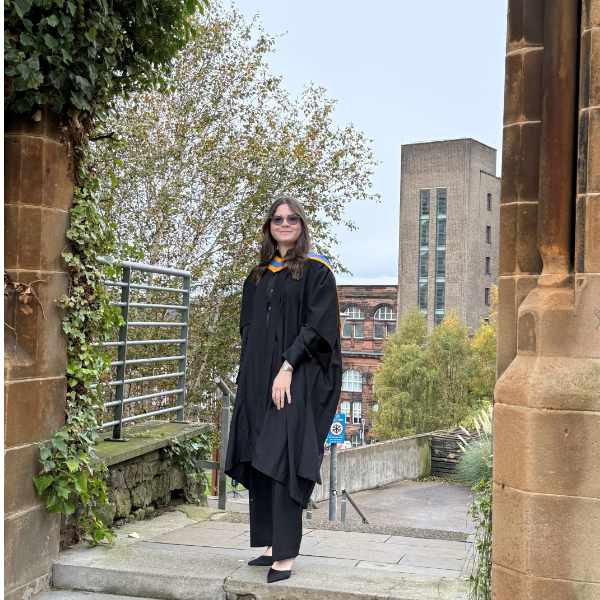
I did both my degrees at Strathclyde - a BSc (Hons) in Computer Science, then an MSc in Cyber Security - and I've stayed on since graduating. I now work in the Department of Computer and Information Sciences as a Knowledge Exchange Assistant on a research project in applied cryptography and privacy. In September I'm starting a new role at NatWest.
How did you make the decision to study at Strathclyde?
Honestly, there was no hesitation. I'd already done my BSc here, so I knew exactly what I was choosing - and not just the teaching. I'd had the whole Strathclyde experience: the socials in Strath Union, the sports clubs and the gym, and the things you only appreciate once you need them such as the mental health support and the careers help. The part I did think carefully about was the subject. My BSc dissertation had been on the security side of computer science and it got me genuinely interested, so I wanted to go deeper. I went through the module list before applying and it looked like it covered every aspect of cyber security and it did.
What aspects of the programme & your experience at Strathclyde did you find most valuable?
How complete it was. Every module and every lecturer added something, and not always what I expected. Some of it was technical, like writing secure code by design and analysing security protocols. Just as much of it was presenting, working in a team, and keeping the human factor in mind while you build. That combination is what made me confident walking into a work environment afterwards. Outside the timetable, the people mattered too, I met classmates on the course who I still spend time with now, and the lecturers were there whenever I needed them and still are.
What aspects of the programme did you find most engaging?
Security Protocols and Threat Models stood out, partly because it connected directly to my BSc dissertation and let me go much further into something I already cared about - though I enjoyed most of the modules. The highlight was my MSc dissertation: I developed an app to help older people stay safe online, and ran interviews and testing sessions with a group of seniors. Designing for real users rather than imagined ones changed how I think about security, and the whole process was smooth and genuinely enjoyable, with a supervisor who was helpful the whole way through.
What have you been up to since graduating from your course?
My BSc dissertation supervisor got in touch after I graduated and asked whether I'd like to work with him on a research project. That was an easy yes. I'm now a Knowledge Exchange Assistant at Strathclyde, working on research in applied cryptography and privacy - which means implementation work, running experiments on real hardware, and writing up the results for both academic and industry readers. From September I'm moving into a role at NatWest, which feels like the natural next step.
How did your university experience help prepare you for your current role?
The BSc taught me how to program. The MSc taught me how to think while I program. I now consider security at every stage rather than as something bolted on at the end, and I look at programs differently because of it - it feels like a real advantage as a developer. The one thing I've had to pick up on the job is the communication and marketing side: getting technical research across to people who aren't inside it. More than anything, the masters is why I feel ready for whatever comes next, rather than only for the job I'm in now.
What would you say to anyone thinking of coming to study at Strathclyde?
Come. And if you're worried about whether you can manage it, I worked part-time through both my degrees and it was doable. When I started the masters I was nervous that it would be too hard, and it was challenging - technically and in terms of soft skills - but the support was there every time I needed it. That's what I wish I'd known in week one, so I'll say it here: it's harder than your undergrad but you won't be doing it on your own. And work hard while you're here. It pays off - not always on the timescale you'd like, but it does.