Statement | Paulina Gonzalez-Martinez | Feb 2026
No time to lose on the just transition in Scotland
Scotland’s latest Just Transition Commission (JTC) report underlines that there is “no time to lose” in moving from reactive responses to industrial decline, towards anticipatory, place-based planning that protects jobs, incomes and communities while delivering net zero. CEP’s research on the distributional impacts of net zero shows that the outcomes of any decarbonisation pathway depend critically on: who bears transition costs, through which mechanisms, and over what timeframe.
Ultimately, the costs of transition can fall on households through a mix of prices, incomes, taxes and pressures on public services, so understanding these channels is essential to assessing both competitiveness and fairness. This reinforces the JTC’s message that proactive planning is needed to avoid unmanaged shocks that place a disproportionate burden on workers, families and communities.
The JTC is clear that Scotland has many of the right building blocks in place, but that progress “has fallen short of what is needed”. It is time to proactively plan rather than respond. CEP has long argued for a more coordinated decarbonisation policy across UK industry to avoid simply offshoring industrial activity, and alongside it offshoring jobs and investment. Our research shows that without effective climate action, the closure of UK manufacturing not only leads to domestic industry and supply chain job losses but also potentially contributes to higher emissions globally where production moves to jurisdictions with lower environmental standards. To prevent this lose-lose situation, effective policy is needed to support investment in low-carbon production technologies at existing sites and in retraining and supporting the transition of affected workers.
Likewise, the Commission calls for anticipatory, site and region-based plans for high-emitting and at-risk industrial assets, a stronger focus on jobs, skills and community resilience, and better use of available policy and investment levers to shape a just transition. The report identifies Sullom Voe in Shetland as one of several “hotspot” areas where this approach now needs to be put into practice, backed by robust monitoring and evaluation.
Investment for the just transition must be mobilised
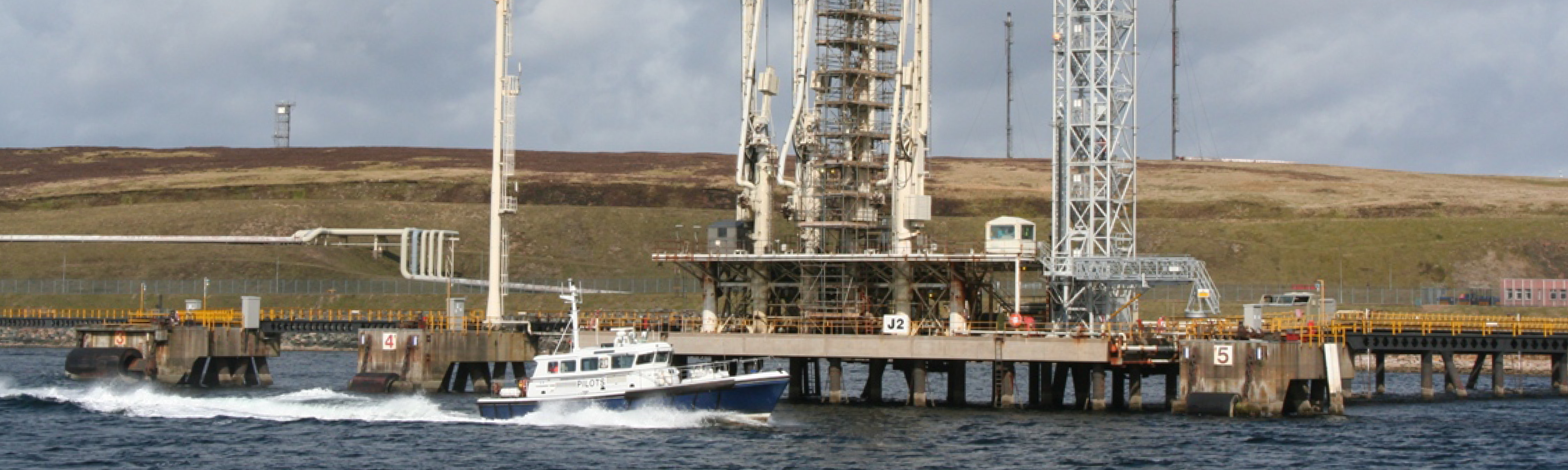
Our recent policy briefs on Sullom Voe Terminal (SVT) in Shetland speak directly to the JTC’s agenda that supports community wealth building measures. Since 2023, CEP has been working with local stakeholders in Shetland to ensure our evidence is both robust and useful for these decisions, helping to inform transition planning that can maximise local benefit. Our “do nothing” scenario shows what failure to act looks like in practice for the Sullom Voe Terminal and Shetland. If oil processing winds down with no transition plans in place, Shetland faces the loss of up to 402 full-time equivalent (FTE) jobs across the local economy by 2050 and a reduction in gross regional domestic product (GRDP) of around £30 million per year, even in the scenario where an expansion of the oil producing Clair field in the West of Shetland proceeds. These negative impacts on income and job losses in an island community such as Shetland risk accelerating outmigration and undermining the viability of core public services. This is the type of unmanaged decline that the JTC stresses has “no just path” and is incompatible with a fair and durable transition. Avoiding another Grangemouth or Mossmorran requires urgent action now.
In contrast, our Phase 1 LCF brief illustrates what anticipatory, place-based planning and investment can achieve at SVT. Using the same Shetland Economy Model, we find that early deployment of Phase 1 LCF production could save up to 350 jobs across Shetland in the 2030s. It could also turn an initial net loss of 34 jobs into a net gain of 269 jobs by 2030, and cap long-term net job losses at around 55, with most new roles arising in the wider local economy (construction, services, ports and harbours, and renewable power). Crucially, the shift to LCF makes better use of Shetland’s limited labour resources, leverages existing infrastructure, and delivers positive GRDP impacts. This provides a concrete example of the kind of market-shaping, investment-backed transition that the JTC argues is now required if Scotland is to avoid further Grangemouth-style shocks and instead secure local economic upsides from net zero.
Our evidence reinforces JTC priorities
The JTC’s high-level messages and our evidence are mutually reinforcing. The Commission calls for earlier, braver decisions, better alignment of UK and Scottish levers, and strengthened capacity for communities and local authorities to shape major industrial transitions in their area. Careful planning can prevent net zero projects from competing for scarce people and materials, avoiding higher costs and delays while securing wider economic benefits.
Our work on the net zero transition shows that net zero will only be achievable and maintain public support if decisions about who pays, how, and when are placed at the heart of policy design, including planning, rather than as an afterthought. The JTC warns that unless the costs and benefits of the transition are shared in an equitable way, the mandate for ambitious climate action will weaken. By linking economy-wide goals with the real choices that shape people’s lives, we can turn net zero into a transition that serves workers, households and communities across Scotland.
Photo by John Bateson on Geograph