Blog | Megan Scherrer | Aug 2026
The transition to net zero requires us to decarbonise our energy systems and is often presented as a purely technological challenge. At the 2026 Energy Ethics conference in St Andrews, however, one message came through clearly: the most difficult challenges may not be technological at all, but those related to power, participation, and how we can have a just transition.
Over three days, academics from around the world gathered at the conference, run by the Centre for Energy Ethics. The event brought together a diverse group of academics, ranging from professors to fellow PhD researchers, with research and perspectives spanning a huge range of geographical contexts, disciplines, and approaches to thinking about energy. Participants were encouraged to consider: What is at stake in our infrastructures of energy? How can change come about? And what visions of human and other flourishing are favoured by our energy infrastructures?
For myself, it was also an opportunity to step outside the immediate focus of my own research and network, and learn from other professionals in the field of energy. Over the course of three days, I had discussions more widely about the energy transition, attended lectures on energy justice, and explored the social and political phenomena that shape our energy infrastructure.
Presenting my research
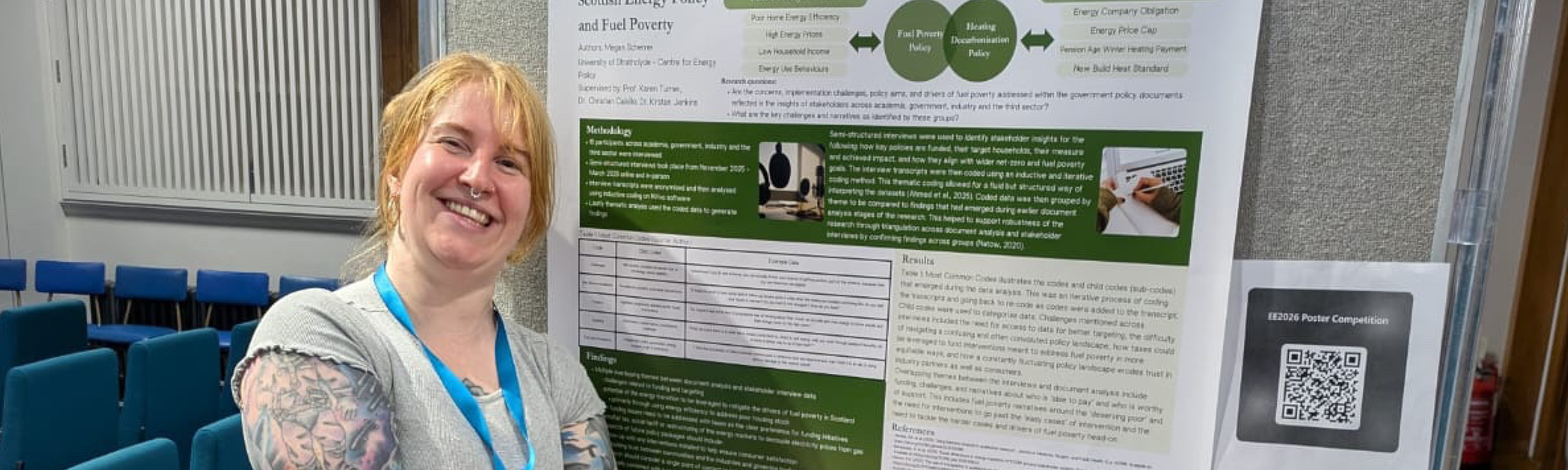
One of the highlights of the conference was presenting a poster on the latest phase of my doctoral research (Megan Scherrer Academic Poster - Energy Ethics conference), drawing on emerging insights from my interview data.
The poster presentation was part of a conference-wide competition and showcased an impressive range of projects. Research topics spanned everything from the impacts of foreign investment on Peruvian energy sovereignty, to ocean imaginaries and how these shape our understanding of our relationship with energy and the environment.
What makes poster presentations valuable is that they encourage you to think about your research differently. This was my second time presenting a poster at a conference, and I continue to find the experience useful, if challenging. It is essentially an academic version of an elevator pitch: the practice of summarising material from a 20+ page thesis chapter coherent argument of less than 1,000 words. It’s a task that forces you to consider the key aspects of your research, and how can you communicate them efficiently and without losing nuance and complexity.
Energy justice and the transition to net zero
Across the three days, I attended panels exploring the varied aspects of energy justice and sociotechnical imaginaries of the energy transition, particularly the question of what it means for the transition to be a just one.
The panels covered an enormous range of topics. Some focused on the planning, development, implementation, and eventual dismantling of infrastructures associated with decarbonisation in the push towards global net-zero goals. Others examined the increasingly complicated geopolitical landscape surrounding Europe's energy transition, where concerns about climate change are now closely intertwined with questions of security, resilience, and competitiveness.
The panels exploring energy justice and the energy transition were of particular interest to me. They repeatedly returned to a key point: it isn't enough to ask whether we can transition away from fossil fuels. We also need to ask what kind of energy system we are transitioning towards, who it benefits, and who gets to shape it.
Moving beyond extractivism
Extractivism was one of the fundamental words of the conference; it describes an approach in which resources are treated primarily as things to be extracted and used, often with social, political, cultural, and environmental consequences. This word reappeared throughout talks and sessions and illustrated larger conversations happening throughout the conference. How can renewable energy infrastructures avoid recreating those same extractivist systems and relationships?
No clear answers emerged, but several ideas were proposed and discussed.
One was the need to move away from Western and colonialist assumptions when designing and developing renewable energy infrastructures. Another was the importance of reflecting on the impacts of existing and historical energy infrastructures and applying the lessons learned moving forward.
Community engagement was another recurring theme but with an important distinction. It is not enough simply to consult communities about infrastructure that has already been designed and implemented. There is a need for true community involvement to make way for community empowerment; giving communities meaningful opportunities to shape the infrastructures that affect their lives and landscapes.
Who gets to shape the energy transition?
Although the challenges of the energy transition were discussed in depth throughout the conference, one message kept coming through: energy justice needs to be built into the transition from the beginning.
There was also a recurring emphasis on putting marginalised voices at the centre of conversations about energy.
We (the royal we) understand that the energy transition has to happen. It is already well underway here in Scotland, with enormous changes taking place across our energy systems and landscapes. But recognising that the transition needs to happen doesn't mean that we should stop asking questions about how it happens.
Who benefits?
Who pays?
Whose knowledge is considered important?
Who gets to participate in decision making?
And what happens to communities and landscapes in the process?