Across the Hub we engage in diverse research projects which demonstrate the breadth of concepts in Early Childhood Education. The research demonstrates a range of interdisciplinary connections as our research seeks to support children to flourish.

Strathclyde Early Childhood Education HubOur Research and Partners
This interdisciplinary project from the Strathclyde Institute of Education and the Computer and Information Systems aims to explore how AI education is currently delivered across Scotland in early years education settings and primary schools, with a dual focus on pupils’ learning experiences and teacher professional development.
Project Dates: June 2025 to March 2026
Researchers involved:
- Dr Stavros Nikou
- Dr Lorna Arnott
- Dr Damien Anderson,
- Prof Marc Roper
Becoming a parent is widely acknowledged to be a major life transition (Butler, Gregg, Calam & Wittkowski, 2020; Cowan and Cowan, 2000) and a time of increased vulnerability (Andrade et al, 2020). Parenting itself is recognised as complex, a role often entered with little preparation, and highly influential in the life course of children (Britto, Ponguta, Reyes & Karnat, 2015; Leadsom, Field, Burstow & Lucas, 2014). Parenting is also recognised to be an international policy priority and a public health policy issue (Heckman, 2017; Hodgkin & Newall, 2007), worthy of financial investment (Sadler et al, 2011).
The aims of this small project are therefore to:
- Hear what it was like to become a parent
- Develop understandings about what it is like to be a parent of young children now
- Draw out the themes emerging from parental accounts to visualise the journey to becoming and being a parent and
- Link participants’ stories to what is already written about transition to parenthood in order to write an opening chapter for Bloomsbury Handbook of Early Childhood Transitions Research
Although it woud be possible to gather stories without formalising this as a research study, given it is a research handbook it is proper to generate a small scale study to underpin the writing of this chapter and to prepare an ethics application to protect participants. In this way this small-scale short-life project will be able to gather recent experiences of the transition to parenthood and the day-to-day parenting role and locate them as relevant to educators as they work to establish positive relationships with the parents of the children in their care.
Researchers involved:
- Aline Wendy Dunlop
- Lynn Taylor
This project will investigate the effectiveness of a play-based program to enhance pre-schoolers’ self-regulation (SR) in the transition to school, with a particular focus on children and families from diverse backgrounds and those experiencing risk or vulnerability. The program will be co-designed with families, Early Childhood (EC) educators, and school teachers. The program will subsequently be trialled in a small-scale pilot study involving two transition teams (EC providers and schools). Children’s SR, learning dispositions, and developmentally appropriate academic learning will be assessed following a quasi-experimental pre-/post-test design. Findings will inform the development of a larger scale study that will scale-out the program more widely in the ACT and/or into other jurisdictions.
Researchers involved:
- Associate Professor Deborah Pino-Pasternak (Chief Investigator, University of Canberra, Australia)
- Professor Barbara Pamphilon (University of Canberra, Australia)
- Associate Professor Kym Simoncini (University of Canberra, Australia)
- Professor Nancy Perry (University of British Columbia, Canada)
- Dr Zinnia Mevawalla (University of Strathclyde, United Kingdom)
Changing Hearts and Minds is a collaborative professional development and research project between Glasgow City Council and the Strathclyde Institute of Education. The project focuses on investigating how to build understandings of, and capacities for, inclusive education in the early years by working with leaders of early years settings across Glasgow.
Researchers involved:
University of Strathclyde
- Dr Zinnia Mevawalla
- Jane Catlin
- Gillian McConnell
External investigators
- Jackie Fulton (Glasgow City Council)
- Dr Kathy Cologon (Macquarie University, Australia)
We are working closely with colleagues in child psychiatry and statistics for a joint UK-Sweden phase 3 diagnostic trial on the efficacy of an iPad-based serious game assessment tool to identify autism spectrum disorder in young children. The trial has taken place in collaboration with Professor Christopher Gillberg and his team at the Gillberg Neuropsychiatry Centre at the University of Gothenburg as well as our colleagues Professor Helen Minnis and Professor Alex McConnachie at Glasgow, and Professor Phil Wilson at Aberdeen. We are working to complete our combined Sweden-UK trial of the iPad early assessment for children with autism, and together we are working to develop a new work in novel forms of psychological and motor assessment for young children, and the development of a new study to include wearable assessment of movement in early life as a biomarkers of neurodevelopmental distress.
Find out more about the Gillberg Neuropsychiatry Centre, University of Gothenburg.
Researchers involved:
- Prof Jonathan Delafield-Butt (Education, University of Strathclyde)
- Prof Chris Gillberg (Gillberg Neuropsychiatry Centre, University of Gothenburg)
- Prof Helen Minnis (Child Psychiatry, University of Glasgow)
- Prof Phil Wilson (Paediatrics, University of Aberdeen)
We are working closely with colleagues in child psychiatry and statistics for a joint UK-Sweden phase 3 diagnostic trial on the efficacy of an iPad-based serious game assessment tool to identify autism spectrum disorder in young children. The trial has taken place in collaboration with Professor Christopher Gillberg and his team at the Gillberg Neuropsychiatry Centre at the University of Gothenburg as well as our colleagues Professor Helen Minnis and Professor Alex McConnachie at Glasgow, and Professor Phil Wilson at Aberdeen. We are working to complete our combined Sweden-UK trial of the iPad early assessment for children with autism, and together we are working to develop a new work in novel forms of psychological and motor assessment for young children, and the development of a new study to include wearable assessment of movement in early life as a biomarkers of neurodevelopmental distress.
Researchers involved:
- Prof Chris Gillberg (Gillberg Neuropsychiatry Centre, University of Gothenburg)
- Prof Helen Minnis (Child Psychiatry, University of Glasgow)
- Prof Phil Wilson (Paediatrics, University of Aberdeen)
- Prof Alex McConnachie (Robertson Biostatistics Centre, University of Glasgow)
- Prof Jonathan Delafield-Butt (Education, University of Strathclyde)
- Prof Phil Rowe (Biomedical Engineering, University of Strathclyde)
- Dr Szu-Ching Lu (Innovation in Autism, University of Strathclyde)
About ten years ago I undertook a Literature Review on Leadership in the Early Years that was published by Education Scotland (Dunlop, 2008). At that time I proposed that empowerment of others, shared leadership and strong relationships were important ingredients of effective leadership. It is time to update that work: to do so it seems important to consult with practitioners who are providing leadership in early learning and childcare settings and in early primary education in Scotland. Closing the Attainment Gap, the Blueprint for expansion of ELC to 1140 hours (equivalent to the primary school day) (Scottish Government, 2018; 2019) and associated recruitment for early years practitioners, and recent academic publications on leadership in the early years make clear this is still a contested concept. System-change on this scale raises questions about whether there is ample leadership to support such change (Nicholson, Kuhl, Monates, Lin & Bonetti, 2018) and questions the ‘expressed purposes of leadership work’ (p.3). Drawing on recent works, such as Davitt and Ryder(2018)six ‘leadership dispositions’ specific to early childhood, Scotland practice guidance (Education Scotland, 2019) and the Blueprint for 2020 Action Plan (2017), this proposed research identifies three clear aims for the study:
- To provide a picture of current ELC and Early Primary leadership experience and qualifications;
- To explore leadership beliefs and day-to-day practices across diverse early years 0-8 settings; and
- To develop further understanding on how to provide sustainable “on-the-job” leadership development.
Researchers involved:
Early interactions between adults and infants are inherently multimodal. Both parties engage in a repertoire of behaviours to connect with one another, fostering shared affective states and foundational meaning-making. This is the essence of primary intersubjectivity—a shared experience that facilitates the creation of affective meaning in the earliest stages of human life. The way these interactions unfold over time, through sequences of action and attention, is fundamental to human experience.
A narrative structure, characterised by phases of changing arousal and intensity, has been proposed to play a vital role in this process. Jerome Bruner argued that a narrative framework serves as both a praxis for human communication and a fundamental mode of cognition. Meanwhile, scholars such as Colwyn Trevarthen have identified narrative as central to the musicality of early interactions. Through an analysis of interaction dynamics, we explore the development and evolution of narrative in early engagements to better understand its form, function, and often-overlooked role in traditional experimental paradigms. By doing so, we hope to gain a deeper appreciation of intersubjective narratives in early education and healthcare, as well as identify opportunities for purposeful intervention.
Researchers involved:
- Prof Jonathan Delafield-Butt (Education, University of Strathclyde)
- Dr. Timothy McGowan (Laboratory for Innovation in Autism, Strathclyde)
- Prof. Mette Væver (Centre of Excellence in Early Intervention and Family Studies, University of Copenhagen)
- Dr Marianne Thode Krogh (Centre of Excellence in Early Intervention and Family Studies, University of Copenhagen)
- Prof. Susanne Harder (Department of Psychology, University of Copenhagen)
At the University of Southern California we work closely with Professor Lisa Aziz-Zadeh and her team at the A-Z Lab set within Prof. Antonio and Hanna Damasio’s Brain and Creativity Institute. We work to investigate motor differences in children with autism and those with developmental coordination disorder using novel iPad methodologies together with fMRI and standardised psychometrics.
With Professor Filippo Muratori and his clinical and neuroimaging colleagues Dr Sara Calderoni and Dr Alessandra Retico and Dr Paolo Bosco at IRCCS Stella Maris Foundation and the Istituto Nazionale di Fisica Nucleare, respectively, we share significant interests and expertise to help elucidate the brain growth differences in young children with autism. We recently provided evidence of significant brainstem growth differences with implications for learning in preschool children, and are currently working on new data from the University of Southern California in analysis of brainstem differences related to Autism Spectrum Disorder and Developmental Coordination Disorder.
Researchers involved:
- Prof Jonathan Delafield-Butt (Education& Innovation in Autism,University of Strathclyde)
- Dr Szu-Ching Lu (Education& Innovation in Autism, University of Strathclyde)
- Mr Tim McGowan (Education& Innovation in Autism, University of Strathclyde)
- Prof Lisa Aziz-Zadeh(Brain and Creativity Research Centre, University of Southern California)
- Dr Laura Harrison (Brain and Creativity Research Centre,Universityof Southern California)
- Prof Filippo Muratori (Neuropsychiatry, University of Pisa)
- Dr Alessandra Retico (Institute for Nuclear Physics, Pisa)
- Dr SarahCalderoni (Neuropsychiatry, University of Pisa)
- Dr Paolo Bosco (Institute for Nuclear Physics, Pisa)
With a Fellowship from the Japan Society for the Promotion of Science, we are beginning new comparative work on early development of sensorimotor intelligence and learning with Prof Tetsuro Matsuzawa, Prof. Yuko Hattori, and Prof. Misato Hayashi at the Primate Research Institute at Kyoto University, a world-leading centre for comparative psychology of primate intelligence. In this collaboration, we seek to advance a novel computational analysis of chimpanzee and human movement to determine its motor kinematics during smart tablet gameplay, with an eye to understanding differences in the degree of variability, or adaptive flexibility, in those movements. This may shed important light on the role of the motor system in development and learning, especially in autism.
Researchers involved:
- Jonathan Delafield-Butt (Education, University of Strathclyde)
- Prof TetsuroMatsuzawa (Advanced Studies, Kyoto University)
- Assistant Prof Yuko Hattori (Primate Research Institute, Kyoto University)
- Assistant Prof Misato Hayashi (Primate Research Institute, Kyoto University)
This doctoral research aims to evaluate the extent to which a focus on reflection and revision of emotional constructs will enable Early Years pedagogues to engage in sustained empathic practice. This nine month evaluative case study of a relational and empathic practice-support programme utilises participant observation, reflective discussion and video-enhanced reflective practice (VERP). Practitioners will participate in experiential learning cycles within their practice setting. Through successive cycles of experience and reflection, emotional constructs will be re-evaluated and revised through the lens of empathy and emotional understanding.
Researchers involved:
- Nicky Shaw (PhD Student)
- Helen Marwick
- Eleni Karagiannidou
The project hopes to identify and combat the dilution of the Scottish Early Years curriculum, in collaboration with children, staff and families across Nursery and Primary One settings. The researchers will introduce a new model for play-based pedagogy that defines play as a continuum of theory, and of practice. This will include iterative and interconnecting cycles that link the role of the environment, child and adult in high quality provision.
The researchers intend to answer: What are the goals of Early Years education and how do we achieve them?
Key elements include:
- the dimensions of play,
- the design and mechanism of an effective play environment,
- observation from the perspective of the child and adult,
- tools for measuring the quality of play-based practice.
Researchers involved:
- Deirdre Grogan
- Charlotte Bowes
This project investigates how the home lives of children aged three and under intersect with digital technologies in diverse families in England, Northern Ireland, Scotland and Wales.
The research team will build knowledge about how very young children develop early talk and literacy, and how families support their learning and wellbeing.
Through survey research, interviews and innovative participatory research methods, the project will generate new understandings of contemporary home learning environments.
Find out more about the project
Project Dates: June 2022 to June 2024
Researchers involved:
- Dr Lorna Arnott (Internal)
- Dr. Zinnia Mevawalla (Internal)
- Dr. Andrew Dalziell (Internal)
- Prof Rosie Flewitt (MMU)
- Prof Julia Gillen (Lancaster)
- Prof Janet Goodall (Swansea)
- Dr Katrina McLaughlin (Queens University Belfast)
- Prof Karen Winter (Queens University Belfast)
- Dr Sandra El Gemeyel (MMU)
This IAA application builds on a recently completed ESRC research project. From 2022 to 2024, a UK-based team at Manchester Metropolitan, Strathclyde, Lancaster, Swansea Universities, and Queen’s University Belfast led a groundbreaking study, Toddlers, Tech and Talk, exploring how very young children (birth to 36 months) use technology at home and its impact on language and literacy learning. The research found:
- When optimally framed by parents and educators, children's learning with technologies can be rich, eclectic, and creative.
- Digital technologies are integral to everyday life and learning at home.
- Viewing children's digital technology use solely as 'screen time' is reductive.
- Technologies should be seen as meaningful artefacts in play, harnessed for their learning potential.
- Evidence-based resources and training are needed for parents and educators to support young children's creative, critical, purposeful, and reflective use of technology.
The IAA project aims to work directly with parents of children from birth to 36 months, practitioners, and policymakers to offer knowledge and training on quality digital play experiences. This project is innovative, as no synchronous activities such as workshops, guidance, Q&A sessions, or training are currently available at a national level and supported by library associations (SLIC) or education authorities (Education Scotland) for this age group.
Based on recent empirical evidence, responsive scaffolding can enrich young children's encounters with technological artefacts, offering significant learning potential. Parents and educators play a fundamental role in supporting children to navigate the complex digital world. However, findings show that most adults have concerns about children's use of technology, which can impede creative engagement. Our research indicates that parents and educators need support to confidently guide young children in a digital society. The proposed IAA will encourage young children to reflect on and make informed decisions about technology in their play and learning.
Project Partners:
The project will partner with the Scottish Library and Information Council (SLIC) and Education Scotland and Education Scotland.
Project Dates: 05/01/2026-31/09/2026
Researchers involved:
- Dr Lorna Arnott
- Dr Charlotte Allan
ESRC Toddlers, Tech and Talk research project infographics

Top tips: How to support very young children’s safe and purposeful tech use (2025)
This infographic presents key ideas about how parents can support very young children's safe and purposeful tech use. The 'top tips' are rooted in empirical research conducted during the ESRC-funded Toddlers, Tech and Talk project.
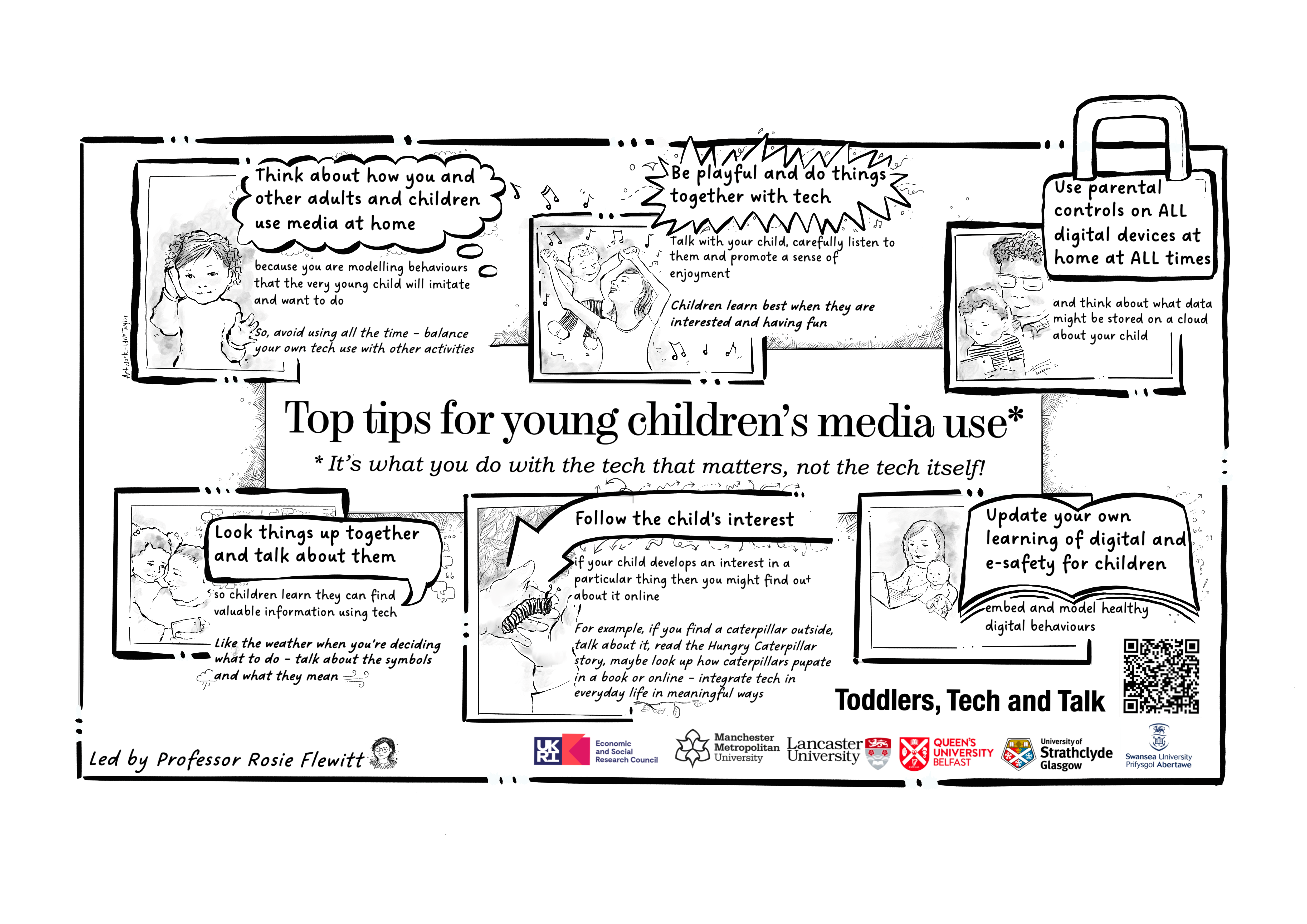
Top tips for young children’s media use (2024)
This infographic presents six 'top tips' for how parents of very young children can support their use of digital media.
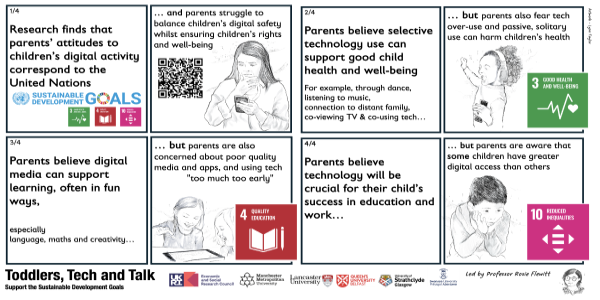
Top tips: Parents’ attitudes to children’s digital activity (2026)
This infographic presents some key findings from the Toddlers, Tech and Talk study about parents' attitudes towards their young children's use of digital technology.