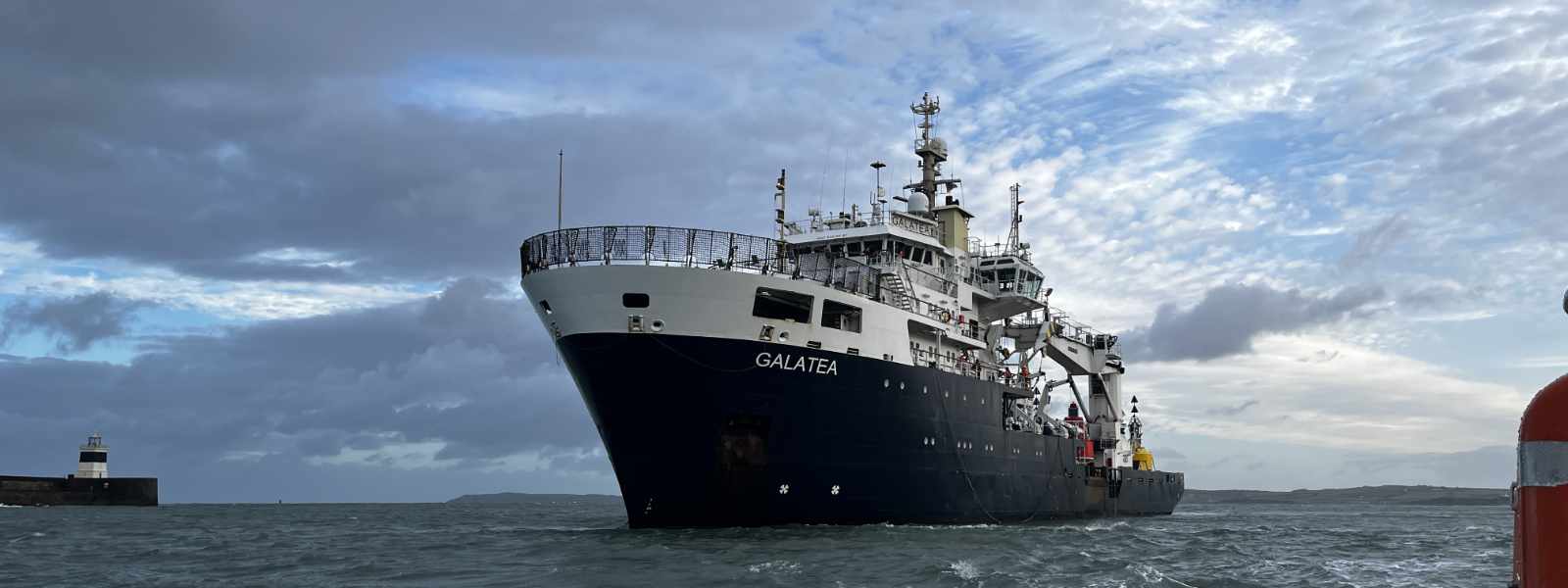
A quantum technology-based navigation system has completed a successful trial at sea, which has shown its potential to operate where other networks are unavailable.
The HARLEQUIN system was tested on board the Galatea, a buoy and lighthouse maintenance vessel, and was shown to be capable of functioning in real-world conditions, outside the laboratory. It could be used to support more widely-used global navigation satellite systems (GNSS) when they are out of service or are less reliable.
HARLEQUIN combines conventional elements of navigation systems with a cold-atom quantum accelerometer. At the heart of this quantum technology is a gMOT (grating magneto-optical trap) cold-atom source, developed over more than a decade through collaboration between Strathclyde and CPI TMD.
First demonstration
The sea trials, led by CPI TMD, were carried out in partnership with the University of Strathclyde, Covesion and Trinity House. The trial was the first demonstration in the field of the gMOT based cold-atom technology, which has potential for other applications in future.
The project is funded by Innovate UK.
Dr Oliver Burrow, a Research Fellow in Strathclyde’s Department of Physics and the University’s lead in the trials, said:
This trial marks a new frontier for the platform and supports the wider goal of developing navigation systems that remain resilient when GNSS signals are unavailable.
"At Strathclyde we’ve been developing gMOT-based cold-atom systems for more than a decade, so it’s exciting to see this technology tested in a genuine maritime environment for the first time.
“We hope this will be the first of many demonstrations, both for navigation and for the broader applications gMOT cold-atom platforms can support.”
Dr Edward Boughton, Head of Applied Science at CPI TMD, said: “Demonstrating stable performance on a real, working maritime platform shows that these technologies are maturing quickly and that they can reach the level of reliability needed for deployment in GNSS-denied settings.”
GNSS signals, such as those from GPS, are increasingly vulnerable to intentional jamming and spoofing and cannot penetrate underwater, underground, or heavily built-up environments.
Seeking alternatives
Governments and industries are actively seeking alternatives to satellite-dependent systems and quantum-enabled navigation technologies such as HARLEQUIN provide a promising path to resilient positioning, navigation, and timing capabilities, helping reduce risk and safeguard critical infrastructure.
Data from the trials will now inform a programme of system upgrades aimed at improving performance and enhancing suitability for long-term shipboard operation. A second field trial is planned for the end of 2026.
The trial aboard the Galatea was carried out alongside the ship’s daily operational tasks, such as maintaining buoys, marking wrecks, and supporting marine infrastructure. The Galatea is operated by Trinity House, the General Lighthouse Authority for England, Wales, the Channel Islands and Gibraltar.