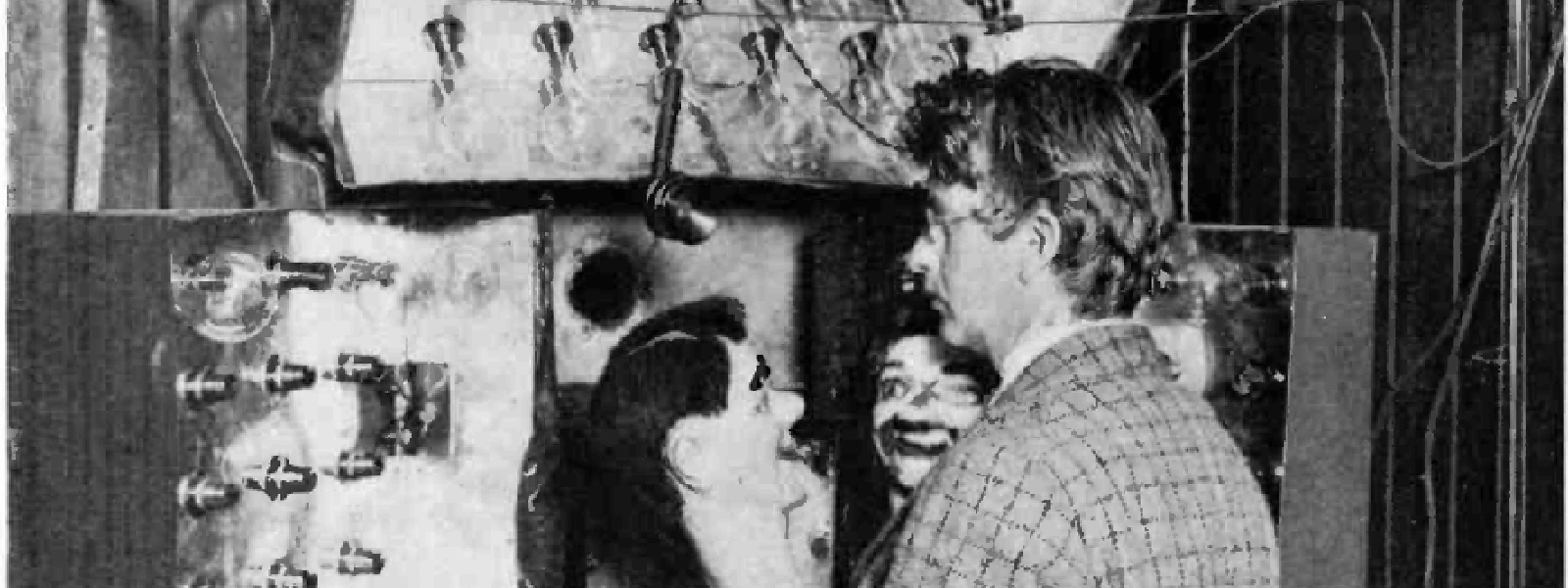
The birth of television has been marked 100 years on at the London address where Strathclyde alumnus John Logie Baird first demonstrated the technology to the world.
Baird gave the first public demonstration of a working television system on 26 January 1926 at 22 Frith Street in London’s Soho.
Working from two attic rooms he had used as a laboratory since 1924, he became the first person to transmit moving images by television – a moment that laid the foundations for one of the most influential technologies of the modern era.
Commemorative plaque
To mark the centenary, a commemorative plaque has been unveiled at Bar Italia which now occupies the Frith Street site site, by the World Origin site organisation. A World Origin Site marks the place, people and moment where something groundbreaking was invented, discovered or first used.
A newly refurbished space, the Baird Room, was also officially opened by Baird’s grandson, Iain Logie Baird.
Born in Helensburgh in 1888, John Logie Baird studied electrical engineering at the Glasgow and West of Scotland Technical College – now the University of Strathclyde – from 1906 to 1914, graduating with a diploma in Electrical Engineering. His connection to the University continues to be recognised today, with a bust of Baird on permanent display in Strathclyde’s Royal College Building.
Baird began experimenting with the transmission and reception of moving images in 1922. His early work included demonstrations using silhouette images at Selfridge’s department store in London. By 2 October 1925, he had successfully transmitted a television image with tonal gradation from his Frith Street laboratory, famously using a ventriloquist’s dummy known as ‘Stooky Bill’, before progressing to live human faces.
Under pressure to publicly establish his claim before rivals, Baird invited around 50 people to witness a formal demonstration in January 1926. It was the first time television had been shown to an invited audience and marked a decisive step towards the technology’s rapid development, which would see television become a mass medium by the mid-20th century.
Pioneering innovation
Professor Graeme West, of Strathclyde’s Department of Electronic and Electrical Engineering, who works in the same Royal College Building where Logie Baird would have studied, attended the centenary event. He previously led a student project to recreate a working replica of Baird’s original ‘televisor’ as part of a STEM outreach initiative.
Professor West said: "John Logie Baird exemplifies Strathclyde’s ethos of useful learning through pioneering innovation.
A century on from his first television demonstration, we continue to draw inspiration from his legacy in our teaching, research and outreach – connecting the past to the future of engineering and technology.
Martin Wilkie from World Origin Site said: “World Origin Site marks and celebrates inventions, discoveries and world firsts and you don’t get a bigger world first than television. It has had such a dramatic effect on entertainment, politics and the economy across the globe and it all started at 22 Frith Street 100 years ago.
“We are so pleased to have had Professor West here to represent the link between Baird’s education at the former Glasgow and West of Scotland Technical College which is now the University of Strathclyde. The work by Strathclyde students to recreate Baird’s technology has been a fascinating link to the past.”