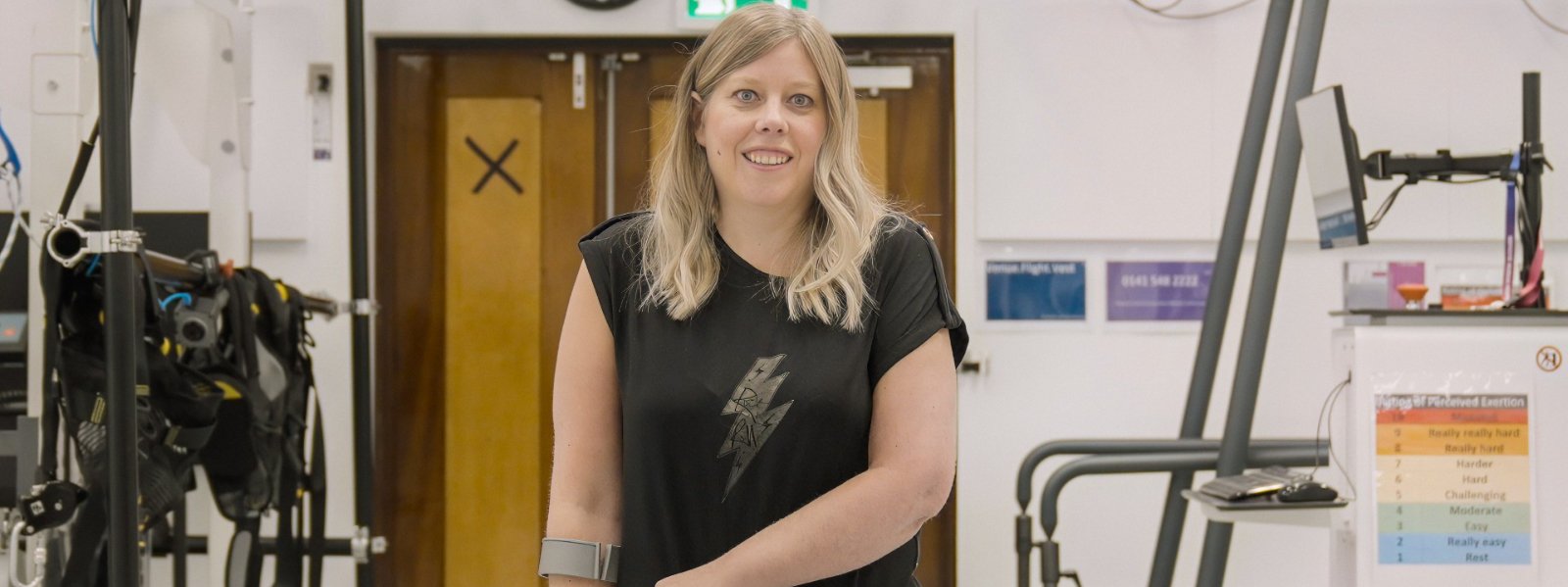
An NHS worker left paralysed by a severe stroke has praised a groundbreaking University of Strathclyde clinic for helping improve her mobility and confidence during recovery.
Gillian Gordon was just 36 when she suffered a stroke that left her completely paralysed down her left side. After emergency treatment and a 12-week hospital stay, she faced long-term challenges, including permanent loss of use in her left arm and continued weakness in her leg.
Pioneering programme
In 2022, Gillian, now 46, was one of the first people to take part in the pioneering rehabilitation programme at the University’s Sir Jules Thorn Centre for the Co-Creation of Rehabilitation Technology. The Centre uses a technology-led approach to retrain the brain and body through interactive tools and gait-focused therapies.
Following an eight-week course developed in collaboration with Chest Heart and Stroke Scotland at the Centre’s Technologically Enriched Rehabilitation Gym (TERG), Gillian reported notable improvements in her mobility and confidence. Speaking on World Stroke Day, she said: “I joined the rehab research project at Strathclyde, and it helped me so much. My fitness and mobility really improved.
The rehab used technology to train my brain to undertake tasks. I played games on a special iPad using a controller and got a very visual response – I could see my hand and arm reacting to what I was asking them to do, and it was amazing to see.
“Being able to walk on a treadmill in a controlled, safe environment was really helpful. I could see on a screen what’s wrong with my walking, so I knew what I needed to do to improve it.
“When you can visually see what you need to do to improve, it makes such a difference. The more patients who get access to this kind of rehab, the better.”
National guidelines
Stroke remains the leading cause of severe disability in the UK. Despite national guidelines recommending intensive rehabilitation, research from CHSS indicates that less than half (45%) of people living with stroke conditions in Scotland have accessed necessary NHS rehabilitation services.
Dr Andrew Kerr, Director of the Centre and a trained physiotherapist, said: "This programme puts stroke survivors at the centre of their own recovery journey.
Through innovative technology and targeted interventions, we support people to rebuild their independence and quality of life. Gillian’s progress is a powerful example of the benefits of sustained, accessible rehabilitation.
The Centre’s team also helped set up a rehabilitation hub at the stroke unit at University Hospital Wishaw with the support of strategic partner NHS Lanarkshire, with three new community-based stroke gyms based on the original model also rolled out across Scotland.
Joanne Graham, Director of Services at Chest Heart and Stroke Scotland, said: "At Chest Heart and Stroke Scotland, we work hard to help people understand their risk of stroke, recognise the signs and symptoms through our Act F.A.S.T. campaign, and take action to protect their health.”