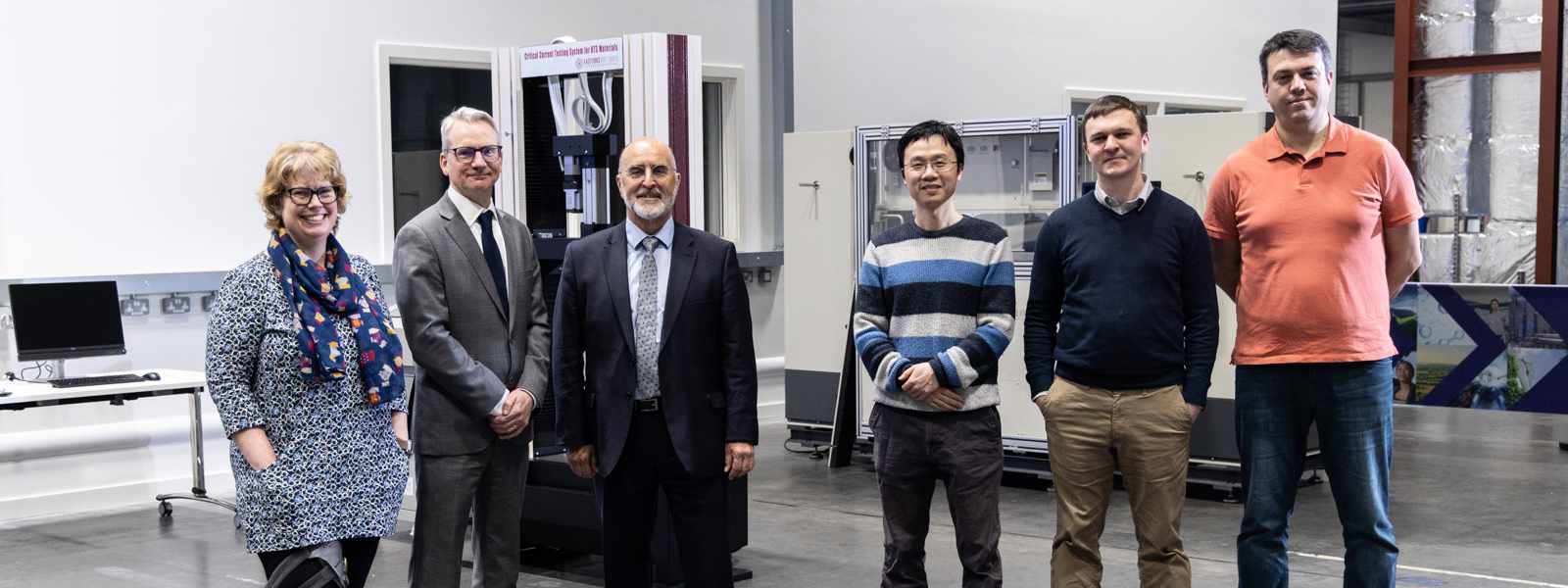
The University of Strathclyde has opened a new national facility designed to accelerate the UK’s development of superconducting technologies for energy systems and nuclear fusion.
The high-temperature superconducting (HTS) facility, located within the Advanced Net Zero Innovation Centre next to Glasgow International Airport, forms part of the Superconducting Machines & Systems Catalyst. It will strengthen the UK’s capability to develop, test and integrate superconducting materials and components for next-generation electrical machines and high-field magnets.
Although termed ‘high temperature’, HTS materials still operate at cryogenic temperatures. For example, rare-earth barium copper oxide (REBCO) tape becomes superconducting at around 20-77 K (-253°C to -196°C). This is significantly warmer than conventional superconductors, which typically require cooling to around 4 K (-269°C) using liquid helium.
Unlocking advances
Operating at these higher temperatures enables more powerful, compact and efficient electrical devices, unlocking advances across power transmission, transport systems, renewable energy technologies and nuclear fusion.
The new facility will provide capabilities including HTS material characterisation, coil winding and mechanical testing under cryogenic conditions. These capabilities will support the development and validation of superconducting components used in high-field magnets and advanced electrical machines.
Professor Min Zhang, who leads the Applied Superconductivity Lab at Strathclyde, said: “Superconducting technologies are becoming increasingly important across energy and transport systems, as well as for fusion energy.
This new facility strengthens the UK’s capability to test and integrate superconducting materials under realistic cryogenic conditions, helping accelerate their deployment across power, transport and fusion sectors.
Supported by the UK Atomic Energy Authority and led by Strathclyde, the Superconducting Machines & Systems Catalyst brings together academic partners including the universities of Edinburgh, Manchester, Nottingham and Bath, alongside industry and government stakeholders.
The Catalyst originated from seed funding through the UK Atomic Energy Authority’s Fusion Futures programme and aims to coordinate national capability in superconducting machines and systems.
Fusion ambitions
High-temperature superconducting magnets are central to the UK’s nuclear fusion ambitions, including the government-backed STEP prototype fusion power plant currently being developed by UK Industrial Fusion Solutions at West Burton.
Superconducting magnets represent one of the highest-value subsystems in a fusion power plant, and domestic capability in their manufacture and validation is considered critical for both strategic resilience and future export opportunities.
The UK already possesses internationally recognised expertise in HTS materials development and qualification, superconducting magnet and coil design, cryogenic engineering and power systems integration. The Catalyst aims to bring these capabilities together into a more coordinated national ecosystem that supports industrial adoption and scalable manufacturing.
Initial work within the programme includes developing a national map of HTS capability and infrastructure, alongside supply-chain and skills analyses and sector-specific studies across four priority industries.
By aligning academic capability with industry and government partners, the initiative aims to reduce risk in superconducting magnet development for fusion deployment while strengthening domestic supply chains and coordinating specialised infrastructure across the UK.