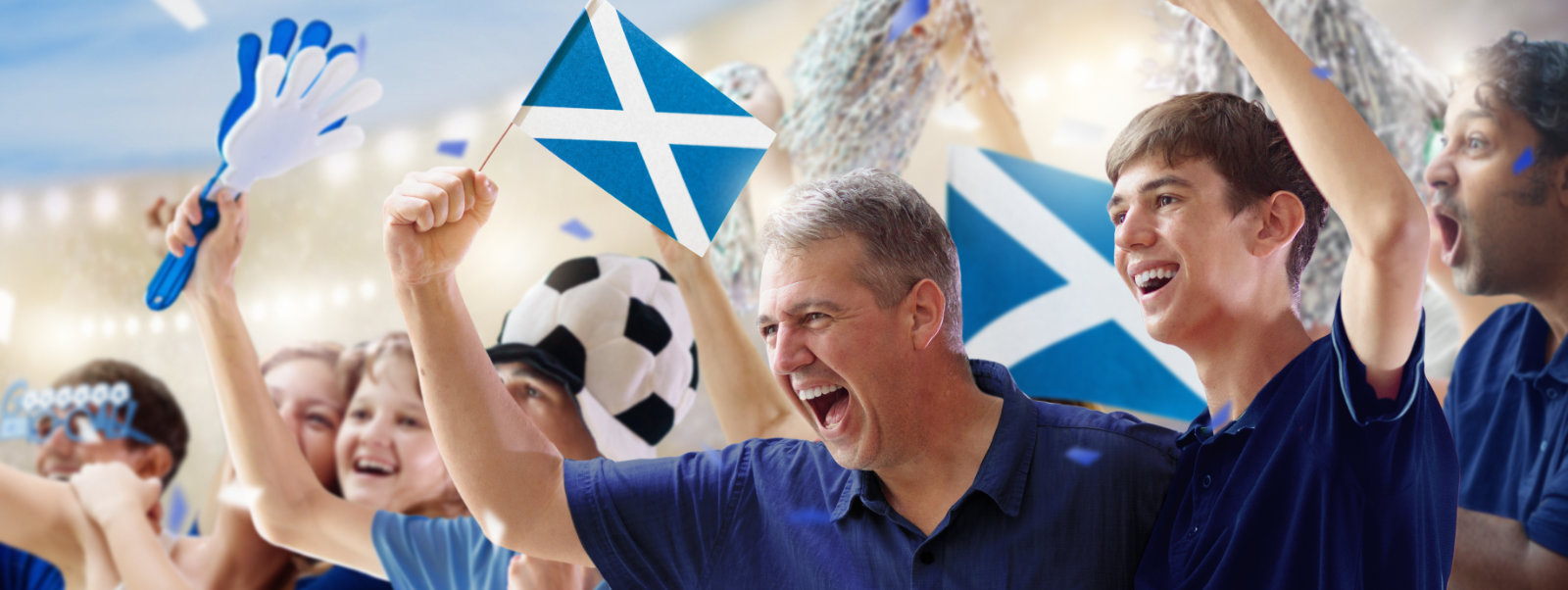
There was jubilation across Scotland when the men’s national football team qualified for the World Cup after an absence stretching almost three decades.
As the tournament begins on 11 June, millions of supporters will focus on Scotland’s attempt to reach the knockout stages for the first time. Yet few fans may realise that Scotland’s very presence on football’s biggest stage represents one of the sport’s most unusual historical anomalies.
Scotland is among only four 2026 World Cup teams which are not independent sovereign states – the others being England, Curaçao and the Netherlands, with the latter two each being constituent countries of the sovereign Kingdom of the Netherlands.
Independent countries
In modern international football, FIFA generally requires its members to be recognised independent countries. Yet Scotland, England, Wales and Northern Ireland continue to compete separately despite all forming part of the United Kingdom.
A research paper from the University of Strathclyde examines how this unique arrangement came to exist – and why other non-sovereign nations, including Greenland and Gibraltar, have struggled for international recognition.
The article, From Greenland to Gibraltar: the position of non-sovereign nations in international football, has been published in the International Sports Law Journal and is authored by sports law expert Roddy Cairns, a teaching fellow in Strathclyde Law School.
The paper explores the complex relationship between sport, sovereignty and national identity through football’s governing structures.
First international
Scotland and England’s privileged status is rooted in history. The two nations contested the world’s first ever international football match in Partick, Glasgow, on 30 November 1872. Although the match finished inauspiciously in a goalless draw, it established the model for international football decades before FIFA itself was founded in 1904.
By the time FIFA tightened its membership rules in the early 2000s, the Home Nations had already been competing internationally for more than a century. Because the new rules applied only to new applicants, the Home Nations, along with a small number of other existing non-sovereign members, such as the Faroe Islands, were permitted to continue to compete.
Their special position is now formally recognised within FIFA’s statutes, which make an explicit exception for the UK associations despite the organisation’s general principle that only one football association should represent each country.
Non-sovereign
Roddy Cairns said: “The position of non-sovereign nations in international sport has long been of interest to both scholars and fans.
“There is a clear disparity between the number of nations recognised by the United Nations and the number recognised by sporting governing bodies such as FIFA or the International Olympic Committee.
Sport provides a unique form of international recognition for non-sovereign nations and Scotland’s position in world football is noteworthy in a global context.
The paper highlights how Scotland’s constitutional position is not necessarily any more autonomous than some nations and territories excluded from international football.
Although Scotland has its own legal and education systems and a devolved Parliament reconvened in 1999, it remains legally part of the United Kingdom. Greenland – an autonomous territory within the Kingdom of Denmark – exercises similar, if not slightly more extensive, self-government powers.
England, meanwhile, does not even possess its own devolved legislature, with laws instead passed centrally through the UK Parliament at Westminster – making it arguably less independent from the UK than Greenland is from Denmark.
Yet Greenland’s national football team remains outside FIFA.
 In May 2024, Greenland’s football association, the Kalaallit Arsaattartut Kattuffiat (KAK), applied to join CONCACAF, the confederation governing football in North and Central America and the Caribbean.
Its application was unanimously rejected.
Long history
The paper argues that non-sovereign nations nevertheless have a long history within football. Alongside the Home Nations, several territories without full sovereignty have been admitted to FIFA or continental federations over the decades, often reflecting political compromise, historical circumstance or regional considerations.
Gibraltar, for example, eventually secured UEFA and FIFA membership after years of legal disputes, despite objections from Spain and its status as a British Overseas Territory. Other territories, including Hong Kong and Puerto Rico, continue to compete internationally despite not being sovereign states.
International recognition
Roddy said: “Changes to FIFA and continental membership rules since the turn of the millennium have made it increasingly difficult, and in some cases impossible, for non-sovereign nations to gain international recognition through football.
“Yet historically, football has often recognised identities and nations in ways that do not always align neatly with international law or statehood.”
As Scotland prepares to return to football’s grandest tournament, the research highlights how international football remains shaped not only by sport but by history, politics and national identity.