
Rajeev Ranjan
In Uruzgan, fewer than one in ten young children had received a first measles vaccine dose. In Bamyan, nearly nine in ten had. Yet, based on routine first-dose coverage, our analysis suggested that no Afghan province had reached the level of population protection needed to interrupt sustained measles transmission under our central assumptions.
The difference between those provinces shows why a national average is not enough. In our new research paper, we found large local immunity gaps, with some provinces much further from population-level protection than others. Those differences matter when vaccination services and outbreak-response resources have to be targeted locally.
Measles is one of the most contagious infectious diseases in the world, but it is also highly preventable through vaccination. Because the virus spreads so easily, very high levels of immunity are needed to stop sustained transmission. When routine vaccination falters, susceptible children can accumulate quickly and outbreaks can return.
Afghanistan shows why this matters. Following the political transition in August 2021, the country's health system experienced major disruption. The interruption of international development assistance created an immediate funding crisis for Sehatmandi, a World Bank-administered programme that contracted more than 2,300 facilities to provide primary and secondary healthcare across all 34 provinces and had supported around three-quarters of national health-service delivery before the disruption. Constraints affecting health workers and implementing organisations added further pressure on routine services, including childhood immunisation.
In our new study in Vaccine, my colleagues and I examined measles risk across Afghanistan's 34 provinces. We wanted the analysis to answer a practical question for decision-makers: where are the largest immunity gaps, and what would it take to stop those gaps from feeding future outbreaks?
We combined provincial vaccination coverage from the 2022-23 Afghanistan Multiple Indicator Cluster Survey with established estimates of measles transmissibility and one-dose vaccine effectiveness. This gave us a province-level measure of transmission potential. We then ran epidemic simulations to explore how outbreaks could develop after an imported case and how much supplementary campaign coverage might be needed under different targeting assumptions.
Readers who want the technical detail can find the full methods, data sources and reproducibility materials in the published paper.
A national average can hide very different realities
The 2022-23 Afghanistan Multiple Indicator Cluster Survey estimated first-dose measles-containing vaccine coverage at 51.2% among children aged 12-23 months. The provincial estimates showed much wider variation.
Across Afghanistan's 34 provinces, first-dose coverage ranged from 8.6% to 88.7%. Twelve provinces had coverage below 40%, and 20 were below 50%. Children living in different parts of the same country were therefore experiencing very different levels of protection.
Applied to these coverage estimates, the transmission-potential index remained above the threshold for sustained transmission in every province under our central assumptions.
For planning, this matters. A national target can look encouraging while provinces or communities with much lower protection remain easy to miss. Subnational estimates help show where additional attention is most needed.
For a disease as transmissible as measles, where immunity is missing matters almost as much as how much immunity exists overall.
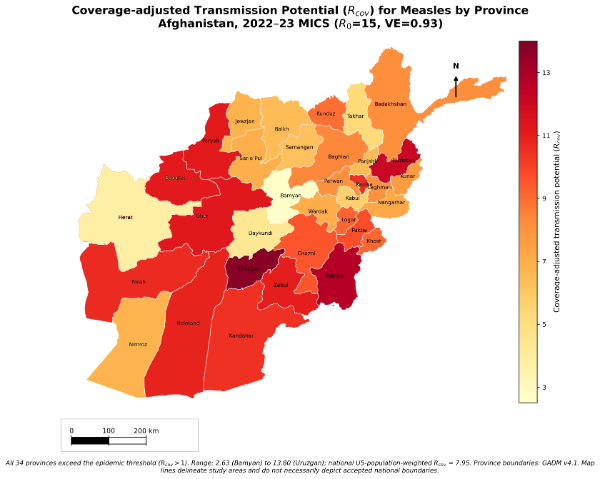
Coverage-adjusted measles transmission potential by province. Cropped from Figure 7A in Ranjan et al. (2026), Vaccine. All 34 provinces were above the model transmission threshold under the central assumptions.
Why two-dose coverage matters
Measles control requires unusually high population immunity.
Under our central assumptions, around 93% of the population would need to be immune to interrupt sustained transmission. A first dose of measles-containing vaccine provides strong individual protection, but it is not 100% effective. Taking that effectiveness into account, the theoretical one-dose coverage needed to reach the population-immunity threshold was 100.36%.
That is not a feasible coverage target.
A first dose remains highly valuable for individual protection. The calculation shows how little margin there is for incomplete vaccination when the virus is this transmissible.
Under the same assumptions, a complete two-dose series would need coverage of about 96.2% to reach the population-immunity threshold. The same survey reported second-dose coverage of 36.8% among children aged 24-35 months. Because the first- and second-dose indicators were measured in different age groups, they should not be read as a direct dropout rate. They do, however, show how far current coverage is from the level required for population protection.
For policy, the priority is to strengthen routine immunisation so that very high two-dose coverage can be achieved and maintained.
Reaching children missed by routine immunisation
Afghanistan has responded to measles outbreaks with large supplementary vaccination campaigns. In October and November 2025, a nationwide campaign vaccinated more than 16.6 million children aged six months to 10 years across all 34 provinces.
The key operational question is who those campaigns reach. If children missed by routine vaccination are also missed during campaigns, high overall campaign coverage can still leave important immunity gaps.
In an idealised scenario where doses could be directed first to children lacking protection from routine first-dose vaccination, the province-summed requirement was about 4.06 million children, or 49.8% of the modelled under-five population. When campaign reach was instead assumed to be random, regardless of previous protection, the requirement rose to about 7.53 million children, or 92.4%.
These scenarios make the effect of targeting clear. A campaign has the greatest impact when teams can find children who have not already gained protection through routine vaccination. When reach is distributed randomly, many doses go to children who are already protected, so much higher overall coverage is needed.
The province-level results tell a similar story. With 95% modelled random campaign reach, the national aggregate transmission measure fell below the model threshold, yet only 17 of Afghanistan's 34 provinces individually did so.
So a campaign can look successful nationally while some provinces remain vulnerable.
Immunisation resilience is a health-system issue
The findings also point back to the health system itself.
Reliable immunisation depends on stable financing, functioning facilities, regular outreach, trained health workers, access to remote communities and the ability to keep services running during political and economic disruption.
In Afghanistan, disruption to outreach and financing, together with constraints affecting the female health-worker cadre, provide important context for reduced vaccine access. Longstanding geographical and socioeconomic inequalities in maternal and child health services also mean that disruption is unlikely to affect every community equally.
Routine immunisation and supplementary campaigns do different jobs, and both are needed. Campaigns can close urgent immunity gaps, while routine services reduce the chance that those gaps reopen.
Sustainable measles control in Afghanistan will depend on sustained high two-dose routine coverage, supplementary campaigns that reach children who have been missed, and restoration of the immunisation-system capacity needed to deliver both.
A lesson beyond Afghanistan
The same problem is relevant in other fragile and conflict-affected settings. National coverage estimates can hide local vulnerability at the very time when health systems have the least capacity to absorb another outbreak.
Our analysis used information that is often available even when routine surveillance systems are under pressure: household vaccination surveys and subnational population estimates. Used carefully, these data can help identify places where immunity gaps may deserve greater preventive attention.
Our model was not designed to predict exactly where or when the next outbreak would occur. Vaccination coverage is only one part of the epidemiological picture; mobility, population displacement, campaign history, age-specific immunity and local contact patterns also shape transmission. We therefore treated the comparison with subsequent World Health Organization surveillance as a retrospective check on geographic patterns rather than as prospective validation of the model.
Subnational risk stratification can still be useful when epidemiological information is fragmented. It can help programmes identify vulnerable areas earlier and decide where preventive effort should be concentrated.
Measles outbreaks are often the visible endpoint of a much longer process: children are missed by routine services, immunity gaps accumulate, geographical inequalities deepen and, eventually, the virus encounters enough susceptible people to spread.
The practical challenge is to keep children within reach of routine services between crises. Doing that consistently is what stops immunity gaps from rebuilding after each campaign.
About the research
This blog draws on: Ranjan, R., Anwari, P., Colson, A. & van der Meer, R. (2026), Measles outbreak risk in Afghanistan: provincial immunity gaps and epidemic potential following immunisation system disruption, Vaccine, 91, 129078. Read the open-access paper.
The findings were also presented to colleagues at the WHO Regional Office for the Eastern Mediterranean (WHO EMRO), where we discussed their implications for measles control and immunisation policy in the region.
Contact: rajeev.ranjan@strath.ac.uk