Mediation in Civil Cases – current situation for high volume, lower value cases
By Charlie Irvine – posted on 12 March 2026
This blog post is a version of the speech given by Charlie Irvine at a special symposium on mediation in civil justice co-hosted by Strathclyde Mediation Clinic last week.
Introduction
Those of us who have been around mediation for a while got a pleasant surprise in autumn 2016. Following the “Gill” review and its discouraging words about encouraging mediation (discussed in my 2010 Edinburgh Law Review article), most of us had low expectations for the new Simple Procedure rules for money claims up to £5,000. And yet this piece of secondary legislation, for the first time in Scotland, laced consensual dispute resolution into a court procedure, from principles to responsibilities to judicial powers.
To illustrate, here are one of each:
- Principle: “Parties are to be encouraged to settle their disputes by negotiation or alternative dispute resolution, and should be able to do so throughout the progress of a case.” Rule 1.2 (4)
- Responsibility: “The sheriff must encourage cases to be resolved by negotiation or alternative dispute resolution, where possible.” Rule 1.4 (3)
- Power: “The sheriff may do anything or give any order considered necessary to encourage negotiation or alternative dispute resolution between the parties.” Rule 1.8 (2)
While the amounts at stake are relatively modest, these disputes matter hugely to the people involved; this is also the largest single category of civil cases (drawing on Courts Data Scotland: Civil, 2025-26 (on file with author), highlighting 29,962 Simple Procedure cases compared to 21,398 Ordinary Cause cases). Unlike many jurisdictions, nothing like this had ever been attempted before. The Ordinary Cause rules, for higher value cases, are almost silent about alternatives to a hearing.
What happens when the rules encourage alternative dispute resolution?
As Director of University of Strathclyde Mediation Clinic, I learned a simple truth: judges respect rules. The Clinic had been providing mediation in a couple of courts since 2014, but each occasion relied on the sheriff’s discretion. Some encouraged mediation while others saw no reason to mention us. This changed as soon as Simple Procedure was published, and we were approached by two Sheriffs Principal asking if we could help them fulfil their duties under the rules. Some individual sheriffs were early adopters, with one devising a process designed to maximise the prospects of resolution:
- Mediators present at Case Management Discussion (in a rather grand court);
- An announcement that “we have expert mediators in court today”;
- Case-by-case briefing to parties on the court process – onus of proof, evidential requirements (including expert reports), and aspects of the claim unlikely to be upheld;
- Parties invited to step outside and speak to mediators; if they choose not to participate the court will arrange an evidential hearing;
- Mediation taking place straight away;
- Post-mediation – parties appear before the bench and confirm that settlement has been reached.
The change and growth following these new rules is best illustrated graphically:
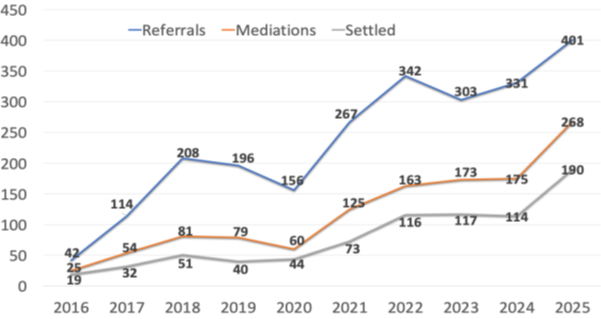
Strathclyde Mediation Clinic - Cases referred, mediated and settled 2014-2025
Key moments to note:
- Rapid increase after new rules came into force in 2017
- Slight reduction early in the pandemic, followed by another rapid increase as online mediation extended geographical coverage to half of Scotland’s courts
- Further increases reflecting government funding and extending the service to more sheriffdoms and courts (35 of 39 by 2024)
Lessons learned
Closer examination of the figures reveals two important truths for anyone seeking to integrate mediation into the civil justice system.
1. Change takes time
Whenever mediation is rolled out to a new sheriffdom we see relatively low rates of uptake and settlement in the first year or two. As the name suggests, the justice system is indeed a system; courts, lawyers, advice agencies and litigants all play their part. Systems adapt incrementally. Key gatekeepers like judges and advisors need evidence that a novel approach is working, and that takes time to accumulate.
At the risk of sounding negative, most people would rather stick pins in their eyes than negotiate face-to-face with their adversary, even on a screen. Settlements tend to come as a pleasant surprise, particularly for those new to mediation. We’ve noticed that after a while sheriffs start to speak positively about mediation, followed by lawyers and other advisors; at some point it reaches a steady state, where all involved come to expect and anticipate it as a necessary step in the litigation process.
2. Judicial encouragement is key
To retrace my steps a little, here is my lived experience of mediation in civil justice:
- Rules influence judicial behaviour
- Judicial behaviour influences advisors (and self-represented parties)
- Advisors influence their clients
- More cases are referred to mediation and settle
- Settlements reinforce judicial behaviour
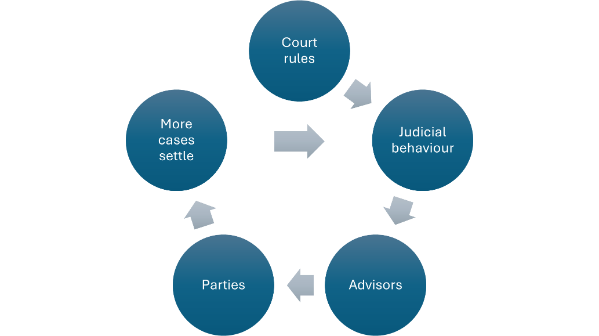
Across 35 courts we can see a similar pattern playing out. Judicial encouragement legitimises efforts to resolve the matter. Advisors, including lawyers and agencies, start to view mediation less as an unusual diversion from the standard route to a hearing and more as a default process through which little is lost and a great deal of time, expense and risk can be saved. Parties tend to view mediation, especially online, as a helpful, convenient and less daunting way to bring their dispute to a close.
To summarise, after 12 years of working with the courts, I have formed this view: justice is best served when courts and mediators work in partnership, helping parties navigate their way through civil disputes to achieve just and sustainable outcomes.
Next steps for Scotland
Applying these principles across the Scottish justice landscape, the next step seems rather obvious: similar rule change for higher value cases. The group organising this symposium has recently drafted a proposal to introduce into the Ordinary Cause rules the same principles and powers as under Simple Procedure. Instead of every case being heading inexorably towards proof (or settlement on the steps of the court) sheriffs would have the option of encouraging “expeditious resolution by negotiation, mediation or other form of non-court dispute resolution.”
It is not difficult to imagine a similar step being taken for the Court of Session rules, lacing consensual dispute resolution into that procedure in the interests of justice. The examples we have heard today from other jurisdictions offer encouragement, and I sincerely hope Scotland moves towards this vision, inspired by my research into the justice thinking of Simple Procedure mediation parties:
“Justice is best served when courts and mediators work in partnership, helping parties navigate their way through legal cases to achieve just and sustainable outcomes.”