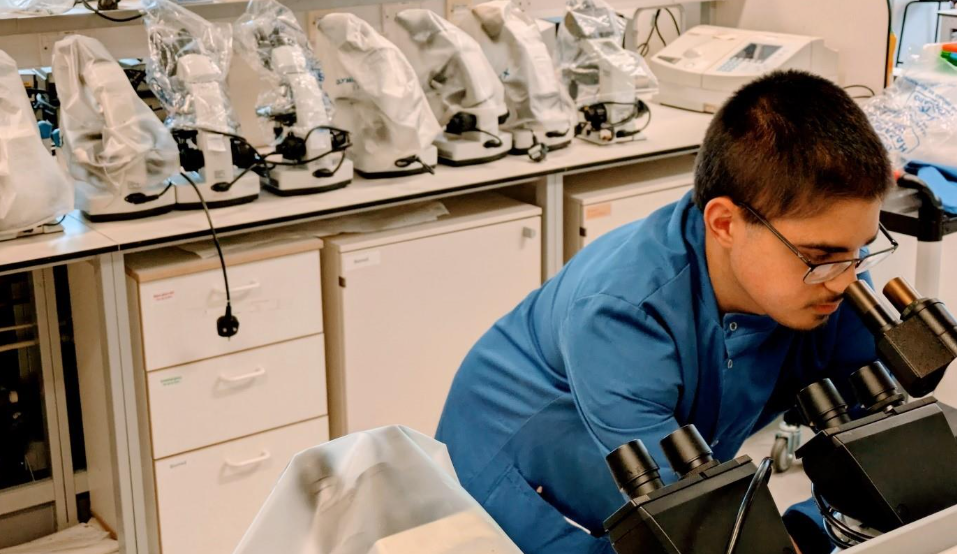
Name: Fuaad Schuurmans
Role within SIPBS: Technician
What inspired you to pursue this career initially?
I think it was when I was a student at Strathclyde doing all of the labs myself. I really enjoyed doing the experiments and always found them mentally stimulating. It was good to be able to learn these new techniques, for example, microbiological techniques and improve my laboratory skills. So, when I saw the advertised technician role at Strathclyde I thought I could bring my experience as someone who's graduated from those labs to help other students to get the most out of them.
Can you walk me through your career journey so far?
I'd just graduated high school, and vaccines were a big thing at that time and so that attracted me to the Biomolecular Science degrees at Strathclyde. I found it to be a good opportunity because the programme offers experience across four different disciplines: immunology, biochemistry, pharmacology, and microbiology. When it came to the fourth year, I had to specialise and I decided to choose microbiology and pharmacology, and that was the joint honours degree I graduated with.
What does a typical day or week look like for you?
Well, during semester time, of course, we are always preparing for teaching labs so that includes any material which need to be made up. For example, making broths and cultures for microbiology labs, or reagents for PCR labs. Once those are set up then the day of the lab comes and you are guiding and helping the students through the lab protocols and answering their questions, particularly relating to specialised techniques or helping them refine their laboratory skills. That's the main part of the job. I also have a research floor management role that covers safety procedures and helping with space allocation.
Which tasks do you enjoy most—and which do you find most challenging?
I always find the microbiology labs the most interesting - and sometimes the most challenging -because sometimes your culture just won’t behave and you're just trying to figure out whether it is the culture or the media causing the problem. I like that the teaching lab material is always evolving meaning that we have to figure out how to make it work well to provide the best experience for the students.
What advice would you give someone starting out in your role?
I would say definitely be proactive in your work - if you have any chances to get further experience then go for it. If there are any questions you have then you should not be afraid to ask for help or advice from colleagues. Increasing your knowledge always helps when it comes to understanding the background and running of labs. You can find a new way to optimise or improve them, giving students an even better experience.