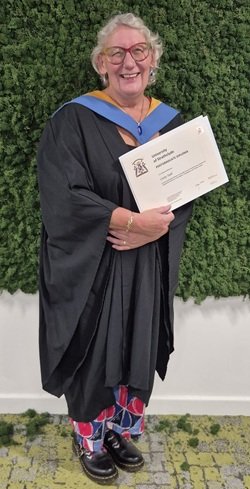
Why did you choose to study at the University of Strathclyde?
Genealogy taster sessions via Future Learn were a great introduction to the Centre for Lifelong Learning at Strathclyde. I liked the ethos and inclusive values demonstrated to attract all levels of experience.
As a distance learning programme, with flexible options, the part time MSc route enabled me to combine employment in Higher Education and study as a mature student.
I took a leap of faith to fulfil a long standing personal goal. I wanted to develop the research skills and knowledge to conduct my own and others’ family history, with confidence and professionalism.
What did you enjoy most about your course?
The content and materials were excellent. My knowledge, skills and understanding were increased immeasurably. I was most engaged by the social history aspect, chronology of events and the psychological impact of genealogical research. I particularly enjoyed a greater awareness of immigration and emigration records, and how this diversity continues to shape cultures, communities and countries.
I enjoyed connecting with others with a passion for Genealogy. The on line group work tasks enabled strengths to shine, mutual support and to learn from one another.
My Diploma Project researched the Foundation Children admitted to the West of England Institution for the Instruction of the Deaf and Dumb in Exeter, from 1827 to 1841. This involved visits into the Devon Archives, to access and photograph original documents, which I absolutely loved. The 200 year bicentennial celebrations of the present Deaf Academy are underway. It is fantastic to be able to contribute and share what happened to those first pupils with current staff and students.
Some of the best moments have been through the conferences, study visits and access to bespoke events. These gave excellent insight and greater understanding of the enormous range of resources, archives and collections available both in Britain and further afield. I continue to engage with the online SIGS Spotlight talks and am excited to attend both the Professional Genealogy Symposium and Academic Conference in June 2026, In Glasgow.
What advice would you give to a prospective student coming to study your course?
Consider carefully your wellbeing, energy, work and time commitments. I embarked upon the Part Time MSc route which proved a challenge in the second year. Unforeseen personal circumstances interrupted my focus and time management. The Course Leaders were excellent in their support, and flexibility enabled me to complete my Diploma studies.
What specialist knowledge/professional skills have you developed studying your course?
The genealogical and palaeographic skills specifically. Knowledge of how to access the vast resources, collections and archives in the UK, Ireland, Europe and countries such Australia, New Zealand, Canada, India and the USA . An appreciation of how records have been lost, moved, destroyed or yet undiscovered.
The course acknowledged the speed of technological advances in DNA and Artificial Intelligence. Awareness of these subjects is critical when engaged with genealogical research, as it may present offer both highly positive outcomes and extreme challenges.
I gained perspective on my strengths and boundaries of my expertise, enabling me to go forward with what I enjoy most – working and communicating with others to achieve a positive experience, whether in the form of a conversation, presentation or a genealogical report.
How is your course helping to enhance your current career and prepare you for your future career?
The Diploma expands my existing freelance portfolio and entitles full membership to the Register of Qualified Genealogists (QG).
Following the completion of my Diploma, I volunteered in a Study to explore the impact of Family History and Wellbeing. This was a joint initiative between the Centre for Lifelong Learning , the Department of Psychological Sciences and representatives from YourTour. It was a fantastic employability opportunity to apply the learning from the Programme. As a result of this participation, I have joined the YourTour team, as well as undertaking private commissions.
What are your ambitions for the future and how do you think your time at Strathclyde will help you achieve your goals?
My ambitions are to maintain my networks and contacts established through the Strathclyde community. My goal is to draw upon my life and professional experiences as a disability practitioner and trainer to offer bespoke and inclusive research services for the D/deaf or Blind / Partially sighted persons, or for anyone unable to access resources independently.
Any final points, or words of wisdom?
At times, the academic demands of study felt overwhelming alongside other commitments. Make use of all the on line academic and pastoral support mechanisms if you need to. Enjoy getting to know others and remember it’s not a race – the journey may be harder than anticipated. I learned as much from my mistakes, but the sense of achievement was worth the sacrifices.