Adapting to a changing climate using innovative, socially just interventions
Introduction
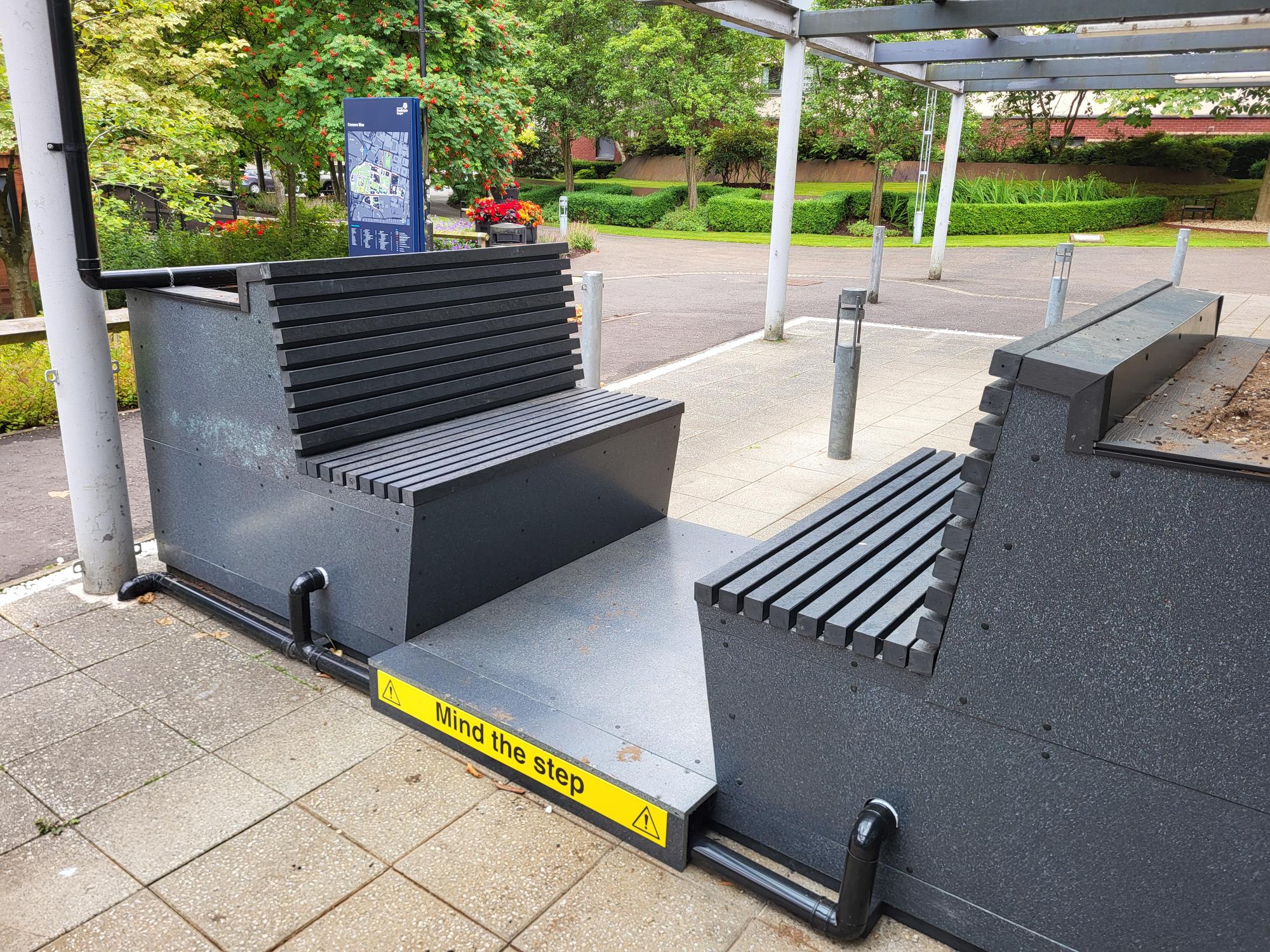
Sustainable Strathclyde has partnered with Sustainable Hope CIC and Civic Engineers to design, build and implement a pioneering Raingarden Parklet; an initiative adaptation intervention that will help build resilience to climate shocks while delivering other benefits, and aligns closely with the University’s strengths in innovation, engineering, and applied research.
The parklet was part-funded by Scottish Government through the Climate Ready Clyde network, who were awarded funding to support adaptation projects and delivery in the region.
What is a Raingarden parklet?
The Raingarden Parklet is an innovative piece of Green Urban Infrastructure designed, created, and built in Glasgow. It represents a new approach to addressing climate resilience in cities, primarily through water attenuation, while simultaneously creating social value through education, training, and pathways into green jobs.
Raingarden Parklets respond to multiple urban challenges:
- Climate resilience – capturing stormwater during heavy downpours, easing pressure on drainage, and reducing flood risk, contributing to “sponge city” principles
- Urban wellbeing – creating resting places, enhancing streetscapes, and providing accessible green space
- Durability and sustainability – constructed from recycled and circular materials, overcoming the short lifespan of timber street furniture
- Visibility and engagement – making climate adaptation solutions visible, understandable, and valued in public spaces.
Beyond their core function, the Raingarden Parklets act as innovation platforms, capable of integrating air quality sensors, bike parking, renewable energy features, street art, and community uses.
Socially Progressive
The Raingarden Parklet initiative is rooted in the principles of the Just Transition – ensuring that the shift to a Net Zero economy creates opportunity, reduces inequality, and leaves no one behind.
Following a successful pilot, the hope will be to scale up the use of Raingarden Pilots across the University campus and beyond. Future aspirations include:
- Working with prisons: Future parklets will be built in partnership with HMP Barlinnie. Working with the Scottish Prison Service to involve prisoners in design, construction, and horticulture, building skills and confidence that can help create pathways to meaningful work on release.
- Skills and inclusion: Supporting people from disadvantaged backgrounds through hands-on training in sustainable construction and green infrastructure.
- Pathways to employment: Linking training to real-world opportunities in the growing Net Zero economy.
- Community engagement: Delivering workshops and educational opportunities that connect schools, universities, and local residents to tangible sustainability solutions.
By working with prisons and community groups, as well as our own University community, the Raingarden Parklet demonstrates how environmental innovation can be a tool for social justice, offering new skills, hope, and opportunities to those often excluded from the green economy.
Adaptation Teaching & Research
The Raingarden Parklet provides a unique live teaching and research platform. Several thematic opportunities are actively being explored for student and research projects, including Design & Engineering, Materials Science, Low-carbon Construction & Manufacturing, Horticulture & Biodiversity, Data & Digital Innovation, Social Research and Market Development.
Raingarden Research Hub
The Raingarden Parklet was at the centre of a recent successful research bid through the Strathclyde RKEI Culture Network Collaborative Cultures Development Fund.
Using the parklet as a focal point, the project will build a multidisciplinary Raingarden Research Hub (RRH) that uses the University's pioneering raingarden parklet as a living laboratory for research, teaching, climate adaptation, biodiversity enhancement, and civic engagement. The project will create a digital collaboration platform that stimulates new student and academic research projects, strengthens interdisciplinary working, and creates a lasting institutional legacy.
The RRH will bring people together to enhance research culture and innovation, delivering a wide range of benefits to the University and beyond, covering research, teaching and learning, lived experience and climate adaptation and resilience. It will leave a positive legacy demonstrating how multi-organisational pilot projects can deliver lasting change and impact and can be used to showcase the University’s ambitious and bold aims.
Get in touch
For more information or to get involved in any of the University’s adaptation work, please contact liam.singleton@strath.ac.uk.