2024 - 25 winners
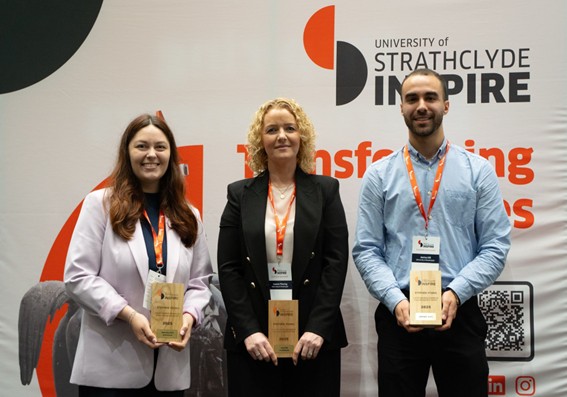
There were three awardees in 2024-2025 who each received £50,000 to support the development of their idea.
Rapisense
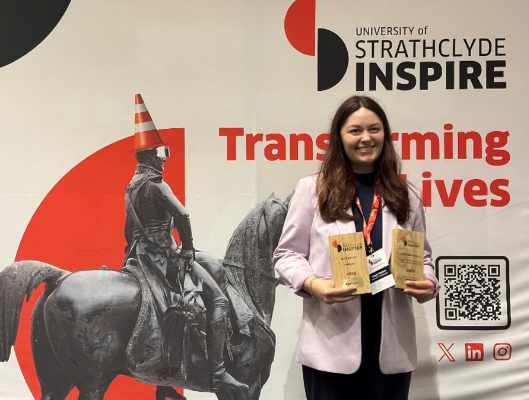
Dr Maggie Raykova from Civil and Environmental Engineering received an award for her proposition which develops advanced sensors to automatically detect tiny contaminants in milk and other samples. One of the biggest global health risks today is antimicrobial resistance, where bacteria become resistant to antibiotics and medicines, making infections harder to treat. Dr Raykova’s research on faster detection of antibiotic residues to catch contaminants early and thus reduce the spread of resistant bacteria, has significant implications for a range of industries.
Dr. Raykova is a Research Fellow leading an exciting pre-spinout called Rapisense. Rapisense aims to address contamination control across dairy, agriculture, food safety and animal health. Their technology will help to reduce waste, protect the environment, and support safer, more sustainable food production.
"We are honoured to receive this Stephen Young award which has been a transformative milestone for Rapisense. The recognition of our vision and support have come at a pivotal time as we work to commercialise our technology and move closer to a viable product. This funding is enabling us to accelerate product development, strengthen industry collaborations, and run pilot trials of our technology with our dairy industry partners."
Dr Magdalena Raykova
Addressing chronic insomnia
Professor Leanne Fleming from the Department of Psychological Sciences and Health was awarded for her solution that will support individuals living with chronic insomnia. The proposition provides a cost-effective training model to improve access to in-person Cognitive Behavioural Therapy.
Prof. Fleming’s research is on the causes and non-pharmacological management of insomnia disorder. The research examines the interaction between insomnia and mental health and physical health. Her research has a particular focus on supporting people living with cancer to sleep well during and beyond cancer treatment.
Prof. Fleming established the Strathclyde Sleep Centre at University of Strathclyde. Its mission is to encourage the prioritisation of sleep as a key component of health by conducting rigorous research, developing impactful treatments and shaping public awareness and policy.
Non-destructive testing of high-value components in manufacturing
Amine Hifi from the Department of Electronic and Electrical Engineering received an award for his solution that provides testing in the manufacturing industry. Non-destructive testing (NDT) of high-value components is commonly regarded as a bottleneck in the sector. The solution is an interactive system that provides a single platform for exploring and analysing NDT data, integrating conventional signal processing techniques with AI-driven defect detection algorithms. This enables real-time deployment and automated or semi-automated reporting, presenting results with confidence levels to help increase trust in the process.
The solution can be implemented across a variety of robotic configurations and offers a modular workflow that ranges from manual inspection, through AI-assisted operation, to full automation. This flexibility delivers faster, more accurate analyses, significant time and cost savings, and has been proven on both composite and additively manufactured materials—making it material agnostic and suited to diverse NDT inspection scenarios.
"This award will be extremely beneficial for the future of the business. It will support development of the existing demonstrator, allowing us to move closer to a market-ready product. And it will be key in helping strengthen the business case by engaging with a commercial champion and gaining guidance and technical input from experienced software developers and consultants as the business moves towards a commercial ready solution."
Amine Hifi