

MSc Cyber Security
ApplyKey facts
- Start date: September
- Application deadline: Application deadlines for international students for September 2026 entry
- Study mode and duration: 12 months full-time
Study with us
Our MSc Cyber Security is ideal for computer science graduates, with or without industry experience, who are prepared to build a skill set suitable for a profession in cyber security. Through this Masters degree you'll:
- understand how to transform employees into cyber security assets by understanding the central role of people in the cyber security landscape
- place yourself at the forefront of expertise when it comes to secure programming, networking and system design
- gain project-driven experience of tools and methods appropriate for understanding and addressing emerging cyber threats
The Place of Useful Learning
UK University of the Year
Daily Mail University of the Year Awards 2026
Scottish University of the Year
The Sunday Times' Good University Guide 2026
Why this course?
What's special about the MSc in Cyber Security offered by Strathclyde is its depth of and breadth of coverage of the cyber security landscape.
Cyber security problems cannot be truly understood solely from a technical or sociological perspective. Cyber security experts should shift perspectives between attackers and defenders, identify human factors, economic motives, and operate within regulatory constraints.
The course will create new cyber security leaders capable of formulating their own abstractions which enable them to manage conceptually the infinite range of attack vectors that increasingly sophisticated actors may attempt to exploit.
From day one, students will go deep into parallel tracks with world-leading experts in threat modelling and secure programming, human-centric security, and network security. This takes student and lecturers together on an adventure deep into specialised topics. At the same time, students will reflect on the bigger picture, appreciating how each skill set earned is just one perspective required to face the realities of mitigating cyberattacks.
Engage with industry
Throughout the course, we offer opportunities to engage with industry through IT careers fairs, guest lectures from local industry, industrially sponsored projects, specialist sessions from our Careers & Employability Service and student demo days to industry.


What you'll study
This one-year MSc in Cyber Security admits students in September.
There are two taught semesters with 10 weeks of contact time plus one week of revision for exams. You'll conduct an MSc dissertation due in August of the year following admission. This Cyber Security MSc is delivered in person.
The degree features three major tracks that reflect the breadth of knowledge required to address cyber security challenges, at the level of programs, networks and the people who use them. The three tracks run across the two taught semesters:
- Human Centred Security underscores that security problems cannot be solved by technological solutions alone, and that we can measure how best to transform people in the chain from security problems to security assets
- Information Security & Networking covers the essential core knowledge and practicalities of securing networked systems, by the end of which students will have mastered a range of tools for testing networks for vulnerabilities
- Security by Design introduces students to methods that can mitigate cyber threats in protocols and programs at design time, by employing advanced techniques developed by security and programming language researchers
The above tracks aim to bring you to the cutting edge of each topic. You'll be prepared for projects in the area of cyber security that interests you most and will have the confidence to explore problems from an interdisciplinary perspective.

Learning & teaching
Classes are delivered via lectures, labs, and online material. In some classes, students will collaborate in small groups. They will engage in hands-on exercises within computer laboratories, receiving support from both a lecturer and lab assistants. For both lectures and labs, instructional and support materials will be placed on our virtual learning environment, MyPlace, for 24/7 student access.
Assessment
The course is strategically structured to ensure a balanced assessment throughout the two taught semesters. Each semester incorporates diverse study modes. Specifically, modules with a human-centric focus relies heavily on in-class presentations for assessment, while technical modules emphasise an end-of-semester examination. The remaining modules incorporate ongoing assessment through practical laboratory exercises. In the third semester, students submit their dissertation, conducted under the supervision of a leading security expert.
Information Security Fundamentals (10 credits)
This module introduces the core concepts of information security — vulnerability, threat, attack, exploit, control, risk and residual risk — and shows how they come together through the two central security mechanisms, access control and cryptography, within the wider organisational context of security culture, policy, standards and business resilience.
By the end of the module you will be able to:
- articulate the meaning of information security, its key concepts, and how they apply to a given organisation
- explain how access control, authentication and encryption combine to meet information security requirements, taking into account an organisation's context and known exploits
- understand how information security is managed in line with international standards and regulation
- select and apply standard industry techniques to manage information security risk within an organisation
- build confidence with the fundamental practicalities of networking and cryptography
Along the way, you'll develop the transferable skills to confidently articulate and contextualise complex concepts, and to use tools that automate security tasks.
Advanced Human Centred Security (20 credits)
Technology alone cannot secure today's digital world—people play a critical role in every cyber security challenge. This module explores how human behaviour, psychology, and organisational factors influence cyber security, helping you understand why attacks succeed and how security can be designed around the needs of real users.
You'll investigate topics such as social engineering, phishing, usable authentication, privacy, security awareness, insider threats, and the human implications of emerging technologies, including AI. Through real-world case studies and practical problem-solving, you'll learn to analyse complex socio-technical security challenges and develop solutions that are secure, usable, and resilient.
By combining insights from cyber security, human-computer interaction, behavioural science, and design, this module equips you with highly sought-after skills for developing security technologies, influencing organisational security practices, and creating user-centred solutions that make a measurable impact in industry and research.
Security Protocols & Threat Models (20 credits)
This module uses powerful concepts and tools to identify vulnerabilities in security protocols and formal methods for eliminating such vulnerabilities. By the end of the module you will be able to:
- identify key features of security protocols and represent those features using message sequence charts and processes
- understand how protocols are critical for a range of networked systems, including wired systems such as the Web, and wireless systems such as smartcards
- precisely formulate security and privacy properties such as secrecy, authentication, unlinkability, and anonymity
- deploy tools that can uncover vulnerabilities in protocols before they are exposed to attackers
Legal, Ethical and Professional Issues for the Information Society (10 credits)
This module aims to ensure that you are aware of the legal, social, ethical and professional issues that are of relevance to computing professionals. By the end of the module you will be able to:
- understand the role and impact of ICTs on society including cybercrime and digital evidence
- understand the relevance to computing professions of laws and statutes such as intellectual property law, Freedom of Information, Data Protection Act, Computer Misuse Act, health and safety legislation, industrial relations legislation, public liability, employer liability
- appreciate the characteristics of professionalism as it relates to modern data management including: codes of practice and competence; the role of the professional body; ethical practice; appreciation of business practices and change management; duties to client, employer and public; professional responsibilities; involvement in continuing education and professional development
Vulnerability Assessment & Security Testing (20 credits)
In this hands-on module, you will learn how real vulnerabilities hide in modern applications and how to find, exploit, and report them. Built in line with industry practice, you will use the same tools and methodologies used in the field to uncover weaknesses that could allow unauthorised entry or take down system availability if left unpatched. By the end of this module, you will be able to:
- develop an understanding of vulnerability types, and security testing methodologies
- conduct vulnerability assessments using industry-standard tools and proven methodologies
- run penetration tests on systems and applications to identify critical security weaknesses
- understand the legal and ethical issues in security testing
- assess the risk associated with each finding and suggest practical steps to reduce potential harm
Advanced Security-by-Design (20 credits)
This module aims to equip you with an understanding of how formal methods can be applied at design time to address software security issues. By using mathematically grounded techniques, you will learn how to eliminate common classes of vulnerabilities, ensure program correctness, and enable more focused testing of other system aspects.
Research Topics in Cyber Security (10 credits)
This module lets you engage directly with cutting-edge cyber security research, diving deep into two topic areas of your own choosing — with a particular focus on human-centred security, covering areas such as usable security and cybercrime — while getting a broader view of the field through your peers' presentations. By the end of this module, you will be able to:
- read, understand, analyse and evaluate top academic papers in cyber security
- clearly and concisely communicate research topics to peers and colleagues, through both written reports and presentations
- create new topics and questions for discussion by identifying gaps and potential improvements in the current research literature
- place research topics in their historical and current context, and critique them effectively
Along the way, you'll build lifelong learning skills and develop your verbal communication, written communication, and critical analysis and critique.
Research Methods (10 credits)
This module prepares you for your individual 60 credit research project in Semester 3. During this module you prepare your research proposal.
Individual Project (60 credits)
You will undertake an individual project under supervision, which should contain an element of original research. The project will be cyber security based. A variety of project types are possible. Where software is developed, assessment will include production of developed code, supporting written documentation, and practical demonstration.
Chat to a student ambassador
Want to know more about what it’s like to be a Science student at the University of Strathclyde? A selection of our current students are here to help!
Our Unibuddy ambassadors can answer all your questions about courses and studying at Strathclyde and offer insight into their experiences of life in Glasgow and Scotland.
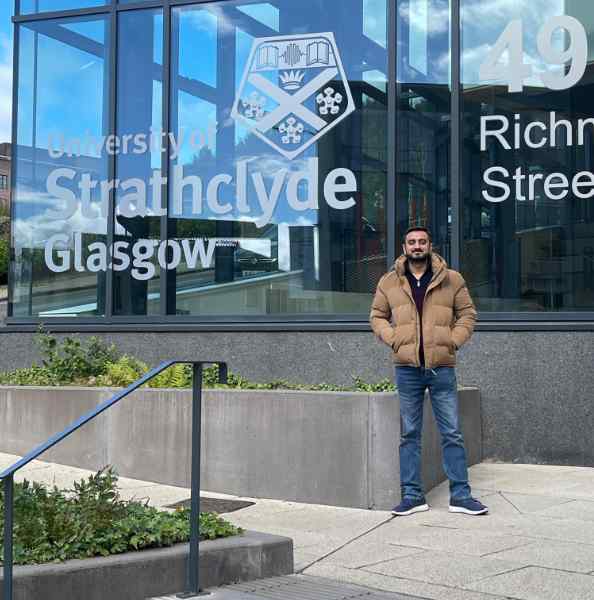
My course prepared me by giving me both technical depth and critical thinking skills. Strathclyde didn’t just teach theory; it emphasised real-world scenarios, research, ethical considerations, and teamwork. Assignments, presentations, and group projects mirrored industry expectations.
MSc Cyber Security graduate
International students
We've a thriving international community with students coming here to study from over 140 countries across the world. Find out all you need to know about studying in Glasgow at Strathclyde and hear from students about their experiences.

Entry requirements
| Academic requirements | Applicants require, at a minimum, a second-class (2:2) honours degree or international equivalent in computer science or a closely related discipline. Significant programming experience is required. If you come from a closely related subject, you would be expected to have experience in the following areas:
|
|---|---|
| English language requirements | You must have an English language minimum score of IELTS 6.0 (with no component below 5.5). We offer comprehensive English language courses for students whose IELTS scores are below 6.0. Please see English Language Teaching for full details. As a university, we now accept many more English language tests other than IELTS for overseas applicants, for example, TOEFL and PTE Cambridge. View the full list of accepted English language tests here. |
Pre-Masters preparation course
The Pre-Masters Programme is a preparation course held at the University of Strathclyde International Study Centre, for international students (non-UK/Ireland) who do not meet the academic entry requirements for a Masters degree at University of Strathclyde.
Upon successful completion, you'll be able to progress to this degree course at the University of Strathclyde.
Fees & funding
Fees may be subject to updates to maintain accuracy. Tuition fees will be notified in your offer letter.
All fees are in £ sterling, unless otherwise stated, and may be subject to revision.
Annual revision of fees
Students on programmes of study of more than one year (or studying standalone modules) should be aware that the majority of fees will increase annually. The University will take a range of factors into account, including, but not limited to, UK inflation, changes in delivery costs and changes in Scottish and/or UK Government funding. Changes in fees will be published on the University website in October each year for the following year of study. Any annual increase will not exceed 10%, and in practice this may be lower (for example,. a 6% increase was applied in 2027/28 academic year).
| Scotland | £12,550 |
|---|---|
| England, Wales & Northern Ireland | £12,550 |
| Republic of Ireland |
If you are an Irish citizen and have been ordinary resident in the Republic of Ireland for the three years prior to the relevant date, and will be coming to Scotland for Educational purposes only, you will meet the criteria of England, Wales & Northern Ireland fee status. For more information and advice on tuition fee status, you can visit the UKCISA - International student advice and guidance - Scotland: fee status webpage. Find out more about the University of Strathclyde's fee assessments process. |
| International | £30,300 |
| Additional costs | If you are an international student, you may have associated visa and immigration costs. Please see student visa guidance for more information. |
| Available scholarships | Take a look at our scholarships search for funding opportunities. |
How can I fund my course?
Scottish postgraduate students
Scottish postgraduate students may be able to apply for support from the Student Awards Agency Scotland (SAAS). The support is in the form of a tuition fee loan and for eligible students, a living cost loan. Find out more about the support and how to apply.
Don’t forget to check our scholarship search for more help with fees and funding.
Students coming from England
Students ordinarily resident in England may be to apply for postgraduate support from Student Finance England. The support is a loan of up to £10,280 which can be used for both tuition fees and living costs. Find out more about the support and how to apply.
Don’t forget to check our scholarship search for more help with fees and funding.
Students coming from Wales
Students ordinarily resident in Wales may be to apply for postgraduate support from Student Finance Wales. The support is a loan of up to £10,280 which can be used for both tuition fees and living costs. Find out more about the support and how to apply.
Don’t forget to check our scholarship search for more help with fees and funding.
Students coming from Northern Ireland
Postgraduate students who are ordinarily resident in Northern Ireland may be able to apply for support from Student Finance Northern Ireland. The support is a tuition fee loan of up to £5,500. Find out more about the support and how to apply.
Don’t forget to check our scholarship search for more help with fees and funding.
International students
We've a large range of scholarships available to help you fund your studies. Check our scholarship search for more help with fees and funding.
Careers
It is well-known there is a shortage of skilled cyber security professionals, indeed most medium to large companies now have a dedicated cyber security team. Particularly in sectors such as finance and critical infrastructure the cyber security teams play a central role in the business model of the organisation. The university provides career advice through specialist industry-specific career sessions from our award-winning Careers Service. There is also an IT careers fair.
In addition, there will be peer support via the parallel Graduate Apprenticeship (GA) in Cyber Security. Students taking the GA are employed in cyber security roles in a range of companies across Scotland. Information sharing will be facilitated between GA students and students taking the MSc in Cyber Security for additional first-hand experience of the market entry points.
The MSc also caters for students aiming to follow up their MSc with a PhD pursuing inspiring research in cyber security. During the Cyber Security MSc, students will be guided deep into the areas of expertise of lecturers, such that they may be guided towards an MSc dissertation disseminating meaningful and impactful results. Students discovering a passion for conducting and writing about research can expect to receive direct support and advice concerning how to go about pursuing a PhD in cyber security.
Start date: Sep 2026
Cyber Security
Start date: Sep 2027
Cyber Security
Glasgow is Scotland's biggest & most cosmopolitan city
Our campus is based right in the very heart of Glasgow. We're in the city centre, next to the Merchant City, both of which are great locations for sightseeing, shopping and socialising alongside your studies.
Contact us
Have you considered?
We've a range of postgraduate taught and Masters courses similar to this one which may also be of interest.