
MSc Applied Gender Studies
ApplyKey facts
- Start date: September
- Application deadline: Application deadlines for international students for September 2026 entry
- Study mode and duration: 12 months full-time; 24 months part-time
Placement: Research placement
Study with us
- develop analytical and practical skills to engage with contemporary gender issues
- undertake research placements in the feminist third sector and with organisations committed to gender equality in education, arts sports and culture
- study how gender ‘works’ in relation to other structural inequalities such as race, sexuality, class and disability
Looking to find out more about this course? View our MSc Applied Gender Studies information session recording.
The Place of Useful Learning
UK University of the Year
Daily Mail University of the Year Awards 2026
Scottish University of the Year
The Sunday Times' Good University Guide 2026
Why this course?
This programme will equip you with an interdisciplinary understanding of gender and its intersection with other forms of inequality, including race, sexuality, class, and disability. You will develop knowledge, understanding and practical skills that will prepare you for further research or a variety of career paths, including the charitable sector, government, education, the civil service or heritage. The programme will also suit people working in these and other sectors who wish to gain further knowledge and skills in Gender Studies.
There are two routes available for this programme.
The MSc Applied Gender Studies route will allow you to explore key topics in gender theory, queer theory and feminist histories, as well as giving you a strong grounding in feminist research methods. This route is suitable for students considering a range of careers or further research in the Humanities.
The MSc Applied Gender Studies (Research Methods) route is strongly focused on social research methods in gender studies, providing the training necessary for further research in the Social Sciences.
This course has a particular emphasis on the impact of Gender Studies in the wider world. Our Research Placement module gives you the opportunity to gain first-hand experience working on a research project with an external organisation. We have strong links with a range of organisations in the feminist third sector, the arts, sport, and culture.


Interested in postgraduate study?
At the Faculty of Humanities and Social Sciences, our friendly and knowledgeable team will be available to provide you with all the information you need to kick-start your postgraduate journey at the University of Strathclyde. Register for upcoming events below:
What you’ll study
The MSc Applied Gender Studies is available as both a one-year, full-time programme or a two-year, part-time programme. Students follow either the broad-based Applied Gender Studies route or the Research Methods route, depending on their methodological interests. Both routes combine interdisciplinary Gender Studies with feminist research training and independent research culminating in a supervised dissertation.
Semester 1: Foundations in Gender Studies
All students begin by developing a shared foundation in Gender Studies and feminist research. Understanding how feminist theory, research and activism has developed over time is a key element of the degree, and our core research methods module includes a visit to Glasgow Women’s Library to learn about feminist archiving and work with their collections.
Applied Gender Studies route
- Understanding Gender
- Feminist Knowledge, Feminist Research
- one optional module
Research Methods route
- Feminist Knowledge, Feminist Research
- Quantitative Methods
- Perspectives on Social Research
Semester 2: Developing specialisms
Students deepen their engagement with feminist debates and refine their research orientation. The focus here differs slightly between the two routes.
Applied Gender Studies route
- Feminisms: Continuity and Change
- two optional modules
Research Methods route
- Advanced Topics in Gender Studies or Feminisms: Continuity and Change
- Qualitative Methods
- one optional module
Optional modules are drawn from a range of disciplines and vary each year, reflecting the interdisciplinary nature of Gender Studies at Strathclyde.
Semester 3: Dissertation
All students complete a Gender Studies dissertation, which is an independent research project supervised by academic staff. The dissertation allows you to apply feminist theory and research approaches from your chosen route to a topic aligned with your academic interests and future goals.
Study routes
Whichever route you choose, you will complete an independent research project, with the two pathways differing in their methodological emphasis and overall structure.
Applied Gender Studies route
The broad-based Applied Gender Studies route offers a broader humanities-informed pathway through Gender Studies, with greater flexibility to choose optional modules that vary each year. While this route also includes training in feminist research methods, it allows more space to explore theoretical, cultural, historical, and interdisciplinary approaches to gender.
Research Methods route
The Research Methods route is particularly suited to students who are interested in social science-oriented research, such as policy analysis, evaluation, or empirical studies of social inequality. This route provides more sustained and structured training in qualitative and quantitative research methods, alongside core teaching in Gender Studies. To make space for this methodological training, students take fewer optional modules.
Part-time route
The part-time route follows the same curriculum as the full-time MSc, with students completing the degree over 24 months. There is a degree of flexibility over which semester part-time students take their optional modules, allowing students to plan their studies around other commitments.
Research placement
The Research Placement option provides students with the opportunity to put their Gender Studies learning and research training into practice in the wider world.
Students conduct a piece of research according to a brief produced in consultation with the host organisation.
The course team have established links with potential placement providers - in Glasgow and beyond - from the feminist third sector and a range of organisations committed to gender equality in arts, sports, and culture.
Students have completed placements in the following organisations:
- Engender
- Glasgow Women's Library
- National Union of Journalists
- Rape Crisis Scotland
- School of Sexuality Education
- Scottish Football Association
- St Paul's Youth Forum
- Strathclyde Sport
- The Parliament Project
- UN Women UK
- University of Strathclyde Equality & Diversity Office
- Women in Journalism
- Women's Support Project
- Zero Tolerance
Meet the programme leaders
Our programme offers a supportive environment to explore gender through intersectional, interdisciplinary, and transnational perspectives, equipping you with critical thinking and analytical skills for diverse professional and academic paths.
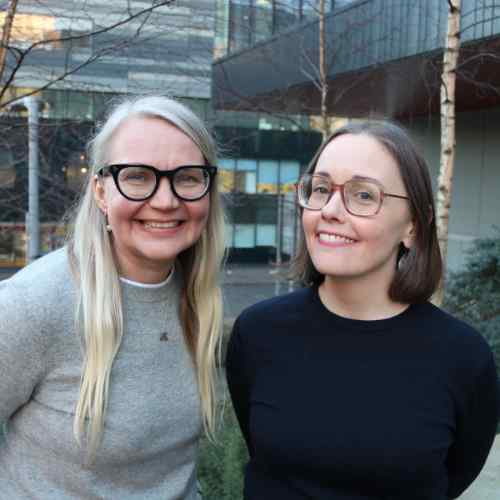
Dr Redi Koobak
Programme leader, Applied Gender Studies (MSc)
The Gender Studies Research Placement is an exciting opportunity to put your learning into practice with one of our partner organisations in the feminist third sector. It’s been inspiring to see the creative, impactful work students produce during their placements.
Dr Sophie Jones
Programme leader, Applied Gender Studies (MSc)
Glasgow Women’s Library
Glasgow has a diverse range of key women’s and equalities organisations in the city. The University of Strathclyde has particularly strong links with the Glasgow Women’s Library, the only accredited museum in the UK dedicated to women’s lives, histories and achievements. You'll benefit from access to the unique archival collections held by the Library as part of this course.
Glasgow Women’s Library is a unique resource in Scotland that nurtures research and inspires academic enquiry on women, gender and queer studies. We are thrilled to be connected to the MSc Applied Gender Studies at Strathclyde and look forward to the ground breaking outcomes for students and the Library that this connection will spark.
Adele Patrick, Lifelong Learning and Creative Development Manager, Glasgow Women’s Library
Understanding Gender
This module offers you an interdisciplinary and historicised understanding of gender theory and its implications for everyday struggles around gendered liberation. You will develop an understanding of the ways in which gender informs, and is informed by, other structural inequalities, drawing on key thinkers on gender from varied feminist traditions, including black feminisms, queer feminisms, trans feminisms and feminist disability studies.
Feminisms: Continuity & Change
20 credits
This module explores contemporary feminist thinking in relation to earlier feminist debates, campaigns, writings, and forms of activism.
You critically examine how feminist ideas, theories, and practices have developed over time, and how continuity and change are theorised within feminism(s). Drawing on interdisciplinary expertise across the department and faculty, the module encourages engagement with a wide range of sources - including archival materials at Glasgow Women’s Library - to analyse the historical, political, and theoretical significance of key feminist ideas, movements, and actors.
Feminist Knowledge, Feminist Research
This module introduces key feminist theories of knowledge and research methodologies. You examine how feminist knowledge is produced within and beyond the academy, and explore the principles, practices, and ethics shaping feminist research. The module includes a visit to Glasgow Women’s Library, offering hands-on engagement with feminist archives and community-based knowledge-making. It also prepares you for the Gender Studies Research Placement.
Gender Studies Research Placement
The placement option provides you with the opportunity to put your gender studies learning and postgraduate research training into practice in the wider world, conducting a piece of research according to a brief devised with the placement organisation. This module runs every year.
Advanced Topics in Gender Studies
This optional module allows you to work closely with a member of staff on a mutually agreed topic in the interdisciplinary field of Gender Studies. It is designed for students who wish to pursue academic interests that are not covered by existing option modules. Through a guided independent reading project, you will develop skills in desk-based research, critical literature review, and independent academic working, while gaining an advanced understanding of feminist theory and research in relation to your chosen topic. This module runs every year.
The range of options on offer every year will vary but may include:
Media, Crime & Violence
This module is designed to provide you with an understanding of how media and cultural contexts shape understandings and practices of crime, violence, victimisation and justice. You will leave with a critical understanding of media representations of crime and violence and skills to identify the ways in which media is used as a vehicle for crime, violence and/or justice.
Queer Social Justice
20 credits
This module explores social justice through queer and feminist perspectives, examining how power, inequality, and resistance are shaped across research, policy, and activist contexts. Students engage critically with questions of intersectionality, positionality, and knowledge production, and consider what it means to “queer” social justice in theory and practice.
Drawing on interdisciplinary scholarship and academic-activist work, the module addresses topics such as education, climate justice, abolitionist thinking, and institutional equality frameworks. Through seminar-based discussion and independent assessment, students are encouraged to challenge taken-for-granted ideas about expertise, authority, and justice
Gender, Health & Modern Medicine
This module explores the relationship between gender, health, and medicine from the nineteenth century to the present. You will examine how ideas about femininity and masculinity shaped medical knowledge, professional practice, and responses to health and illness in Britain, Ireland, and the United States.
Using a range of primary sources - including magazines, medical texts, film, and oral histories - you will develop critical skills in historical and gender analysis.
Feminism, Gender & Violence
This optional module examines the complex relationship between gender and violence from a feminist and intersectional perspective. You will explore how violence is gendered, how gender can be enacted through violence, and how these dynamics are shaped by structural inequalities such as race, class, and gender identity.
Building on a shared conceptual framework, the module focuses in depth on sexual violence, using case studies drawn from Gender Studies, Media, Social Policy, Criminology, and Politics. Topics vary each year and may include sexual violence at music festivals, image-based abuse, so-called ‘honour’ violence, carceral politics, war and militarism, and feminist digital activism against sexual violence.
Communicating Research
20 credits
This module focuses on the impact of academic research outside the walls of the University. You'll encounter cutting-edge research in a range of scholarly fields, and deepen your understanding of how knowledge is produced in the academy.
The module also introduces you to a range of practical skills, supporting you to develop expertise in engaging with a variety of publics.
You'll have the opportunity to use both audio and video technologies through, for instance, podcasting, video production, and writing for public exhibitions.
Narrating Social Change
This module will explore the way class, race, gender, sexuality and disability, as well as historical processes of colonialism, displacement, and migration, shape the creation, circulation, and reception of a wide variety of literary texts, as well as how literature can shape the public response to social and political incidents.
Storytelling, Memory & Heritage
20 credits
This interdisciplinary module focuses on narrative, memory and public history. You will receive a mixture of theory and practical skills and engage with questions like: what is public history? How do we tell stories about the past?
The module casts a critical eye on what voices are privileged at the expense of others, thinking about sexualities, race and ethnicity, disability and gender. This public history class will equip you with transferable skills for careers in heritage, public engagement, creative practice and journalism.
Being at Strathclyde I found the learning environment extended beyond the classroom. I attended events organised by the Strathclyde Feminist Research Network, including a brilliant guest lecture from Angela McRobbie, and I took part in a group session crowdsourcing LGBT+ history in the library’s archives of the Strathclyde Students’ Association newspaper.
Learning & teaching
The core courses are delivered in weekly seminars where there is an emphasis on student participation and engagement.
On both Feminist Knowledge, Feminist Research and Feminisms – Continuity and Change, some of our classes are held at Glasgow Women’s Library.
Assessment
The assessment is all in the form of coursework, with a range of assessments designed to allow students to demonstrate different research and writing skills.
All the core courses have more than one assessment point so that receiving and responding to feedback is built in to the course design. Optional modules are taught and assessed in a variety of ways.
On the Research Placement module, students will deliver their research in a form agreed in advance with the Placement provider so as to best meet their needs and provide the student with the opportunity to develop skills in delivering research in real world contexts.
Guest lectures
Within the Faculty of Humanities & Social Sciences you'll have access to a wide range of research events focused on gender and sexuality throughout the year.
Strathclyde Feminist Network offers an annual seminar programme bringing in guest speakers from the feminist and equality sectors as well as visiting academics.
We host a Postgraduate Feminist Reading Group, which provides a forum for staff and students on taught and research programmes to come together to discuss and debate key texts. As founder members of Gender Equal Media Scotland, we're also involved with a range of events relating to journalism, media and the creative industries.
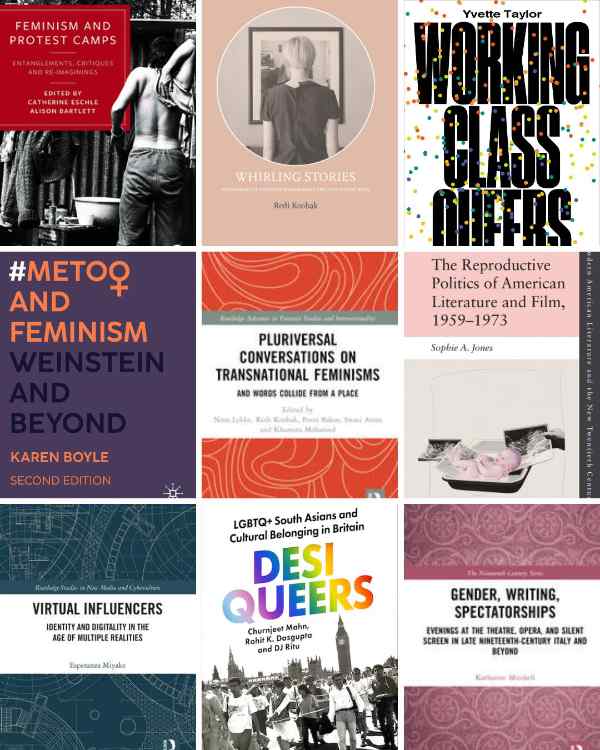
Published books by our teaching staff
- Feminism and Protest Camps - Entanglements, Critiques and Re-imaginings, edited by Catherine Eschle and Alison Bartlett
- Whirling Stories: Postsocialist Feminist Imaginaries and Visual Arts by Redi Koobak
- Working Class Queers by Yvette Taylor
- #MeToo and Feminism: Weinstein and Beyond by Karen Boyle
- Pluriversal Conversations on Transnational Feminisms: And Words Collide from a Place by Nina Lykke, Redi Koobak, Petra Bakos, Swati Arora and Kharnita Mohamed
- The Reproductive Politics of American Literature and Film, 1959-1973 by Sophie A. Jones
- Virtual Influencers: Identity and Digitality in the Age of Multiple Realities by Esperanza Miyake
- Desi Queers: LGBTQ+ South Asians and Cultural Belonging in Britain by Churnjeet Mahn, Rohit K. Dasgupta and DJ Ritu
- Gender, Writing and Spectatorships: Evenings at the theatre, opera and silent screen in late nineteenth-century Italy and Beyond by Katherine Mitchell
Chat to a student ambassador
If you want to know more about what it’s like to be a Humanities & Social Sciences student at the University of Strathclyde, a selection of our current students are here to help!
Our Unibuddy ambassadors can answer all the questions you might have about courses and studying at Strathclyde, along with offering insight into their experiences of life in Glasgow and Scotland.
Entry requirements
Applied Gender Studies welcomes applicants with diverse educational and professional experiences. To be admitted to the programme students should normally possess:
| Academic requirements/experience | First-class or Second-class Honours degree, or international equivalent, in Humanities or social science. Applicants with relevant experience (paid or voluntary) in feminist, queer or equalities work will also be considered. Supporting references: academic references where possible, but for students applying from a professional background, professional references are appropriate. |
|---|---|
| English language requirements | Please check the University's English requirements before making your application. |
Pre-Masters preparation course
The Pre-Masters Programme is a preparation course held at the University of Strathclyde International Study Centre, for international students (non-UK/Ireland) who do not meet the academic entry requirements for a Masters degree at University of Strathclyde.
Upon successful completion, you'll be able to progress to this degree course at the University of Strathclyde.
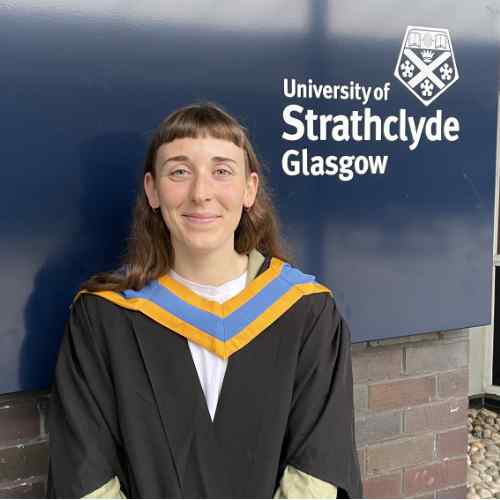
For my dissertation I interviewed different groups of women who regularly cold water swim. As a cold water enthusiast myself, this was a labour of love and probably my favourite task from the whole year. I was so well supported by my dissertation supervisor and the rest of the department.
Faculty of Humanities & Social Sciences Scholarships
EU Engagement Scholarships are available to EU applicants who would have previously been eligible for Home (Scottish/EU) fee status.
Fees & funding
All fees quoted are for full-time courses and per academic year unless stated otherwise.
Fees may be subject to updates to maintain accuracy. Tuition fees will be notified in your offer letter.
All fees are in £ sterling, unless otherwise stated, and may be subject to revision.
Annual revision of fees
Students on programmes of study of more than one year (or studying standalone modules) should be aware that the majority of fees will increase annually.
The University will take a range of factors into account, including, but not limited to, UK inflation, changes in delivery costs and changes in Scottish and/or UK Government funding. Changes in fees will be published on the University website in October each year for the following year of study and any annual increase will be capped at a maximum of 10% per year. This cap will apply to fees from 2026/27 onwards, which will not increase by more than 10% from the previous year for continuing students.
| Republic of Ireland |
If you are an Irish citizen and have been ordinary resident in the Republic of Ireland for the three years prior to the relevant date, and will be coming to Scotland for Educational purposes only, you will meet the criteria of England, Wales & Northern Ireland fee status. For more information and advice on tuition fee status, you can visit the UKCISA - International student advice and guidance - Scotland: fee status webpage. Find out more about the University of Strathclyde's fee assessments process. |
|---|---|
| Scotland, England, Wales & Northern Ireland | Full-time: £10,100 *Please note: Year 2 fee will be subject to an increase |
| International | £23,550 |
| Additional costs | International students may have associated visa and immigration costs. Please see student visa guidance for more information. |
| Available scholarships | Take a look at our scholarships search for funding opportunities. |
Please note: the fees shown are annual and may be subject to an increase each year. Find out more about fees.
How can I fund my course?
Scottish postgraduate students
Scottish postgraduate students may be able to apply for support from the Student Awards Agency Scotland (SAAS). The support is in the form of a tuition fee loan and for eligible students, a living cost loan. Find out more about the support and how to apply.
Don’t forget to check our scholarship search for more help with fees and funding.
Students coming from England
Students ordinarily resident in England may be to apply for postgraduate support from Student Finance England. The support is a loan of up to £10,280 which can be used for both tuition fees and living costs. Find out more about the support and how to apply.
Don’t forget to check our scholarship search for more help with fees and funding.
Students coming from Wales
Students ordinarily resident in Wales may be to apply for postgraduate support from Student Finance Wales. The support is a loan of up to £10,280 which can be used for both tuition fees and living costs. Find out more about the support and how to apply.
Don’t forget to check our scholarship search for more help with fees and funding.
Students coming from Northern Ireland
Postgraduate students who are ordinarily resident in Northern Ireland may be able to apply for support from Student Finance Northern Ireland. The support is a tuition fee loan of up to £5,500. Find out more about the support and how to apply.
Don’t forget to check our scholarship search for more help with fees and funding.
International students
We've a large range of scholarships available to help you fund your studies. Check our scholarship search for more help with fees and funding.
International students
We've a thriving international community with students coming here to study from over 140 countries across the world. Find out all you need to know about studying in Glasgow at Strathclyde and hear from students about their experiences.

Careers
Graduates of the MSc Applied Gender Studies go on to work in a wide range of fields, including the feminist and voluntary sector, equality and diversity roles, policy and advocacy, education, media, and cultural organisations.
The programme is well suited to part-time study, and students already working in relevant areas may have opportunities to undertake research for their placement or dissertation within their workplace, allowing them to connect academic study with professional practice.
We also support students progressing to doctoral study. Graduates have gone on to PhD research across the Humanities and, via the Research Methods route, within the Social Sciences.
Glasgow is Scotland's biggest & most cosmopolitan city
Our campus is based right in the very heart of Glasgow. We're in the city centre, next to the Merchant City, both of which are great locations for sightseeing, shopping and socialising alongside your studies.
Start date: Sep 2026
Applied Gender Studies
Start date: Sep 2026
Applied Gender Studies
Start date: Sep 2026
Applied Gender Studies (Research Methods)
Start date: Sep 2026
Applied Gender Studies (Research Methods)
Have you considered?
We've a range of postgraduate taught and Masters courses similar to this one which may also be of interest.
Contact us
Prospective student enquiries
Contact a member of our team on LiveChat between 10am and 4pm (GMT)
Telephone: +44 (0) 141 444 8600