We investigate secure communication methods based on quantum principles, including quantum key distribution and quantum networks. Our work aims to enable fundamentally secure data transfer and lay the foundations for a global quantum internet.
PhysicsQuantum Communication
Satellite Quantum Key Distribution and Space Quantum Communications
Currently deployed public key cryptography that underlies the security of the internet is at risk of being compromised by quantum computers. A potential mitigation is the use of quantum key distribution (QKD) to enable “quantum-safe” communications that offers forward security proof against “harvest and decode later” decryption attacks. However, QKD over optical fibre links is limited in range due to the unavoidable exponential losses with distance, constraining practical direct quantum signal transmission to a few hundred kilometres. To extend the distance over which secure communications can be performed, satellite distribution of quantum keys can exploit the lower losses of vacuum free-space transmission to span intercontinental links. The challenge is to develop and deploy quantum systems into space despite the harsh environment and limitations on size, weight, and power of satellite platforms.
Strathclyde has been working on accelerating space quantum technologies, satellite QKD in particular, with involvement in several missions to demonstrate the feasibility of quantum communications from orbit. We work closely with experimentalists, engineers, and companies to build, launch, and operate quantum communication payloads into space, having contributed to the first CubeSat quantum entanglement demonstration on SpooQy-1. Currently developed or operational missions include SPOQC, VOLT, and QEYSSat/ReFQ. Our expertise lies in modelling, simulation, and performance evaluation of satellite QKD systems, as well as mission architecture.
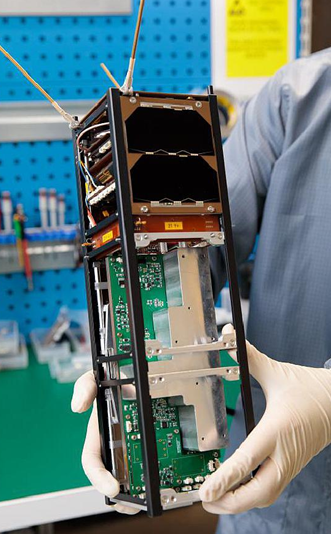
SpooQy-1 CubeSat, built by the Centre for Quantum Technologies, National University of Singapore, in collaboration with the University of Strathclyde. This mission tested the generation of quantum entanglement in a nanosatellite, paving the way for the Space Quantum Internet.
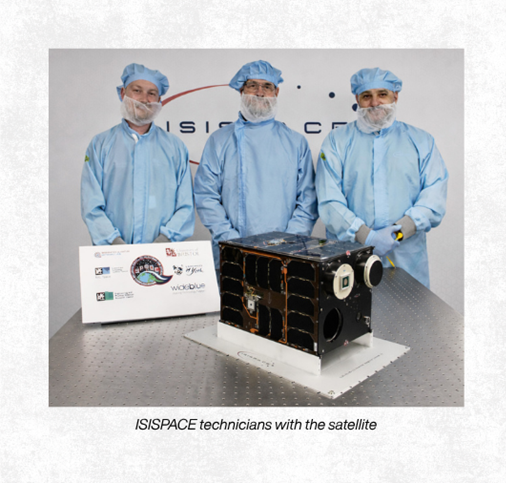
SPOQC CubeSat, launched by the Integrated Quantum Networks (IQN) Hub, of which Strathclyde is a partner. This mission will test quantum key distribution from space with 2 separate types of quantum sources. Strathclyde provides theoretical and modelling support.
Beyond QKD, quantum communication has applications in enhancing or enabling distributed sensing, timing, positioning, and information processing. The underlying resource is quantum entanglement which needs to be established across long distances. Strathclyde is working towards satellite quantum networks and components required to create quantum information networks (AKA the quantum internet) such as quantum memories and repeaters, space-qualified entanglement sources, and supporting sub-systems. A particular area of research is the architectural and operational design of space-based quantum communication constellations and their interface with terrestrial systems.
We also work with other groups on the development of single photon sources for QKD as well as electronic-photonic transduction. Such quantum light sources will be important for connecting quantum processors, high performance secure communications systems, and for quantum imaging and sensing, such as optical very long baseline interferometric telescope arrays.