We are developing new technologies and methods across neurotechnology, biophysics and biophotonics with the ultimate goal of improving human health and wellbeing. Our researchers study how diseases develop, discover new treatments, create tools that restore lost bodily functions, and use high‑performance computing to explore large biomolecules. This cutting‑edge work feeds directly into our teaching, giving students the chance to learn from, and work with, world‑leading scientists.
PhysicsHealthcare Technologies and Biophysics
Neurotechnology
At the Strathclyde Neurotechnology Centre, our research focuses on developing devices that interface with neural systems. These devices are microfabricated in our cleanroom facility. A major area of interest is neurophotonics, techniques for delivering and collecting light from the brain.
Retinal prosthetics
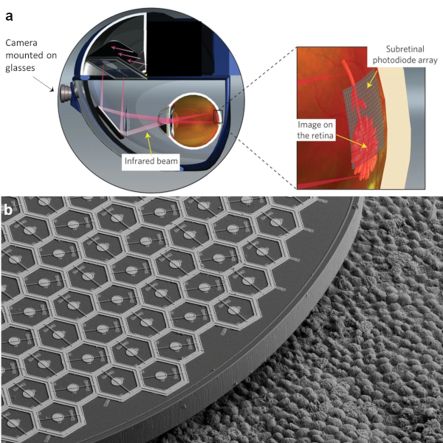
Degenerative retinal conditions, such as age‑related macular degeneration, cause the light‑sensitive photoreceptor cells to die while the inner retinal neurons remain relatively intact. By electrically stimulating these surviving neurons, visual responses can be restored.
We are developing a photovoltaic retinal implant that replaces the photoreceptors and receives both power and visual information wirelessly via infrared pulses. Our team is creating novel electrode structures to enhance implant performance and reduce pixel size, with the goal of improving restored visual acuity to around 20/80.
Optogenetics
Optogenetics is a transformational technique that allows specific populations of neurons to be controlled with light at millisecond precision. This combination of genetics and photonics enables targeted studies of neural circuits.
We are developing optoelectronic technologies that allow neuroscientists to examine the functional properties of genetically targeted cells, including:
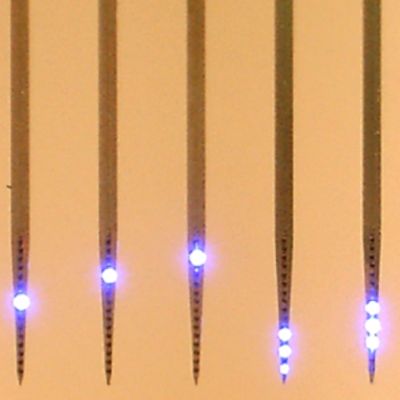
- Needle‑like probes with integrated µLEDs for optogenetic control and micro‑electrodes for monitoring neural activity
- Cortical arrays with the potential to restore lost sensory perception
- Arrays of glass microneedles that guide light deep into the brain, capable of exciting thousands of neurons in vivo with precise spatiotemporal patterns
Observing Alzheimer’s disease
In collaboration with neuroscientists at the Strathclyde Institute of Pharmacy & Biomedical Sciences, our researchers have developed an innovative technique using tapered optical fibres to observe Alzheimer’s disease as it progresses in the brain. This method uses light to detect and measure the build‑up of amyloid plaques at different depths. Crucially, these measurements can be made in living animals as they move naturally, rather than under anaesthetic or in fixed positions.

Soft Matter and Biophysics
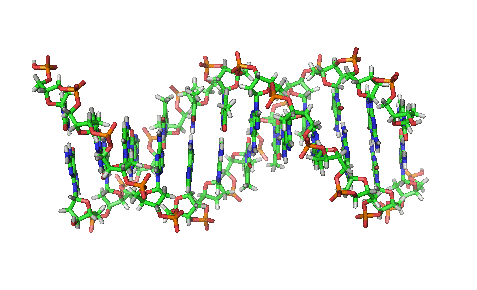
The Soft Matter and Biophysics group uses computer simulations, high‑performance computing, and analytical methods to study soft condensed matter. We are particularly interested in the behaviour of DNA and RNA.
Because atomistic simulations are limited to fewer than 50 base pairs, they cannot fully capture properties such as bending and supercoiling. Our coarse‑grained models reduce the degrees of freedom, allowing us to simulate thousands to millions of base pairs. Understanding the dynamic behaviour of DNA and RNA is essential for advancing drug discovery and biotechnology.
Biophotonics
Our Biophotonics research group aims to develop optical technologies that enable high‑resolution imaging and manipulation of biological systems. We design and characterise nanoscale structures with unique physical and chemical properties and use them to probe biological processes.
Nanodiamond
In the Nanobiophotonics group, we are developing new microscope imaging techniques using nanodiamonds. Replacing a carbon atom in a nanoscale diamond with a nitrogen atom alters its optical properties, causing it to fluoresce. This fluorescence does not bleach and is ideal for super‑resolution imaging such as STED microscopy.
Nanodiamond fluorescence is also extremely sensitive to temperature and magnetic fields, enabling us to detect these properties inside living cells. We can use nanodiamonds to monitor radiotherapy‑induced damage with sub‑cellular resolution.
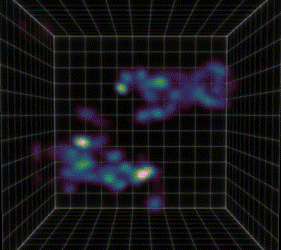
Nanoparticle-cell interactions
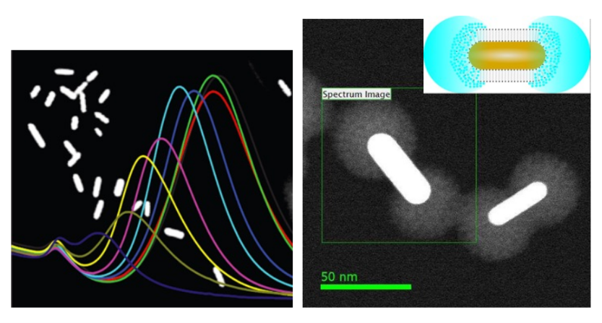
In the Photophysics group, we use plasmonic nanoprobes designed to latch onto cancer cells, enabling accurate detection through liquid biopsy, a faster and less expensive alternative to imaging. We are enhancing this technique by studying fluorescence lifetime, which improves accuracy and precision.
Recently, we discovered that our plasmonic nanoprobes can also disrupt the formation of β‑amyloid aggregates in the brain, a key pathology of Alzheimer’s disease.