The Semiconductor and Materials research area focuses on the applications, characterisation, theory and simulation of semiconductors and materials. It has long been a major strength at the University of Strathclyde, and benefits from numerous industry collaborations, such as the Fraunhofer Centre for Applied Photonics and the National Physical Laboratory. We have a particular emphasis on translating materials research into devices and scalable technologies, with local capabilities in semiconductor packaging, characterisation and system integration. A range of material platforms are investigated including silicon, III-V, and wide bandgap semiconductors.
PhysicsSemiconductors and Materials
Fundamental studies of materials
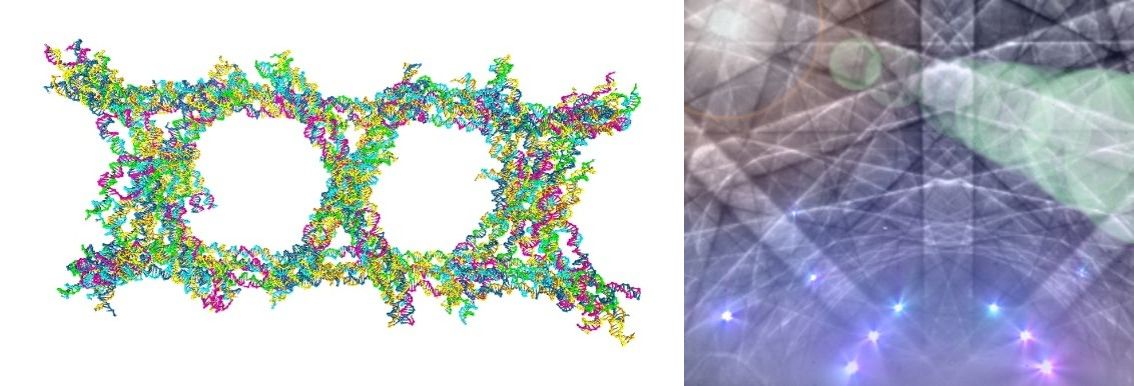
Materials sit at the heart of many modern technologies, from faster electronics and brighter displays to medical devices and sustainable energy systems. To make these technologies better, we need to understand how materials behave at very small scales, how their structure affects their properties, and how they can be designed or improved for specific uses.
At Strathclyde, our researchers combine advanced experiments with powerful computer modelling to study materials in detail. We develop methods to fabricate semiconductor films and quantum dots [Laurand, Massabuau]. We develop and use innovative scanning electron microscopy to examine semiconductors and other materials [Martin, Trager-Cowan, Massabuau]. Alongside this, multi-scale modelling allows us to explore how atoms, molecules and larger structures interact in semiconductors, biomaterials, colloidal quantum dots and soft materials [Hourahine, Henrich]. Together, these approaches help us design new materials, understand existing ones more deeply, and support the development of future technologies.
Devices
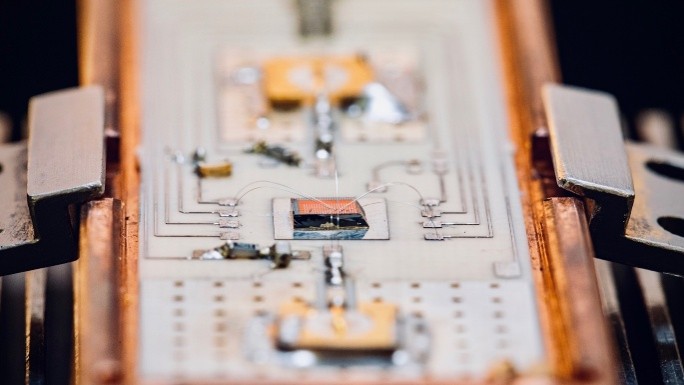
Semiconductor and materials research underpins many of the devices we use every day, from the light sources in displays and communications systems to sensors, medical technologies, as well as the building blocks of quantum and classical computers.
At Strathclyde, we develop new devices by combining advanced materials with innovative design and fabrication methods. Our work includes light-emitting diodes and lasers [Herrnsdorf, Dawson, Laurand, Hastie], light sensors [Massabuau], colloidal quantum dot devices [Laurand], devices for quantum technologies [Lagoudakis, Rossi, Hastie, McKnight], and technologies that can interface with neural systems [Mathieson]. These devices can help create faster communications, more sensitive detection systems, improved healthcare tools and new approaches to computing. By linking materials research with device engineering, we aim to turn discoveries in the laboratory into practical technologies with real-world impact.
Applications
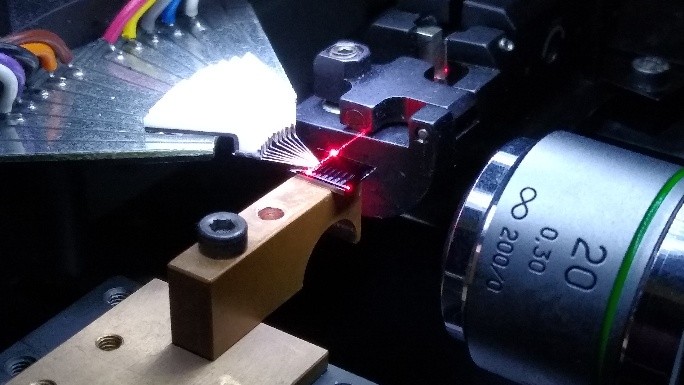
Technologies do not only rely on individual devices, but on bringing these devices together into complete systems that can solve practical problems. At Strathclyde, we work across this full range, from materials and device development through to system-level integration for real-world applications.
Our work includes photonic integrated circuits and heterogeneous integration, where different materials and components are combined to create compact and powerful optical systems [Strain]. Our work on optical communications and information processing [Herrnsdorf, Hurtado, Dawson, Strain] can help increase the speed and efficiency of data networks and enable new ways of handling information. This research links fundamental science with practical solutions for real-world challenges.
List of Academics
- Prof Martin Dawson
- Prof Jennifer Hastie
- Dr Oliver Henrich
- Dr Johannes Herrnsdorf
- Dr Ben Hourahine
- Prof Antonio Hurtado
- Dr Konstantinos Lagoudakis
- Dr Nicolas Laurand
- Professor Robert Martin
- Dr Fabien Massabuau
- Prof Keith Mathieson
- Prof Loyd McKnight
- Dr Alessandro Rossi
- Prof Michael Strain
- Dr Carol Trager-Cowan
Related Research Groups and Facilities
- Semiconductor Physics (SemPhys)
- Institute of Photonics (IoP)
- Physics of Space, Earth and Life-Science (SEALS)
- Quantum and Light Matter Interaction Theory Group (Q-LiMIT)