Earth Observation
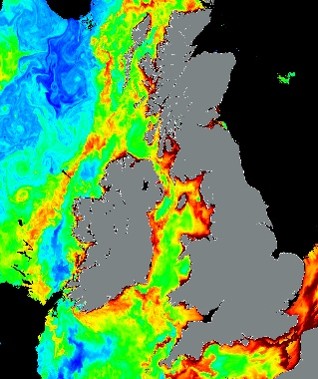
The oceans play a vital role in setting the Earth’s climate and the global carbon budget. The Marine Optics and Remote Sensing group are developing new algorithms to improve interpretation of ocean colour satellite images for optically complex natural water. We are particularly interested in challenging conditions including turbid coastal waters, coccolithophore blooms and Arctic fjords. We have also developed new approaches to observe zooplankton swarms from space. Our aim is to provide high quality ocean colour data to support key stakeholders including industry, communities and policymakers. [McKee]
Inter-satellite Quantum Internet
There is a growing demand for secure and reliable communication between constellations of satellites in orbit around the Earth. With funding from the UK Space agency and EPSRC, the Institute of Photonics is developing micro-light-emitting diode (micro-LED) based low-SWaP (Size, Weight and Power) classical and quantum communications systems for intersatellite links. Micro-LED transmitter arrays can be used for link alignment and beam steering. Developing quantum key distribution hardware in the UV-C wavelength range helps to achieve low-SWaP and improves performance by reducing solar background radiation.
In collaboration with the Universities of Bristol, Bath, York, and Fraunhofer UK, quantum key distribution hardware in the UV-C wavelength range is being developed, benefiting from low SWaP due to the wavelength, and reduced solar background. [Oi, Herrnsdorf]
Satellite Quantum Key Distribution
Currently deployed public key cryptography that underlies the security of the internet is at risk of being compromised by quantum computers. A potential mitigation is the use of quantum key distribution (QKD) to enable “quantum-safe” communications that offers forward security proof against “harvest and decode later” decryption attacks. However, QKD over optical fibre links is limited in range due to the unavoidable exponential losses with distance, constraining practical direct quantum signal transmission to a few hundred kilometres. To extend the distance over which secure communications can be performed, satellite distribution of quantum keys can exploit the lower losses of vacuum free-space transmission to span intercontinental links. The challenge is to develop and deploy quantum systems into space despite the harsh environment and limitations on size, weight, and power of satellite platforms.
Strathclyde has been working on accelerating space quantum technologies, satellite QKD in particular, with involvement in several missions to demonstrate the feasibility of quantum communications from orbit. We work closely with experimentalists, engineers, and companies to build, launch, and operate quantum communication payloads into space, having contributed to the first CubeSat quantum entanglement demonstration on SpooQy-1. Currently developed or operational missions include SPOQC, VOLT, and QEYSSat/ReFQ. Our expertise lies in modelling, simulation, and performance evaluation of satellite QKD systems, as well as mission architecture. [Oi]
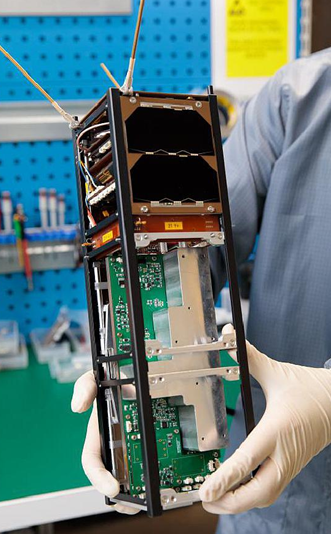
SpooQy-1 CubeSat, built by the Centre for Quantum Technologies, National University of Singapore, in collaboration with the University of Strathclyde. This mission tested the generation of quantum entanglement in a nanosatellite, paving the way for the Space Quantum Internet.
Space Navigation and Timing
Positioning, navigation and timing (PNT) services help us know where we are and keep essential systems running on time. Research in quantum technology at Strathclyde Physics is advancing compact atomic sensors and timing platforms suitable for deployment in future space missions. Our department is developing new space technologies to make these services more accurate and reliable to critical infrastructures, such as the national grid, our transport system, and communications networks.
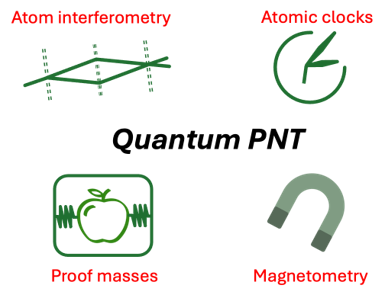
Our researchers are creating compact quantum sensors for use in space. These include cold-atom platforms for measuring gravity and inertial forces (Arnold, Griffin) and highly sensitive magnetic-field sensors (Ingleby, Patton, McGilligan, Griffin). Our work on atomic clocks, and secure networks for connecting atomic clocks will provide the essential references for next generation sensors and connected systems (Offer, McGilligan, Arnold, Griffin). This work will help navigation when GPS signals are weak or unavailable, and in the future can be used for navigation and communications with deep-space satellites.
Strathclyde works with the European Space Agency, the UK Space Agency, international networks, and with many industry partners to turn these ideas into practical technologies for future space missions. We are core partners of the Quantum Enabled Position, Navigation, and Timing (QEPNT) and Quantum Sensing Imaging and Timing (QuSIT) Hubs, developing quantum technologies to solve real-world problems for space application. [Arnold, Griffin, Ingleby, McGilligan, Offer, Patton]
Space Weather and Radiation
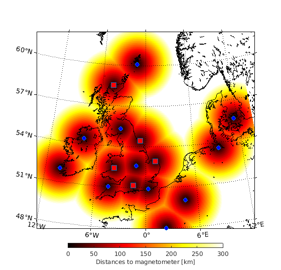
The Earth is bathed in solar radiation in the form of light and charged particles in the solar wind. Solar storms cause changes in the Earth’s geomagnetic field that can impact on a number of key areas including satellite communications and energy transmission. The UMQT group (Ingleby/Griffin) are developing a range of optically pumped magnetometers that combine microfabricated atomic vapour cells with optical probe beams to create compact and portable sensors that can measure subtle changes in the Earth’s magnetic field. In collaboration with the British Geological Survey (BGS), they are extending a network of quantum observatories across the UK to measure geomagnetic events and study resulting ground-induced currents (https://geomag.bgs.ac.uk/research/quantum_magnetometers/home.html). In collaboration with industrial and governmental partners, the UMQT team (Ingleby, Mrozowski, Dyer) have built and operated remote distributed sensor arrays, operating autonomously off-grid to successfully measure space weather and other atmospheric geomagnetic fields. UMQT also develop hybrid quantum-classical systems for scalable space weather and industrial applications (Dyer, Ingleby, Griffin). The SEALS group (Patton) are using Nitrogen Vacancy centres embedded in mm-sized, diamond crystals to produce highly sensitive magnetometers to detect changes in the geomagnetic field associated with space weather. [Griffin, Ingleby, Hunter, Patton]
Laser–Plasma Radiation Testing of Semiconductor Devices for Space Applications
People and objects launched into space are exposed to increased levels of potentially harmful radiation. The SCAPA facility is used to generate intense bursts of high-energy radiation using laser–plasma acceleration, producing a broad spectrum of electrons, protons and secondary radiation that closely replicates the space environment. In this project, Ga₂O₃ UV-C photodetector devices are exposed to these beams at energies up to ~10 MeV, with the total dose selected to represent several months of operation in Low Earth Orbit. The irradiated samples are then systematically characterised to quantify changes in detector performance, such as sensitivity and response speed, and to identify radiation-induced defects within the semiconductor. By combining realistic radiation exposure with detailed post-irradiation analysis, this work provides a rapid, laboratory-based route to assess and improve the radiation tolerance of next-generation photodetectors for space applications. [Massabuau, Martin, McKenna]