Photonics is a major cross disciplinary research theme at the University of Strathclyde, bringing together expertise in the science, engineering and application of light. It connects research across the Institute of Photonics (IoP), Ultracold Matter and Quantum Technologies group (UMQT), Semiconductor Physics (SemPhys) and Quantum and Light Matter Interaction Theory (Q-LiMIT) groups. Together, we develop research from fundamental studies of light and materials to the design, manufacture and application of advanced photonic systems.
PhysicsPhotonics
Light-emitting devices
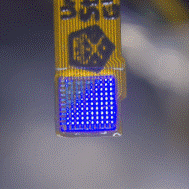
A key strength is the close connection between materials, devices, theory and applications. Research on new light-emitting materials and devices [Martin/Massabuau/Laurand/Trager-Cowan] complements the work carried out since 2002 at the Institute of Photonics in the fabrication of gallium-nitride (GaN) micro-LEDs [Dawson/Herrnsdorf/Strain]. A key motivation for this research is the use of high-density arrays of micro-LEDs in instrumentation and scientific applications. These capabilities are supported by expertise in material characterisation, microfabrication and processing at the clean-room facility of the Technology and Innovation Centre, create new opportunities to translate new materials into practical emitters, lasers and optical devices.
Integrated Photonics
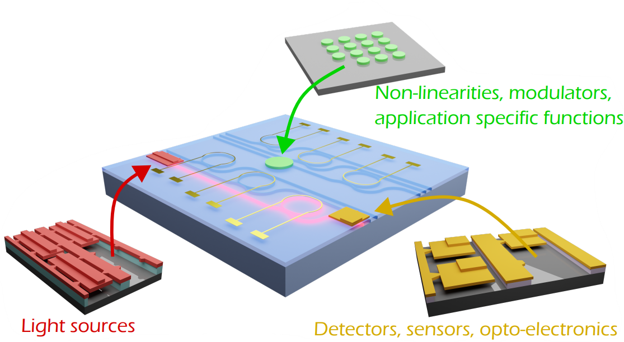
We have broad expertise in the design and micro-fabrication of Photonic Integrated Circuit (PIC) technologies across a wide range of material platforms. We develop new materials for specialist applications and collaborate with industrial partners to ensure the future scalability and foundry compatibility of these techniques [Strain]. These technologies support applications in communications [Rajbhandari], sensing, quantum systems, high-performance computing and manufacturing. In parallel, our research in neurophotonics [Mathieson] combines photonic devices with neuroscience, supported by SSD capabilities in material characterisation, device processing and integration. The Institute of Photonics’ recent work on implantable micro-LED arrays demonstrates the potential of this multidisciplinary approach. Furthermore, our research in colloidal semiconductor photonics integrates nanomaterials, optoelectronics, and biochemistry to create novel photonic materials and devices with impact across different fields, e.g., healthcare, sensing, quantum technologies, and digital lighting [Laurand].
Advanced Lasers
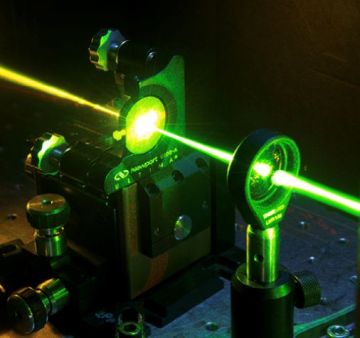
Another key strength of Photonics in Strathclyde, it the research activity in the physics and engineering of compact solid-state and optically pumped semiconductor laser systems [Hastie/Kemp] developed for numerous applications in different industrial, technological and academic areas, including quantum technologies for sensing, ranging and biological imaging. From laboratory benchtop systems to prototyping with the Fraunhofer Centre of Applied Photonics, and practical implementation and tests with our academic and industrial partners, we use our novel laser concepts and materials, and exploit new material and processing technologies to achieve high performance operation at novel wavelengths.
Neuromorphic and Optical Computing
Photonics also provides a strong link between hardware and emerging computing technologies. Our researchers use photonic systems for neuromorphic computing [Hurtado/Porte-Parera], developing new ways to process information using light. This work connects naturally with expertise in nonlinear optical dynamics, including research on nonlinear dynamics, spatial structures and solitons [Ackemann/Oppo] as well as spintronics [Ackemann] in semiconductor lasers, and with the wider computational and theoretical study of light–matter interactions.
Frequency Combs
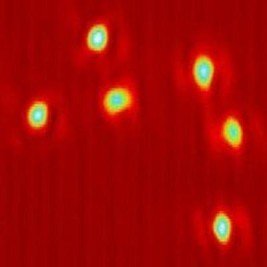
Cavity solitons in Kerr resonators were discovered at Strathclyde in 1994 by Andrew Scroggie and Willie Firth and then applied in 2010 to generate frequency combs, i.e. spectra that span more than one octave in the frequency (or wavelength) domain while being formed by thousands of equally separated teeth. Cavity soliton frequency combs have taken the photonics community by storm and have found applications in frequency standards, optical clocks, optical communications, future GPS, astronomy and quantum technologies.
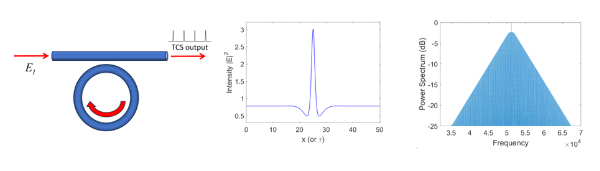
Collaborations of Strathclyde [Oppo] and experimental groups at the Emergent Photonics Research Centre in Loughborough, the Max Planck Institute for the Science of Light in Erlangen, Germany, the Dodd-Walls Centre for Photonic and Quantum Technologies in Auckland, New Zealand, and the CNRS Laboratoire Carnot in Dijon, France, engineered new frequency combs via laser cavity solitons, via counter-propagating cavity solitons, via two-polarization cavity solitons and even lead to quantum simulations of Ising machines.
In summary, by linking quantum and nonlinear optics with materials science, semiconductor devices, integrated photonics, advanced lasers, computing and biomedicine, the Photonics theme provides a framework for stronger collaboration across Strathclyde. It creates opportunities for shared facilities, collaborative projects, joint doctoral training and industrial partnerships, while accelerating the development of photonic technologies with real scientific, economic and societal impact.
In summary, by linking quantum and nonlinear optics with materials science, semiconductor devices, integrated photonics, advanced lasers, computing and biomedicine, the Photonics theme provides a framework for stronger collaboration across Strathclyde. It creates opportunities for shared facilities, collaborative projects, joint doctoral training and industrial partnerships, while accelerating the development of photonic technologies with real scientific, economic and societal impact.
Related Research Groups and Facilities
- Institute of Photonics (IoP)
- Quantum and Light Matter Interaction Theory Group (Q-LiMIT)
- Semiconductor Physics (SemPhys)
- Ultracold Matter and Quantum Technology (UMQT)
- Physics of Space, Earth and Life-Science (SEALS)