At Strathclyde our research across quantum science involves studying the collective behaviour of many quantum particles, which manifests in bulk quantum systems such as superfluids [Wilson, Haller], supersolids [Ackemann, Robb, Haller, Kirton], and quantum droplets. Developing a fundamental understanding of bulk quantum systems has relevance across a broad range of physical systems from astronomy (pulsars and neutron stars), condensed matter (superconductors), quantum materials, fluid dynamics (turbulent flows), nonlinear systems (solitons) and pattern formation.
PhysicsQuantum Science
Superfluid and vortex dynamics
In a quantum many-body system the interactions between the constituent microscopic particles lead to emergent macroscopic phenomena. Such macroscopic phenomena include superfluidity (fluid flow without viscosity) and superconductivity (conduction of electricity without resistance). Novel phases such as high-temperature superconductivity form the basis of quantum materials, where useful emergent properties can lead to new technologies. Studying the dynamics of vortices (quantum whirlpools) can give key insight into the inner workings of superfluid and superconducting systems. At Strathclyde we use superfluids formed of ultracold atoms called Bose-Einstein condensates (BECs) to provide an extremely clean and well-controlled system for studies of collective quantum behaviour. BECs enable exquisite control over interactions, geometry, and rotation (vorticity). Importantly, in superfluids formed of mixtures of ultracold atoms we can tune the interactions to emphasize quantum effects such as fluctuations.
Research at Strathclyde explores how vortices interact with pinning potentials, how vortex interactions are linked to energy dissipation, and the role that vortices play in energy transport in quantum turbulence.
Solitons
Solitons are a hallmark of nonlinear science: robust, dispersion-free waves that propagate without changing shape. They appear in many disciplines, such as optics, fluid dynamics, and biological systems. In quantum gases, matter-wave solitons emerge from the balance between kinetic dispersion and attractive interatomic interactions described by the Gross–Pitaevskii equation.
Because they bridge single-particle physics and complex many-body behaviour, solitons provide a powerful platform for exploring nonlinear and quantum dynamics. Our research focuses on lattice solitons, Floquet-driven solitons, bound states of solitons, and quantum solitons.
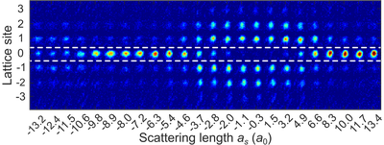
Density distribution of a wave packet initially localized at a single lattice site, shown after a fixed hold time for different interaction strengths. Solitons form at specific attractive (-8a_0) and repulsive (+10a_0) interaction strengths [PRL 135, 263404 (2025)].
Floquet-driven systems
Periodic driving provides a powerful tool for engineering and controlling quantum systems. In optical lattices, Floquet driving can be used to modify the band structure and explore phenomena such as photon-assisted tunnelling, artificial gauge fields, and Super-Bloch oscillations.
Studying interacting systems in Floquet-driven lattices, however, remains challenging. Interactions can induce instabilities and heating on timescales comparable to the modulation period, rapidly destroying the coherence of the system. Understanding these excitation mechanisms and identifying optimal driving-frequency windows are therefore essential for realizing stable quantum simulations.
We investigate how these instabilities depend on the lattice tilt, driving frequency, detuning, and interaction strength. Our goal is to identify stable parameter regimes and develop robust driving protocols for exploring novel and intriguing quantum states in lattice potentials.
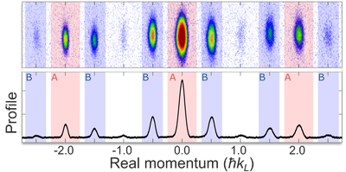
Momentum distribution of a wave packet following expansion from a one-dimensional optical lattice. The density peaks reveal the momentum of the superfluid background (regions A) and the momenta of the excited modes (regions B) [PRR 5, 033024 (2023)].
Supersolids, quantum droplets and magnetism via light-mediated interactions
Light-mediated interactions between cold or ultracold atoms via feedback from a single mirror results in self organisation, and can be used to study complex phases and phase transitions including supersolids and magnetic ordering. For an explanation of how diffraction and the Talbot-effect mediate light-induced interaction between atoms, see the overview and this review.
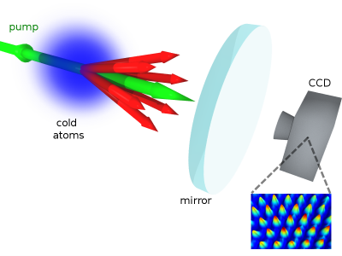
Supersolids are an unconventional state of matter which exhibit both spatial structure (like a crystal) and phase coherence (like a superfluid). We aim to realize this intriguing phase of matter in a laser-driven Bose-Einstein condensate of ultracold Cs atoms. Optical feedback leads to the nontrivial spatial correlations leading to supersolidity. This work will develop a unique platform for exploring emergent behaviour and symmetry-breaking in self-organised ultracold matter. We will also study quantum droplets and their connection to solitons. Investigations of persistent temporal dynamics will provide a fruitful connection to the archetypical quantum Hamiltonian Mean Field Model advancing the knowledge of the statistical mechanics of long-range coupled systems and time crystals.
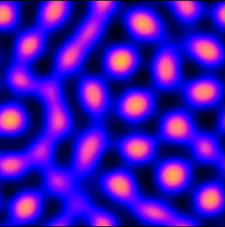
The work on supersolids builds on earlier and ongoing work on self-organized phases in laser-cooled atomic ensembles and vapour cells in single-mirror feedback setups. We established the emergence of anti-ferromagnetic and ferrimagnetic structures in close analogy to Ising spin systems and are looking now at quadrupolar ordering and how it interacts with dipolar anti-ferromagnetism, with interesting connections to heavy-fermions systems and unconventional superconductivity in condensed-matter.