Many quantum technologies depend on laser systems with exceptional coherence, wavelength stability and spectral purity. These lasers are used to cool and trap atoms, interrogate optical clock transitions, perform precision spectroscopy and provide the stable optical references required for quantum-enabled sensing and timing.
Research within the Institute of Photonics develops advanced semiconductor and solid-state laser technologies that combine high performance with compact and deployable architectures [Hastie, Kemp, Moriya]. Recent work has demonstrated a monolithic-cavity semiconductor disk laser (VECSEL) operating at 689 nm (see picture), a wavelength of particular importance for strontium-based quantum technologies. The system delivers sub-kilohertz linewidth operation and frequency stability suitable for applications including optical clocks and atom interferometers, demonstrating a route towards replacing large laboratory laser systems with compact and robust alternatives.
Complementary work has demonstrated iodine-stabilised VECSEL systems that provide compact optical frequency references based on molecular spectroscopy. Together, these developments address a major challenge in quantum engineering: delivering laboratory-grade coherence and stability in systems suitable for deployment in real-world environments.
Other activities develop compact solid-state laser architectures based on innovative gain materials and thermal-management approaches, including pioneering work on diamond Raman lasers and diode-pumped Ti:sapphire lasers. These technologies offer efficient, tunable and high-performance sources for sensing, spectroscopy and quantum-enabled instrumentation.
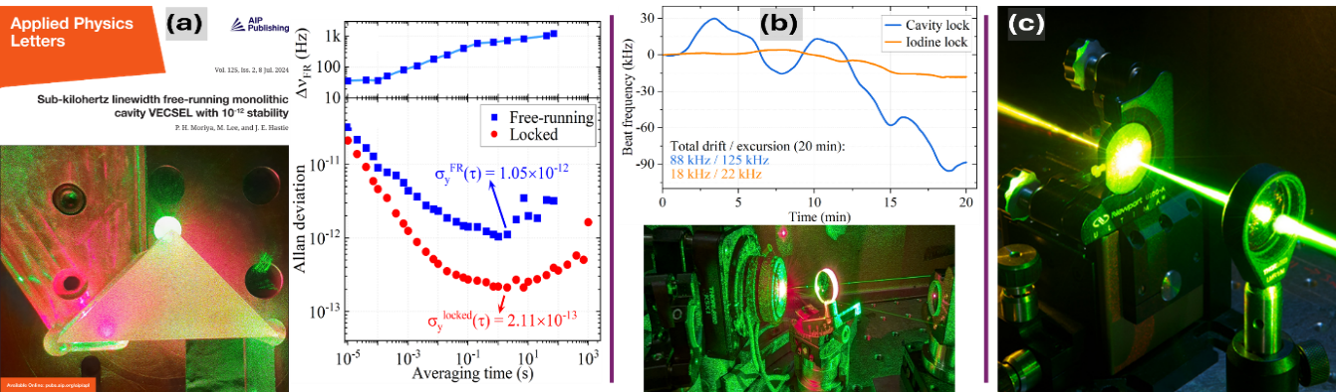
High-performance lasers developed at Strathclyde. (a) Compact monolithic-cavity VECSEL and (b) iodine-locked VECSEL for ultra-coherent laser generation in strontium-based quantum technologies. (c) Monolithic diamond Raman laser at yellow wavelengths.
Integrated Photonics
Future quantum technologies will require miniaturisation comparable to the transition from discrete electronic components to integrated circuits. Integrated photonics provides a route towards this goal by incorporating sophisticated optical functionality onto semiconductor chips.
Research at Strathclyde develops photonic integration technologies that combine optical generation, routing, and manipulation within compact devices [Strain]. This includes heterogeneous integration approaches that allow components fabricated from different materials to be combined on a common photonic platform, enabling highly functional systems for quantum communications, sensing and information processing.
These technologies help address one of the key challenges facing quantum technologies: moving from laboratory demonstrators to scalable, robust and manufacturable systems.
New photonic circuit designs can be fabricated in the Institute of Photonics’ state of the art 500m2 cleanroom facility [Guilhabert], allowing rapid prototyping and experimental validation of target optical functionalities. These PICs, enhanced by the heterogeneous integration of multiple materials, support the advancement of new quantum technologies, whether they utilise optical point emitters or distributed optical nonlinearities.
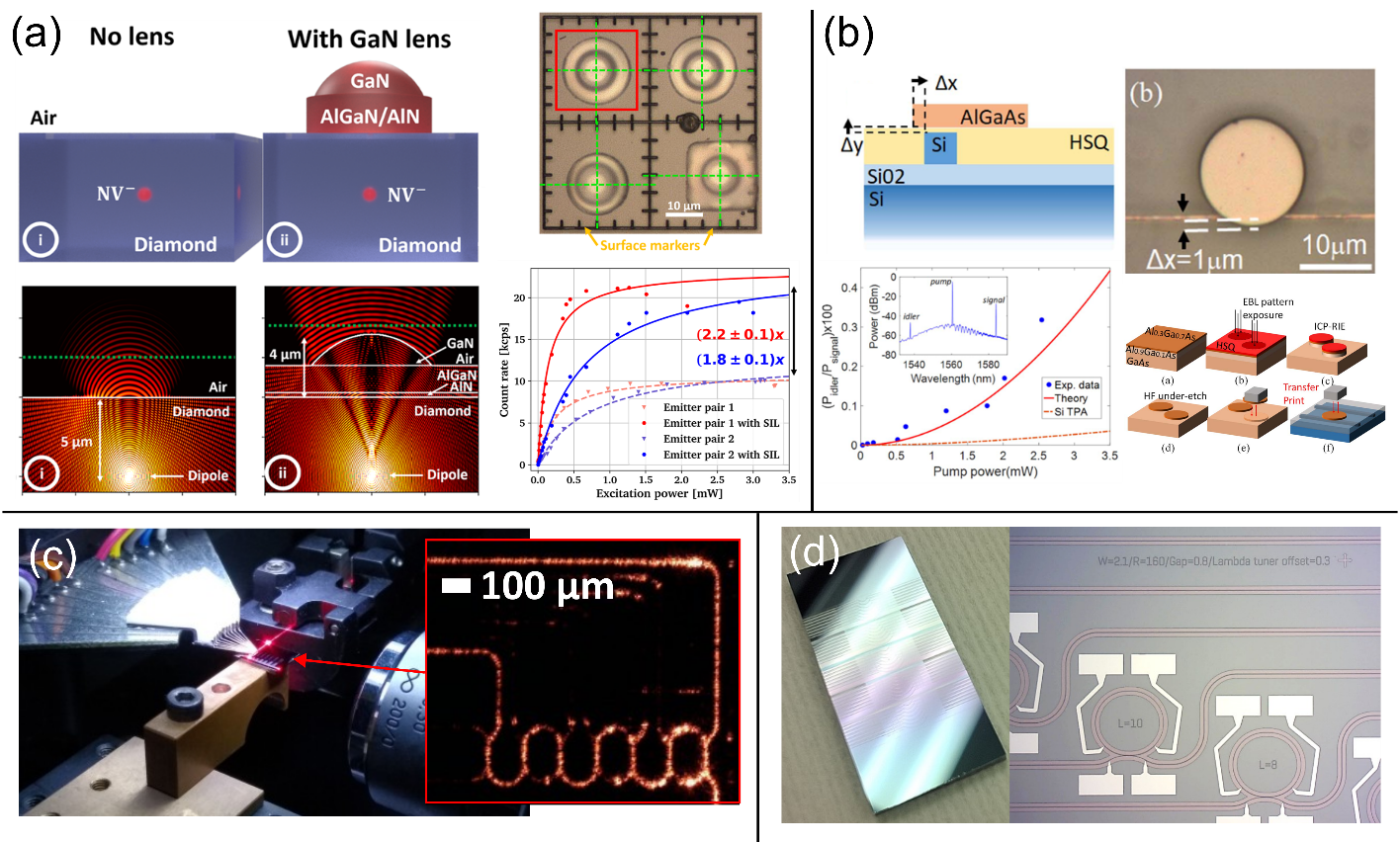
(a) Enhancement of the collection efficiency of the light emitted by a quantum defect in diamond, using a micro-transfer printed index matched gallium nitride micro-lens. (b) Nonlinear optical generation via a micro-transfer printed AlGaAs whispering gallery mode resonator. (c) Silicon nitride PICs operating at visible wavelengths. (d) In-house fabrication of silicon nitride PICs.
Atomic components
Research within the Department focuses on the development of advanced atomic components and enabling technologies for next-generation quantum sensors and atomic clocks. This activity brings together expertise in atomic physics, photonics, laser systems and microfabrication to develop compact, robust and high-performance devices that can translate precision atomic measurements from the laboratory into deployable atomic sensors.
A major area of research is the development of miniaturised atomic vapour cells and associated optical components for alkali-based sensing and timing systems. This includes the design, fabrication and characterisation of microfabricated vapour cells, alongside techniques for integrating optical functionality directly with atomic packages. Research also encompasses mass producible approaches to atomic deposition and the development of diffractive optical elements, and approaches for reducing the size and complexity of complete atomic systems.
These components underpin research into chip-scale atomic clocks, magnetometers, wavelength references and wider precision quantum sensors. Emphasis is placed on technologies for resilient positioning, navigation and timing, where compact atomic clocks and magnetic-field sensors have the potential to provide capabilities in environments where satellite-based navigation is unavailable, disrupted or unreliable. [McGilligan]
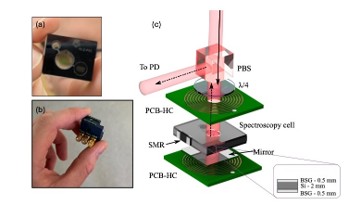
(a): A micro-machined rubidium vapour cell with a 6mm optical path length, encompassing integrated coatings for operation as a two-photon optical clock. (b): Packaged wavelength reference. (c): illustration of the internal components of the packaged wavelength reference, including the micro-fabricated vapour cell, dielectric reflector, and printed-circuit-board coils for Zeeman shifting the laser frequency and adding modulation for locking.
Translation and Industrial Impact
A major strength of Strathclyde's quantum technology ecosystem is the close integration of fundamental research, innovation and industrial engagement. Our researchers work with NPL, government agencies, established industrial partners and emerging start-ups to accelerate the translation of new quantum technologies from the laboratory into real-world applications. This activity spans the full innovation pipeline, from component development and system prototyping through to commercialisation and deployment.
One important element of this ecosystem is the close relationship between the Department of Physics and strategic partner, the Fraunhofer Centre for Applied Photonics (CAP). Led by Professor Loyd McKnight from the Institute of Photonics, Fraunhofer CAP is one of the UK's leading centres for the translation of photonics and quantum technologies, providing expertise in optical system design, packaging, manufacturing and systems integration. Through collaborations with industry partners, Fraunhofer CAP helps bridge the gap between laboratory demonstrations and deployable technologies.
The Department also generates direct routes to commercial impact through spin-outs and entrepreneurial partnerships. A recent example is Quantrologee, a new quantum sensing company originating from a collaboration between researchers at the University of Strathclyde and the University of Glasgow. The company combines expertise in quantum magnetometry and gravity sensing to develop next-generation sensing technologies for applications including navigation, infrastructure monitoring and security.
These activities are further strengthened through Strathclyde's leadership role in the Photonics & Quantum Accelerator (PQA), a major collaborative initiative that brings together the Universities of Strathclyde, Glasgow, St Andrews and Heriot-Watt, industry, public-sector organisations and innovation partners to support sustainable growth in Scotland's photonics and quantum sectors [Leburn]. The PQA helps create new opportunities for collaboration, skills development and technology adoption across the wider ecosystem, supporting the translation of emerging technologies into societal and economic benefit.