At Strathclyde our research across quantum computing and simulation involves development of novel platforms based on atomic, superconducting and semiconductor qubit architectures, covering low-level hardware development to quantum software and algorithms relevant for applications in material science, quantum chemistry and fluid dynamics.
PhysicsQuantum Computing and Simulation
Quantum Computation
Quantum computing offers a powerful approach to information processing by using quantum bits (qubits) which are two-level systems that evolve under the laws of quantum mechanics. By exploiting the phenomenon of quantum superposition and entanglement, this offers routes to provide exponential speed-up of hard classical tasks such as factorisation, accelerate optimisation of industrially relevant problems in logistics, energy and financial sectors, as well as providing a programmable quantum processors which can be used to speed up drug development and design new materials.
At Strathclyde we are actively engaged in development of quantum hardware, software, and algorithms, with strong links to industrial partners (including Infleqtion and Quantum Motion), as well as within the UK National Quantum Technology Programme through participation in the Hub for Quantum Computing via Integrated and Interconnected Implementations (QCi3), and partnerships with the National Quantum Computing Centre (NQCC) and the National Physical Laboratory (NPL).
Quantum Computing Hardware
A major challenge in the development of scalable, fault-tolerant quantum hardware is the realisation of platforms able to provide large numbers of high-quality qubits, which can be used for quantum operations with very low errors. We are actively pursuing two distinct architectures to this end.
Neutral Atom Quantum Computers
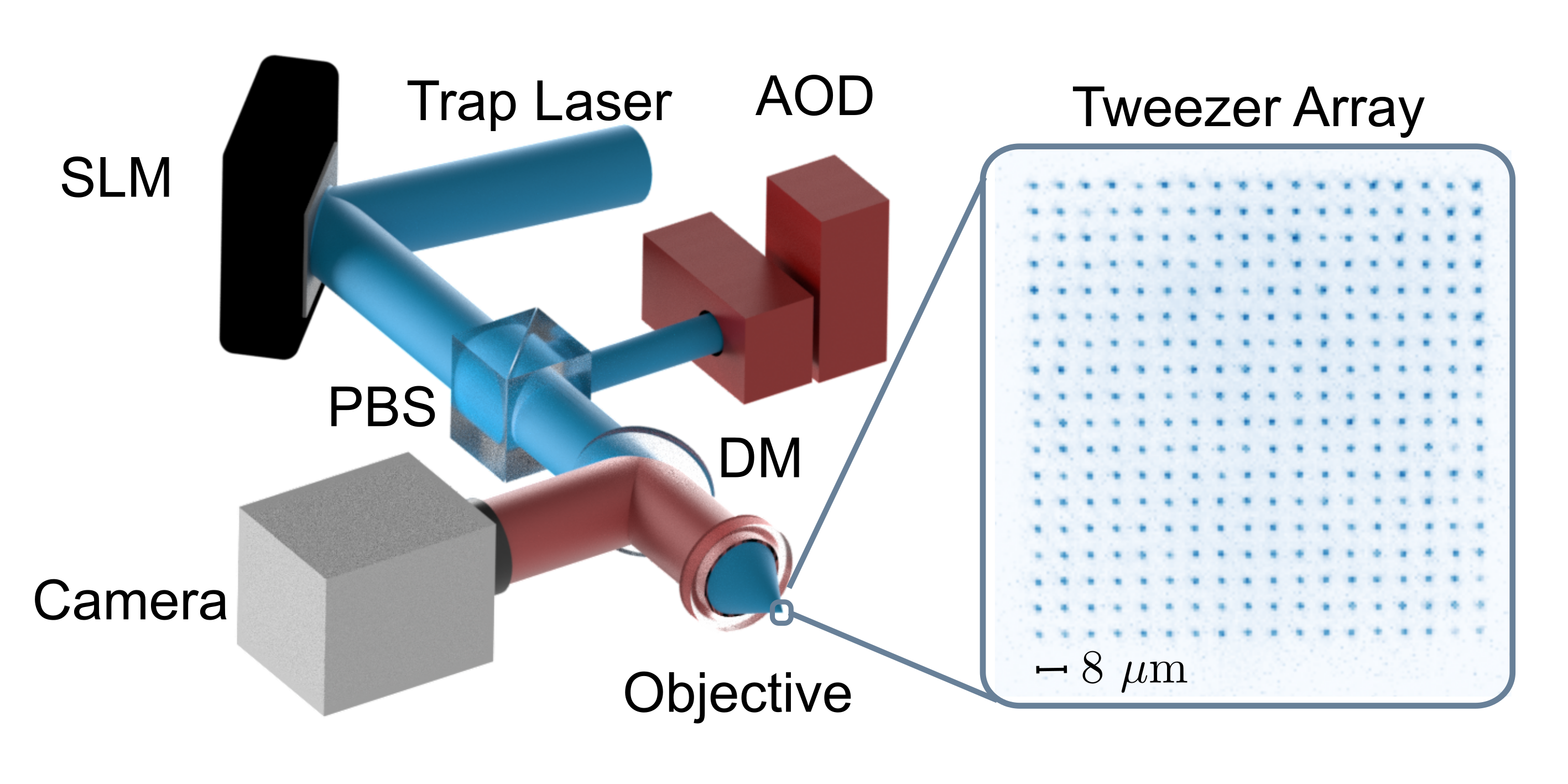
Strathclyde is the UK leader in the development of neutral atom quantum computers, in which arrays of atomic qubits are created using microscopic optical tweezers [Pritchard]. By coupling atoms to highly excited Rydberg states, strong long-range interactions can be created to enable solution to a wide range of graph optimisation problems, or enable high fidelity gates for realising quantum error correction.
Semiconductor Qubits
An alternative technology under development by the Semiconductor Quantum Electronics Lab (SEQUEL) is semiconductor qubits which offer lower footprint and compatibility with industrial chip manufacturing. We are actively developing spin qubits based on silicon and silicon carbide, as well as working on integrated cryogenic electronics to enable scaling to large qubit numbers.
Quantum Algorithms
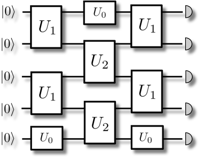
Designing and testing algorithms that efficiently exploit the capabilities of quantum hardware is essential to fulfil the promise of quantum computing. Quantum algorithm development involves mapping complex computational problems onto hardware-native quantum operations, taking device constraints into account, combining quantum and classical resources effectively, and optimising circuits to mitigate the effects of noise and imperfections.
Research at Strathclyde addresses multiple levels of quantum algorithm design. At a fundamental level, we develop new approaches to quantum control, error correction and mitigation, and benchmarking to characterise and improve the performance of quantum processors [Pritchard, Poggi]. On the application side, we design protocols that use quantum computers to tackle outstanding problems in materials science and quantum chemistry [Kendon, Poggi], as well as logistics and optimisation [Pritchard]. In addition, we explore quantum computing paradigms beyond the circuit model, such as quantum annealing and quantum walks [Kendon], and investigate the integration of quantum computing with high-performance computing (HPC) platforms [Kendon].
Quantum Simulation
Quantum simulation describes the approach of using quantum hardware to realise a controllable platform on which to perform systematic studies of many-body systems that is directly relevant to studies of materials and quantum chemistry.
Quantum Simulation Platforms
At Strathclyde, we do this using experimental platforms based on laser cooled and optically trapped neutral atoms. By cooling the atoms close to absolute zero, they form quantum degenerate gases which display drastically different behaviour for bosonic atoms (which form a single macroscopic groundstate known as a Bose-Einstein condensate) as for fermionic atoms (which form a degenerate Fermi gas).
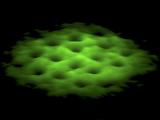
We study these gases either in large traps to enable studies of quantum fluid dynamics and turbulence [Wilson], as well as optical lattices. These lattices, formed from the standing wave interference between laser beams, can be used to create coherent atomic wavepackets for precision measurements [see related work on Quantum Sensing] as well as to enable studies of how these can be stabilised by atomic interactions to create solitons [Haller]. We are also studying spontaneous magnetic ordering [Ackemann] and the formation of supersolid states and droplets/solitons via light-mediated interactions. [Ackemann, Haller].
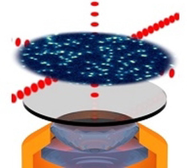
By using overlapping lattices, combined with high-numerical aperture microscope objectives, we can build quantum gas microscopes [Kuhr]. In these systems atoms are trapped in periodic potentials analogous to the confinement of electrons in a material, and by varying the trap depth and interactions we can control their evolution to prepare and study novel quantum phases such as a superfluid or Mott Insulator phase, or even introduce disorder to realise a Bose glass.
At Strathclyde we have built the first Fermionic quantum gas microscope, which offers the potential to explore and understand the properties of high-temperature superconductors.
Quantum Simulation Theory
Theoretical quantum simulation is essential for enabling exploration and understanding of complex quantum systems, driving the design and development of new hardware approaches and enabling us to understand experimental observations in the presence of limitations such as finite temperature or environmental noise.
At Strathclyde this work includes developing new software tools for modelling complex open quantum systems, including OQuPy, an open-source software platform for simulating open quantum systems based on tensor-network approaches such as the Time Evolving Matrix Product Operator (TEMPO) method. These techniques enable efficient simulations of quantum systems coupled to complex environments and provide powerful tools for understanding decoherence, noise processes, and experimental observations under realistic conditions [Kirton].
In addition, we study the dynamics of strongly interacting quantum systems, with particular emphasis on long-range interactions, collective phenomena, and the emergence of complex many-body behaviour. We develop theoretical and computational approaches to understand information scrambling and quantum chaos, exploring how quantum information propagates through interacting matter and how coherence is lost or preserved under realistic conditions. This work provides fundamental insights into the limits of quantum simulation and computation, while informing the design and interpretation of experiments on a range of quantum simulation platforms, including neutral-atom arrays and other programmable quantum devices [Poggi].
A further direction is using tools from theoretical quantum simulation, such as tensor networks, to facilitate efficient classical simulation of complex problems like interacting plasmas or molecular vibrations [Poggi]
Complementing these simulation efforts is research into the fundamental physics of many-body open quantum systems. This includes studies of light-matter interactions, dissipative phase transitions, non-equilibrium dynamics, and the role of environmental coupling in many-body quantum systems. Through the development and application of advanced theoretical and computational methods, we seek to understand emergent quantum phenomena and provide predictive models that inform and guide experiments.
Fermionic Quantum Computing
At the intersection of quantum simulation and quantum computing is the emerging field of fermionic quantum computing, in which a programmable qubit architecture is realised with native encodings of fermionic properties naturally found in materials and chemistry, providing efficient routes to simulation of battery cathodes or exotic lattice gauge theories relevant for high energy physics. At Strathclyde a new platform combining lattices and tweezers using fermionic Lithium is in development to explore this new approach [Hilker].