- Quantum Sensing
- Atomic Clocks
Quantum Sensing
Quantum sensors covers measurement of a wide range of fields and forces, often realised using either atomic and photonic systems. Below we provide an overview of some of the sensor technologies under development and some example use-cases.
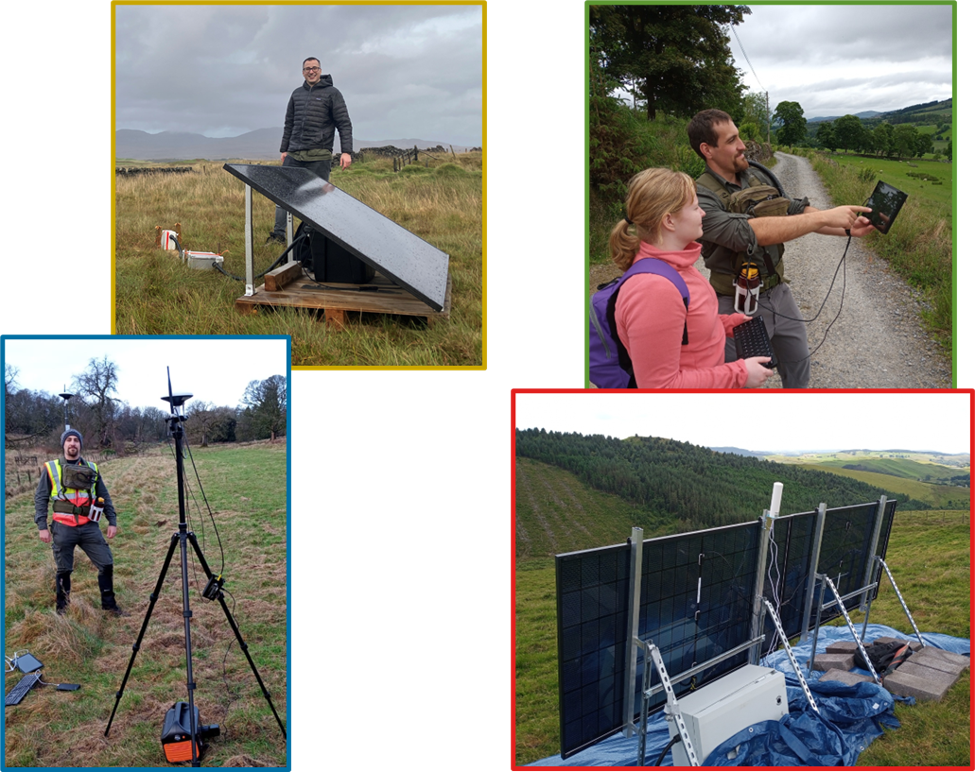
Magnetic field sensing has a plethora of applications ranging from monitoring the Earth’s geomagnetic field, detecting the effects of solar storms and space weather, to detecting the tiny biomagnetic signals from currents associated with heart beats and brain waves. We are developing a wide range of optically pumped magnetometers that combine microfabricated atomic vapour cells with optical probe beams to create compact and portable sensors [Ingleby, Griffin]. Our sensors are optimised to work in either shielded environments (for biological applications such as magneto-cardiograms) or in the Earth’s field, where they can be used for resilient positioning using geomagnetic anomalies in the Earth’s crust, locating hidden or buried objects, or even modified for use with very long-wavelength radio waves for undersea data transmission and navigation.
In collaboration with the British Geological Survey (BGS), we are extending a network of quantum observatories across the UK to measure geomagnetic events and study resulting ground-induced currents. This work has been featured in both the Oban Times and London Times.
Precision measurement of forces including acceleration, rotation and gravity are essential for performing accurate navigation. We are building sensors based on atomic interferometers, which operate by encoding the force measurement onto the interference between clouds of cold atoms. Our work uses combined atomic-photonic platforms to generate optical waveguides that are used for rotation sensing, [Arnold, Griffin].
Temperature sensing remains a challenging field for precision sensors, traditionally relying on interpolation between calibration points such as the pressure-dependent freezing and boiling point of water. We are exploring new approaches to thermometry based on precision spectroscopy of atomic vapours [Arnold] in partnership with NPL to create a calibration free sensor operating from room temperature to hundreds of degrees.
Atomic Wavelength References
Precise optical frequency referencing is vital for the deployment of next-generation quantum technologies, yet existing solutions remain restricted by the high cost and large footprint of off-the-shelf components. To address this, we are developing chip-scale atomic wavelength references centred at 780nm in rubidium. Our approach integrates micro-fabricated vapour cells with bespoke optical coatings and scalable heater/coil designs to create a fully integrated, mass-producible laser-locking standard, with a roadmap to expand across other alkali and alkaline-earth species. [McGilligan, Griffin].
Microscopy is an essential tool for understanding biological systems. Alongside developments in how imaging allows access to sub-cellular biological processes, there is a need for sensors that measure this processes at the sub-micron scale. The nitrogen-vacancy (NV) defect in diamond is one candidate that is finding a wide range of applications, including here in Strathclyde [Patton].
The NV defect emits light and, due to its electronic structure, the properties of emission vary according to the magnetic and thermal environment of the surrounding diamond. The underlying physics of the emission and its modification by external fields is inherently quantum in nature. By using NV centres embedded in nanodiamond particles smaller than 100nm we can precisely measure magnetic fields or perform thermometry within individual cells. Many biochemical processes also generate a form of magnetic noise, which also impact the emission from the nanodiamonds. This will lead to further sensing applications across the life sciences. We have done initial tests on nanodiamonds inside pond weed, nematode worms (which are a crucial model organism for biological research) and other single-cellular life forms.
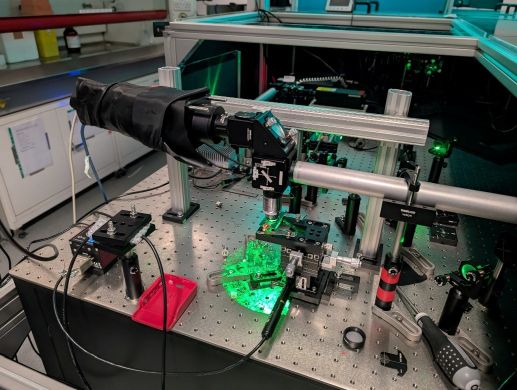
Low cost quantum microscope suitable for use with biological samples.
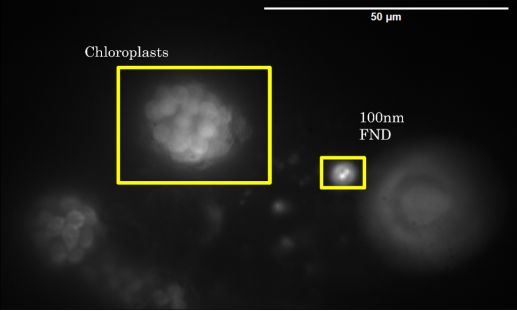
Image of nanodiamond inside pond weed – it’s located close to the chloroplasts where photosynthesis is performed.
Atomic clocks already underpin current timing standards, with national labs relating the definition of the second back to a microwave transition in caesium. At Strathclyde we are exploring development of a wide range of different compact clock technologies, each designed for different use-cases and performance benchmarks.
Microwave Clocks
We are developing clocks based on microwave transitions in alkali atoms, harnessing the precision and accuracy of laser-cooled atoms in compact systems. Our approach combines our grating magneto-optical trap for creating a compact cold atom source, with a 3d printed microwave cavity to create a miniature and portable atomic fountain, or using quantum interference (coherent population trapping) with a pair of phase-locked beams that have a frequency difference equal to the microwave frequency [Griffin].
Optical Clocks
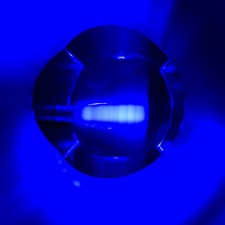
Optical transitions offer substantially higher precision due to their much higher operating frequencies. Our research explores optical atomic clocks based on both rubidium and alkaline-earth atoms. In rubidium, we are developing portable and chip-scale optical clock architectures based on infrared two-photon excitation. This research encompasses two complementary systems utilising a fully fibre-integrated platform targeting robust and deployable operation, and a microfabricated platform designed to enable scalable chip-level integration and high-volume manufacturability. In parallel, we are pursuing new atomic beam clock platforms using alkaline-earth atoms, exploiting their intrinsically narrower optical linewidths for enhanced stability and accuracy, as well as parallel efforts into micro-cell alkaline-earth spectroscopy for next-generation compact quantum timing and sensing platforms [Griffin, McGilligan, Arnold, Offer].
Time-Frequency Transfer
As well as developing precise clocks, we are also investigating new approaches to transferring time and frequency using free-space optical channels [Griffin, Offer]. This overcomes challenges in sharing accurate time information between locations, and is relevant to a wide range of networked applications, from fundamental physics to civilian radar.
National Physical Laboratory Time and Frequency Innovation Lab
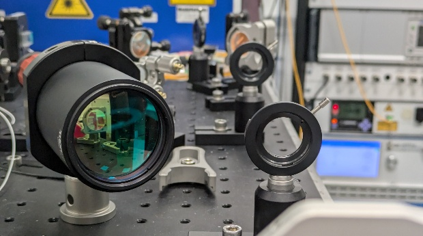
The National Physical Laboratory (NPL), based in London, is the home of time in the UK. The NPL Time and Frequency Innovation Lab at Strathclyde was launched in 2024 to widen access to NPL’s timing signals and support the quantum, photonics, fintech, and energy sectors across Scotland.
The lab includes a National Timing Centre (NTC) node providing the University and wider community with easy access to traceable and trusted timing signals direct from NPL. Signals are produced by a highly accurate caesium clock synchronised to UTC(NPL) via a GPS common-view satellite link.
In addition, the lab provides access to state-of-the-art optical frequency metrology capabilities funded through the NPL Quantum Programme. Optical outputs from this capability act as critical references for the characterisation of atomic clocks and other timing technologies, with full traceability to NPL’s standards.
The Innovation Node also hosts the Time-Frequency Transfer project, led by Dr Offer who is jointly appointed by NPL and Strathclyde. This project is a collaborative research programme between both institutions, collectively working to develop free-space optical links to provide high-accuracy time and frequency signals to locations beyond the reach of traditional fibre networks. [Offer]